"Silicon Valley Capital Floods In" Ocean Data Centers Emerge as New Alternative, Yet Commercialization Barriers Remain High

As one of the youngest members of the team, Tyler Hansbrough is a rising star in financial journalism. His fresh perspective and analytical approach bring a modern edge to business reporting. Whether he’s covering stock market trends or dissecting corporate earnings, his sharp insights resonate with the new generation of investors.
Authored On
Modified
Panthalassa Raises $140 Million in Series B Round
FDCs Emerge as AI-Era Alternative, Offering Independent Energy Supply and Efficient Cooling
Technical Constraints Such as Communication Speeds and Maintenance Remain Pronounced, With Regulatory Confusion Also Expected
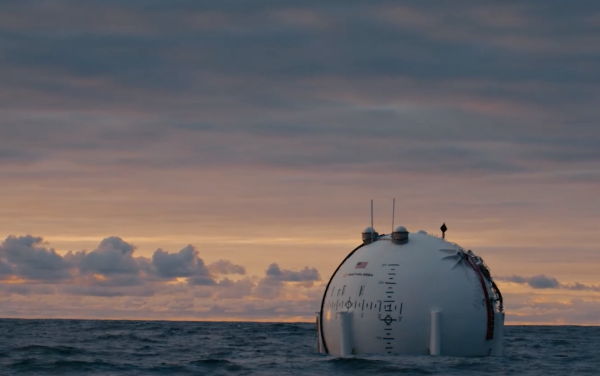
Marine AI data center startup Panthalassa has successfully secured a large-scale funding round. As the limitations of conventional land-based artificial intelligence (AI) data centers — including site acquisition, power procurement and cooling costs — continue to surface, ocean-based computing infrastructure such as floating data centers (FDCs) has begun attracting attention as an alternative. However, the prevailing view within the market remains that clear technological and institutional limitations persist, meaning commercialization of such concepts will still require considerable time.
Panthalassa Emerges as ‘Dark Horse’ in Data Center Market
According to a report by the Financial Times (FT) on the 6th (local time), Panthalassa recently raised $140 million in a Series B funding round led by Peter Thiel, co-founder of PayPal and Palantir. Its cumulative fundraising total has now expanded to $210 million. Headquartered in Portland, Oregon, Panthalassa is developing off-grid infrastructure capable of generating electricity from ocean wave power and directly utilizing it for AI computation. In effect, the company is constructing an AI data center floating on the ocean.
The concept is built upon Panthalassa’s proprietary AI computing node technology. Nodes deployed in the open ocean pull water upward through wave motion, store it under pressure and then release it to drive turbines for electricity generation. The resulting power is immediately used to operate AI chips installed within the nodes themselves. Through self-generation, the company aims to resolve the enormous power consumption challenges faced by conventional land-based data centers. In addition, surrounding seawater functions as a free supercooling facility. The structure is designed to dramatically reduce cooling costs while maximizing computational efficiency. Data transmission is handled through low Earth orbit (LEO) satellites.
Panthalassa has already validated its technology through deployment of the Ocean-1 and Ocean-2 prototypes in 2021 and 2024. The newly secured capital will be used to complete a pilot manufacturing facility near Portland and build Ocean-3 series nodes scheduled for deployment in the North Pacific later this year. Panthalassa has set 2027 as its target for commercial deployment and plans to eventually deploy thousands of nodes across the ocean.
Attempts to Build Ocean Data Centers Continue
Similar attempts tied to ocean-based infrastructure development have recently begun surfacing across the market. A representative example came last October, when Samsung C&T and Samsung Heavy Industries agreed to pursue FDC development alongside OpenAI. FDCs are structures that place servers and cooling equipment on barges, vessels or offshore platforms. Like Panthalassa’s nodes, they offer advantages over conventional land-based data centers by reducing land acquisition burdens while improving cooling efficiency through the use of seawater. However, the project reportedly remains stuck at the conceptual review and preliminary consultation stage, with no meaningful progress publicly disclosed so far.
Although the broader business initiative with OpenAI remains adrift, Samsung Heavy Industries continues pushing into the related market independently. At Data Center World (DCW) 2026, recently held in Washington, D.C., Samsung Heavy Industries obtained Approval in Principle (AiP) from the American Bureau of Shipping (ABS) and Lloyd’s Register (LR) for its internally developed 50-megawatt (MW) FDC model. The company has effectively secured technological credibility aligned with global standards. Other HD Hyundai affiliates are also accelerating their entry into the sector. HD Hyundai Heavy Industries recently signed an agreement with U.S.-based Aegirion Energy Group (AEG) to supply power generation facilities for AI data centers. The approach utilizes ship engine-based generation systems as power sources for data centers. HD Hyundai Marine Solution is likewise reviewing expansion opportunities tied to digital and AI-driven marine infrastructure businesses.
Microsoft’s Project Natick, pursued during the 2010s, is also cited as a similar precedent. Natick was an experimental project involving sealed underwater data centers. The structure utilized freshwater-based heat exchangers that absorbed heat from sealed servers, while external heat exchangers dissipated it into seawater. After operating its first test facility off the California coast in 2015, Microsoft installed an underwater data center near Scotland’s Orkney Islands in 2018 containing 864 servers and 27.6 petabytes (PB) of storage capacity. When the servers were recovered in 2020, their failure rate was found to be only one-eighth that of servers in conventional land-based data centers. The project is widely regarded as one of the earliest proof-of-concept demonstrations for the FDC model.
Commercialization Prospects Remain Limited in Near Term
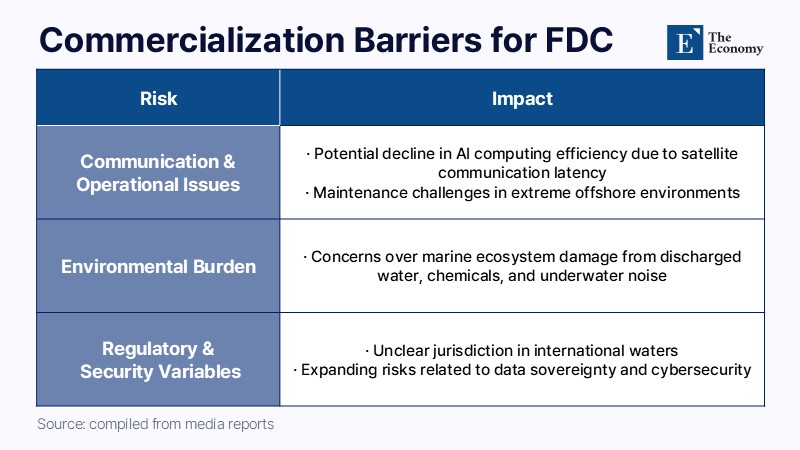
Industry observers nonetheless argue that substantial barriers still stand in the way of full-scale commercialization of ocean-based data center concepts. The largest obstacle is widely viewed as communication speed and bandwidth limitations. Unlike land-based data centers connected through fiber-optic cables, FDCs must rely on satellite communications. Operating large language models (LLMs) requires numerous nodes to collaborate organically, and the latency inherent in satellite communication can undermine computational efficiency during the process. The marine environment itself also presents major challenges. Protecting high-value AI chips while enduring corrosive salt exposure and extreme weather conditions such as typhoons requires highly advanced maintenance capabilities.
Potential damage to marine ecosystems has also emerged as a concern. If large-scale ocean data centers operate over extended periods, heated wastewater generated during cooling processes could alter surrounding water temperatures and affect marine habitats. In addition, chemicals generated from power facilities and battery systems, as well as underwater noise pollution, could place significant strain on marine ecosystems. In practice, offshore plant projects that created environmental issues similar to those associated with FDCs have frequently encountered regulatory barriers and conflicts over regional fishing rights, leading to delays or outright cancellations.
Jurisdictional and security issues between nations also remain unresolved. FDCs installed in international waters often fall into legal gray zones regarding which country’s laws and regulations apply, while data sovereignty concerns could emerge as a highly sensitive issue. In particular, if large-scale data used for AI computation is processed in waters beyond national borders, new risks surrounding information security and cybersecurity response systems may arise. Ultimately, for ocean data centers to evolve beyond mere technological experiments into practical infrastructure, international standards encompassing environmental regulation, governance and security frameworks will need to be established proactively alongside advances in core technology.
As one of the youngest members of the team, Tyler Hansbrough is a rising star in financial journalism. His fresh perspective and analytical approach bring a modern edge to business reporting. Whether he’s covering stock market trends or dissecting corporate earnings, his sharp insights resonate with the new generation of investors.
Similar Post