German Auto Industry Enters Downturn as Chinese Demand Evaporates, EV Weakness Deepens; Berlin Redirects Industrial Strategy Toward Defense Sector

As one of the youngest members of the team, Tyler Hansbrough is a rising star in financial journalism. His fresh perspective and analytical approach bring a modern edge to business reporting. Whether he’s covering stock market trends or dissecting corporate earnings, his sharp insights resonate with the new generation of investors.
Authored On
Modified
German Auto Sector Reels From Collapse in Chinese Demand, Supply Chains Simultaneously Destabilized
China Surges Ahead in EV Race as EU Electrification Mandates and High-Cost Structure Tighten Pressure
Berlin Launches Full-Scale Countermeasures, Redirecting Manufacturing Base Toward Defense Production
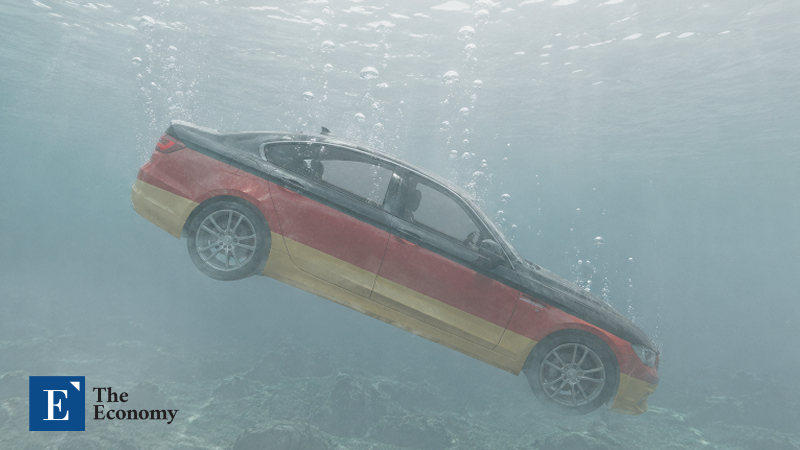
Germany’s automotive industry, long regarded as the backbone of the country’s economy, is entering a period of acute instability. German premium automakers have rapidly lost ground in what was once their largest market, China, while simultaneously failing to establish meaningful competitiveness in the global electric vehicle sector amid intensifying pressure from Chinese rivals. In response, the German government has begun actively resisting the European Union’s forced EV transition agenda while moving to repurpose idle automotive plants into defense manufacturing hubs in an effort to preserve the country’s industrial base.
Crisis Across Germany’s Automotive Industry
On the 28th (local time), Polish financial outlet Bankier.pl reported that German auto-parts manufacturers are increasingly being pushed into plant closures and insolvency proceedings as financial conditions deteriorate. Global filtration systems company Mann+Hummel announced plans to gradually shut down its production facility in Speyer, Germany, by 2028, citing soaring energy costs, elevated wage levels, and weak growth as key obstacles to maintaining domestic manufacturing operations. Erich Jaeger, a 90-year-old specialist in automotive electrical wiring systems, recently filed for bankruptcy at the Friedberg District Court.
Germany’s automakers themselves are also facing mounting pressure. Volkswagen’s net profit plunged 44% year-on-year last year, while Mercedes-Benz reported a 49% decline. Porsche and BMW posted collapses in operating profit of 98% and 55.4%, respectively, during the same period. Industry observers have begun warning that German automakers are effectively facing the longest downturn since the end of World War II. Against this backdrop, companies are accelerating restructuring efforts to secure survival. Volkswagen Chief Executive Officer Oliver Blume recently told business outlet Manager Magazin that the company plans to cut an additional 1 million units of production capacity. The broader objective is to reduce global annual vehicle production from an originally planned 12 million units to 9 million units.
The crisis engulfing Germany’s auto industry stems from multiple converging factors. The most immediate blow has come from collapsing demand in China. China was once the single largest market for German automakers, with Volkswagen, BMW, and Mercedes-Benz at one point generating more than 30% to 40% of global sales from the Chinese market alone. However, the situation has reversed sharply over recent years as China’s economy slowed. With Chinese consumers tightening spending, sales in the luxury segment — a category dominated by German brands — contracted significantly. According to global mobility data from U.S. ratings agency Standard & Poor’s (S&P), total sales of German automotive brands in China plunged roughly 25% between 2021 and last year. Volkswagen, which once held the No. 1 position in China, lost leadership to Chinese EV giant BYD in 2024 and subsequently fell another rank behind Geely Automobile last year.
Mounting Structural Headwinds Across the Industry
Chinese automakers that displaced German brands in the domestic market are now rapidly expanding their influence globally. Their dominance is especially pronounced in the EV sector. According to the International Energy Agency (IEA), Chinese brands accounted for approximately 55% of global EV sales last year, driven by surging exports to Europe, Southeast Asia, and Latin America. By comparison, Europe — including Germany — held only the mid-20% range of global market share during the same period. Despite German premium brands aggressively launching new EV models, competitive dynamics have shown little sign of shifting.
German EVs are widely viewed as suffering from weak price competitiveness and underdeveloped software capabilities. Volkswagen in particular shifted strategy toward partnering with Chinese firms after its in-house software subsidiary CARIAD failed to deliver meaningful results. The company invested $700 million to acquire a 4.99% stake in Chinese EV startup Xpeng. The first jointly developed vehicle unveiled last month, the ID. UNYX 08, featured Xpeng’s “Turing” artificial intelligence chip and XNGP autonomous driving architecture. Volkswagen has also invested $5 billion in U.S. EV startup Rivian to jointly develop software and EV platforms through a new joint venture. Such developments have fueled growing criticism that Volkswagen is effectively being reduced to a hardware subcontractor.
These developments have been compounded by the EU’s aggressive electrification agenda, inflicting severe strain across the industry. Automakers are being forced to mass-produce EVs under policy pressure despite insufficient competitiveness, resulting in mounting cost burdens and deteriorating profitability. In 2023, the EU mandated a 100% reduction in carbon dioxide (CO₂) emissions from new passenger cars and vans sold within the bloc by 2035 compared with 2021 levels — effectively banning new internal combustion engine vehicle sales. While the target has since been lowered to 90% following backlash from European industry players, markets continue to view the policy framework as fundamentally aimed at enforcing a full-scale transition.
Germany’s structurally high manufacturing costs have further intensified the crisis. Automotive production costs in Germany are estimated to be roughly 30% to 40% higher than those in Eastern Europe. Elevated labor expenses, powerful unions, rigid labor regulations, and stringent environmental and quality standards have all driven up overall input costs. At the same time, the prolonged strength of the U.S. dollar against the euro has sharply increased the burden of importing dollar-denominated raw materials, while persistently elevated energy prices following the Russia-Ukraine war have delivered a severe blow to energy-intensive manufacturing industries.
Berlin Mobilizes to Minimize Economic Fallout
The German government has begun deploying extensive measures to stabilize its domestic automotive sector. One of the clearest examples is Berlin’s direct pushback against the EU’s campaign to phase out internal combustion engine vehicles. Germany’s recently announced economic package explicitly incorporated the principle of technological neutrality, stating that new internal combustion engine vehicle registrations should continue to be permitted even after 2035. The move signals that Berlin is unwilling to sacrifice its domestic automotive ecosystem in pursuit of an unconditional EV transition. Markets interpret the policy as a demand for vehicles powered by carbon-neutral synthetic fuels or advanced biofuels to be classified as “zero-emission” vehicles.
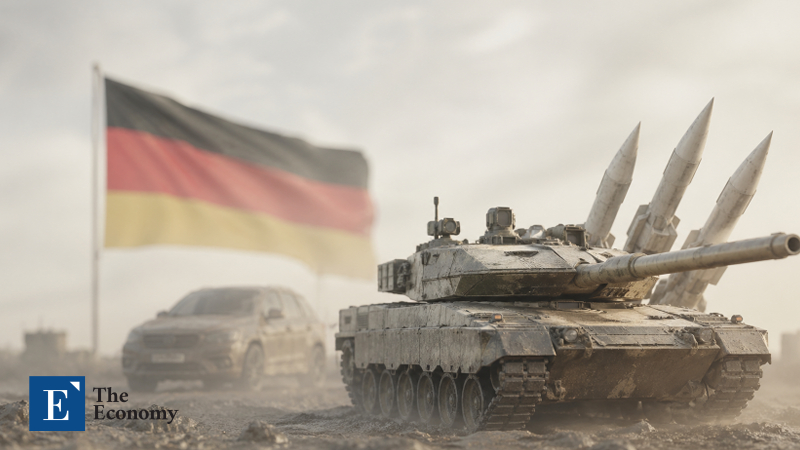
Berlin is also pursuing a broader strategy of transforming Germany’s manufacturing base from automotive-centered production toward defense manufacturing hubs. The objective is to sustain the economy by reallocating idle factories and highly skilled industrial labor into military production. Last March, Germany relaxed its constitutional debt brake mechanism to allow defense spending exceeding 1% of gross domestic product (GDP) on an exceptional basis, while separately establishing a $580 billion infrastructure special fund. Fiscal resources for defense-sector expansion are therefore already secured. Expectations surrounding industrial restructuring have also strengthened as roughly 90% of European defense technology venture investment is currently concentrated in German companies.
The private sector is increasingly aligning with this shift. Volkswagen is reportedly reviewing plans with Israeli defense contractor Rafael to manufacture Iron Dome missile components at its Osnabrück plant beginning in 2027. Deutz, the 162-year-old engine manufacturer, supplied power-generation engines for Saudi Arabia’s Patriot missile systems and recorded 15% revenue growth last year without undergoing large-scale restructuring. Automotive parts giant Schaeffler has also established a dedicated defense division and is expanding into drone engines, armored vehicle systems, and military aerospace components. In December last year, the company signed a memorandum of understanding (MOU) with German defense technology firm Helsing to cooperate on drone development, setting a production target of 10,000 to 20,000 drones annually, with emergency surge capacity reaching as high as 100,000 units.
As one of the youngest members of the team, Tyler Hansbrough is a rising star in financial journalism. His fresh perspective and analytical approach bring a modern edge to business reporting. Whether he’s covering stock market trends or dissecting corporate earnings, his sharp insights resonate with the new generation of investors.
- Previous “Violation of Donor Intent” vs. “Harassment of a Competitor” Musk-Altman Legal Battle Intensifies, With OpenAI’s For-Profit Transition at the Core
- Next “Safety Voids Exposed by the Race for Speed” — China Halts Autonomous Driving Licenses After Robotaxi Failures, Putting AI Credibility on Trial
Similar Post