[U.S.-China Summit] “Pressure Cloaked as Cooperation”: U.S.-China Summit Marked by Tacit Checks as Both Sides Target Weaknesses Through Technology Diplomacy

Aoife Brennan is a contributing writer for The Economy, with a focus on education, youth, and societal change. Based in Limerick, she holds a degree in political communication from Queen’s University Belfast. Aoife’s work draws connections between cultural narratives and public discourse in Europe and Asia.
Authored On
Modified
“Overcoming the Thucydides Trap”: Xi Issues Indirect Warning to U.S.
Trump Brings U.S. CEOs, Presses Market Opening While Underscoring Technological Supremacy
Intense Technology Diplomacy Yields Limited Substantive Cooperation
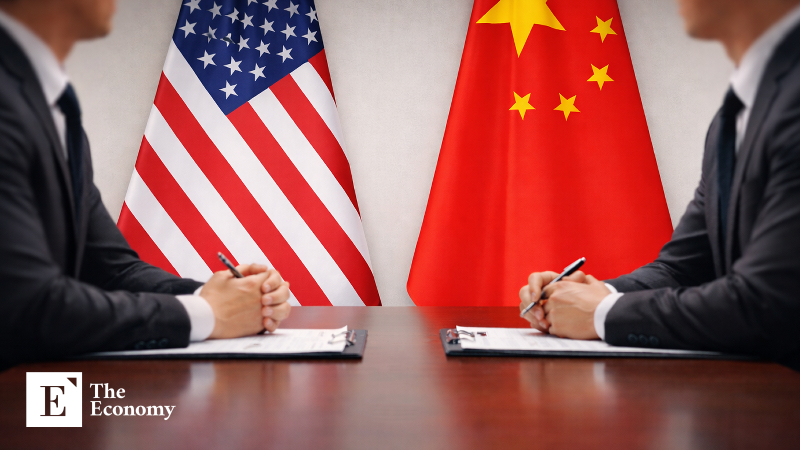
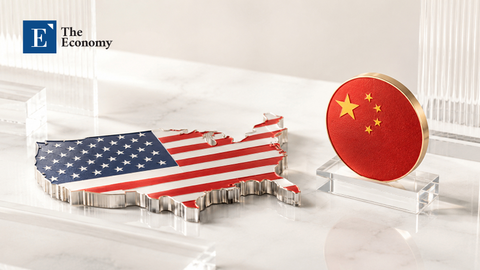
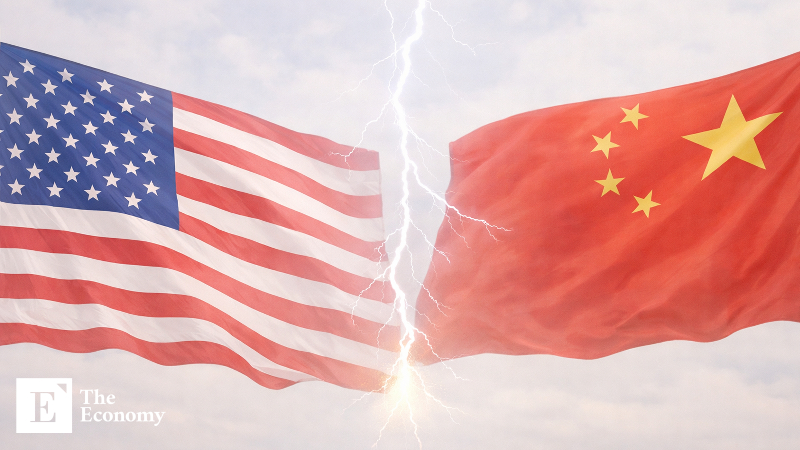
Chinese President Xi Jinping invoked the concept of the “Thucydides Trap” during his meeting with U.S. President Donald Trump, who was on a state visit to China. The remark amounted to an indirect critique of Washington’s economic pressure campaign against China, which has continued since Trump’s first administration. The United States, for its part, countered by bringing along CEOs from companies representing its core industries, using them to showcase its technological and financial dominance. Tacit pressure, rather than bilateral cooperation, became the central axis of the summit. Experts say the meeting is therefore unlikely to lead to any meaningful improvement in bilateral relations.
Xi Takes Aim at U.S. Regulatory Pressure
According to Chinese state broadcaster CCTV on the 14th, Xi said in his opening remarks at the summit held that morning at the Great Hall of the People in Beijing, “The world once again stands at a new crossroads,” adding, “What matters is whether China and the United States can overcome the Thucydides Trap and open a new paradigm in major-power relations, whether they can jointly respond to global challenges and inject greater stability into the world, and whether they can together create a brighter future for bilateral relations for the welfare of the two peoples and the destiny of humanity.” He continued, “These can be called questions of history, questions of the world, and questions of the people, and you and I, as leaders of major powers, must together write the answer for our times.”
The international community is focusing on the fact that Xi directly mentioned the Thucydides Trap in a meeting with the United States. The Thucydides Trap is a concept in international politics that describes the tendency for war to break out when a rising power threatens an established hegemon and the incumbent power responds with fear and containment. It was popularized by U.S. political scientist Graham Allison in describing U.S.-China relations. In practice, relations between the two countries have deteriorated rapidly since the Trump administration first launched full-scale pressure against China. In 2019, Trump’s first administration directly sanctioned Chinese telecommunications giant Huawei and imposed 25% tariffs on $200 billion worth of Chinese imports, triggering what became known as a “trade war.” The Biden administration also sought to counter China, which had generated enormous gains through low-cost exports, through measures such as the Infrastructure Investment and Jobs Act. After Trump’s second administration took office last year, tariff tensions originating in the United States flared again, reigniting a trade war between the two countries.
Experts interpret Xi’s call to overcome the Thucydides Trap as a message aimed at Washington’s pressure strategy against China. On the surface, it reads as diplomatic rhetoric urging the two countries to avoid conflict. In substance, however, it may carry a strategic message that China should not be fixed as a “permanent second-tier power” within a U.S.-led international order. The Trump camp is also likely to have viewed the remark less as a simple proposal for cooperation and more as a demand that Washington stop containing China’s growth and expanding influence.
Trump Uses U.S. Business Leaders as Instruments of Power Projection
The United States also maintained a conciliatory posture on the surface. A representative example was Trump’s decision to bring a large group of major U.S. business leaders on the China visit. The U.S. delegation included senior administration officials such as Secretary of State Marco Rubio, Defense Secretary Pete Hegseth, and U.S. Trade Representative Jamieson Greer, as well as executives representing the American business community. The 16 CEOs included Jensen Huang of Nvidia, Elon Musk of Tesla, Tim Cook of Apple, Stephen Schwarzman of Blackstone, Larry Fink of BlackRock, Kelly Ortberg of Boeing, Brian Sikes of Cargill, Jane Fraser of Citigroup, Larry Culp of GE Aerospace, David Solomon of Goldman Sachs, Sanjay Mehrotra of Micron, and Cristiano Amon of Qualcomm. They accompanied Trump not merely as part of the delegation but also met directly with Xi at the Great Hall of the People.
The large-scale visit by leading U.S. executives appears to signal a possible easing of trade barriers between the two countries. A closer look, however, suggests that Washington’s move was likely shaped by carefully calibrated interests. Most of the CEOs included in the delegation wield influence in industries where the United States maintains global supremacy. AI chips represented by Nvidia, aircraft and engines represented by Boeing and GE, and global dollar finance represented by BlackRock, Goldman Sachs and Citigroup remain areas where China has yet to fully replace the United States. In effect, Trump used the corporate delegation to emphasize U.S. technological superiority to Beijing.
This move can also be read as a demand to regain access to the Chinese market. Since China still needs U.S. technology and capital, Washington is applying pressure for corresponding market-opening and regulatory-easing measures. China has been weaponizing resources such as rare earths in response to U.S. restrictions, using them as bargaining chips. Since U.S. semiconductor export controls intensified in 2022, Beijing has also steadily expanded sanctions on U.S. technology companies including Nvidia and Micron. As a result, U.S. companies’ access to the Chinese market has effectively been constrained, while raw-material procurement costs and supply-chain instability have sharply increased across advanced industries. From Washington’s perspective, this situation could become a strategic risk that threatens technological supremacy, extending well beyond a conventional trade dispute.
Outcomes Limited to Risk Management
Major research institutions also assess that the two countries have moved beyond the grammar of traditional diplomacy. Their view is that the summit took on the character of “technology diplomacy,” in which advanced science and technology are linked with diplomacy, security and trade strategy to secure national interests, as both Washington and Beijing placed core technological and industrial capabilities directly on the negotiating table. The German Marshall Fund, a U.S. think tank, said, “This summit was less an economic summit than an extension of technology geopolitics,” noting that while past U.S.-China negotiations focused on tariff reductions and adjustments to trade imbalances, the central agenda has now shifted to control over AI semiconductors, rare earths, battery supply chains and advanced manufacturing. The Center for Strategic and International Studies also assessed that the meeting showed how the center of U.S.-China competition has moved from tariffs and trade balances to strategic technology controls involving semiconductors, AI, batteries and critical minerals.
There is also a view that the summit is unlikely to lead to substantive economic cooperation. Although both sides publicly issued messages of cooperation and stability, major differences remain over core issues such as semiconductors, AI and supply chains. The Brookings Institution described the summit as characterized by “low expectations amid fears of escalation.” This means that while neither side wants the conflict to spiral out of control, neither is willing to halt the competition for core industries and technological supremacy.
Stanford University’s Freeman Spogli Institute for International Studies assessed that “both countries have no intention of stopping strategic competition itself, and U.S.-China relations are moving closer to a phase of managed competition rather than recovery.” It added, however, that “the United States cannot replace its dependence on Chinese manufacturing supply chains and markets in the short term, while China also remains dependent on the United States in areas such as advanced semiconductors, dollar finance and aviation technology.” With the realization of decoupling effectively difficult, both countries have shifted policy priorities toward de-risking centered on risk management.
Aoife Brennan is a contributing writer for The Economy, with a focus on education, youth, and societal change. Based in Limerick, she holds a degree in political communication from Queen’s University Belfast. Aoife’s work draws connections between cultural narratives and public discourse in Europe and Asia.
Similar Post