Australia’s Military Readiness Shaken as Aging Submarines Near Retirement While Nuclear Fleet Stalls Under Drifting AUKUS Framework

Matthew Reuter is a senior economic correspondent at The Economy, where he covers global financial markets, emerging technologies, and cross-border trade dynamics. With over a decade of experience reporting from major financial hubs—including London, New York, and Hong Kong—Matthew has developed a reputation for breaking complex economic stories into sharp, accessible narratives. Before joining The Economy, he worked at a leading European financial daily, where his investigative reporting on post-crisis banking reforms earned him recognition from the European Press Association. A graduate of the London School of Economics, Matthew holds dual degrees in economics and international relations. He is particularly interested in how data science and AI are reshaping market analysis and policymaking, often blending quantitative insights into his articles. Outside journalism, Matthew frequently moderates panels at global finance summits and guest lectures on financial journalism at top universities.
Authored On
Modified
Australian naval strategy pushed into a stopgap extension regime for aging submarines
AUKUS trapped by supply-chain bottlenecks and shortages of skilled labor
Western undersea capabilities pressured by China’s expanding blue-water navy
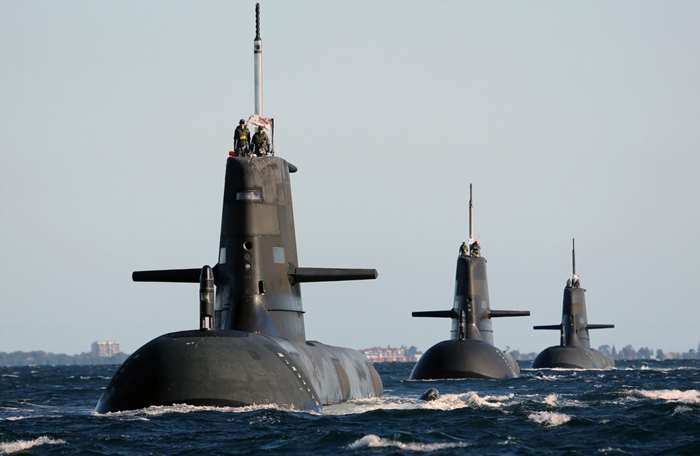
Australia’s submarine force has entered a critical stress test. AUKUS — the trilateral security partnership among the United States, the United Kingdom and Australia established to secure nuclear-powered submarines — had been regarded as a cornerstone strategic initiative aimed at counterbalancing the rapid expansion of China’s navy. Yet Australia has already exposed spiraling costs and severe technical disorder in the life-extension program for its existing Collins-class submarines. The United States and Britain are likewise confronting submarine production bottlenecks and the erosion of shipbuilding capacity, leaving the broader AUKUS framework increasingly defined by industrial limitations rather than strategic ambition.
Australia Scraps Core Collins-Class Retrofit
According to Australia’s public broadcaster ABC on May 21 local time, the Australian Department of Defence recently abandoned plans to replace the diesel engines and generators that had formed the centerpiece of the Collins-class submarine Life of Type Extension (LOTE) program. The government will instead shift toward a selective maintenance approach in which each submarine is assessed individually and only limited replacements are conducted when deemed necessary.
The Australian government had originally estimated the life-extension budget for its six Collins-class submarines at between $4 billion and $5 billion, but later sharply increased the figure to approximately $7 billion. Despite the enormous expenditure, Canberra has now effectively abandoned upgrades to the most critical propulsion systems. A review conducted by former U.S. Navy official Gloria Valdez concluded that the Collins-class fleet could remain operational for another decade without full engine replacement while potentially shortening maintenance timelines.
The latest decision reflects an emergency attempt to fill the capability gap created after Australia canceled its French submarine contract and opted into the AUKUS framework. Under the original plan, the Collins-class vessels were to receive new diesel engines based on French technology. However, the abrupt termination of the French program following the launch of AUKUS in 2021 destabilized the technological and supply-chain assumptions underpinning the entire LOTE project. Canberra has consequently retreated from a full replacement strategy toward a survival-oriented approach centered on maintaining and repairing failing systems for as long as possible.
Australian Defence Minister Richard Marles stated during a speech at Melbourne’s Lowy Institute that the decision represented a strategic choice aimed at minimizing technical risk and maximizing submarine availability. Military analysts inside Australia, however, have criticized the move as a de facto admission of schedule failure and loss of cost control. Australia’s National Audit Office (ANAO) also recently warned that the Defence Department had failed to establish an adequate management framework from the earliest stages of the project.
The Royal Australian Navy plans to begin phased overhauls starting with HMAS Farncomb, a vessel that has already reached the 25- to 30-year service threshold. While weapons systems and combat systems will receive modern upgrades, the navy is effectively attempting to keep aging submarines equipped with original propulsion systems operational through the 2040s. Whether stable force readiness can actually be maintained into the 2040s remains highly uncertain. Australia’s defense and security sector increasingly fears that prolonged delays in AUKUS nuclear submarine deliveries could leave the navy trapped between a widening submarine capability gap and long-term dependence on obsolete platforms.
Britain’s Shipbuilding Crisis Runs Deeper
The situation is increasingly viewed as exposing the structural weaknesses of Australia’s defense industry. Although Australia possesses submarines, it has never maintained an independent ecosystem capable of sustainably designing, constructing and servicing submarines over the long term. If even core upgrades to conventional diesel submarines are collapsing under management failures and soaring costs, transitioning toward nuclear-powered submarines would demand vastly more advanced institutional, technological and workforce foundations.
The absence of a domestic nuclear industry compounds the problem. Australia has no experience operating commercial nuclear power plants and maintains strict federal restrictions on the approval of nuclear fuel manufacturing facilities, nuclear reactors, enrichment facilities and reprocessing plants. Although nuclear-powered submarines are not equivalent to constructing civilian nuclear power stations, Australia still faces the burden of building an operational framework for nuclear submarines despite possessing virtually no established nuclear regulatory infrastructure, safety systems, workforce expertise or maintenance capability.
Britain itself is hardly a stable pillar within the AUKUS structure. Decades of underinvestment and neglect have severely weakened the country’s shipbuilding capacity. Although the British government has proposed constructing as many as 12 SSN-AUKUS submarines, the British Parliament has warned of flaws and bottleneck risks embedded in the AUKUS rollout process. Lawmakers specifically cautioned that delays in investment at the Barrow-in-Furness shipyard — Britain’s sole submarine construction facility — along with shortages of skilled labor and supply-chain integration failures could derail critical timelines.
Britain’s own naval force structure is also under mounting pressure. Construction of Astute-class submarines has repeatedly suffered schedule delays, while the Type 26 and Type 31 frigate programs are progressing more slowly than expected amid supply-chain disruptions and inflationary pressures. Through its recent Strategic Defence Review (SDR), the British government reaffirmed plans to expand submarine production. Yet it remains unclear whether actual industrial capacity can keep pace as defense budget pressures and labor shortages intensify simultaneously. Because SSN-AUKUS is a multinational program interconnected with both the United States and Australia, any disruption to the production schedule risks triggering cascading delays across the entire framework.
The Harsh Reality of the AUKUS Industrial Base
For Australia, this represents perhaps the most troubling aspect of the entire arrangement. Canberra effectively entered AUKUS on the assumption that Britain’s nuclear submarine design and production capabilities remained dependable. Yet Britain’s shipbuilding industry has contracted dramatically compared with the era of imperial naval dominance. While Britain still retains world-class submarine design expertise, it remains vulnerable to the same production bottlenecks and supply-chain instability now afflicting even the United States. Australia therefore finds itself waiting not only for the maturation of its own fragile industrial base, but also for the uncertain recovery of Britain’s diminished shipbuilding sector. This suggests that Australia’s need to sustain the Collins-class fleet into the 2040 timeframe may solidify from a temporary stopgap into a long-term structural burden.
The deeper issue lies in the widening gap between strategic necessity and industrial feasibility. Australia’s operational requirements for submarines far exceed those of conventional coastal navies. Unlike the confined operational environments of the Baltic Sea or the North Sea that shape European submarine doctrine, Australia’s primary theaters — the Pacific and Indian Oceans — require extreme endurance, long-range deployment capability and sustained operational persistence across vast maritime distances. The submarines Australia seeks to develop and procure therefore demand performance standards far beyond those of conventional submarine fleets.
The most immediate factor intensifying these requirements is the growing expansion of the Chinese navy into the Indian Ocean. China’s naval operations are rapidly extending beyond the South China Sea into broader Indian Ocean waters, while the frequency of blue-water deployments by Chinese nuclear submarines and surface strike groups continues to increase. The International Institute for Strategic Studies (IISS) has assessed that China began deploying submarines into the Indian Ocean as early as 2014 and steadily expanded diplomatic, economic and military influence throughout the region after establishing its first overseas military base in Djibouti in 2017. From Australia’s perspective, monitoring the South China Sea and the Taiwan Strait alone is no longer sufficient. Canberra increasingly requires a long-duration undersea surveillance network encompassing rear access routes throughout the Indian Ocean. Yet Australia currently faces only mounting uncertainty over whether such long-range undersea capabilities can realistically be established.
Some analysts have consequently begun questioning the fundamental viability of AUKUS itself. At launch, AUKUS was hailed as an Anglo-American maritime alliance reconstruction project designed to counterbalance China’s expanding naval power. Over time, however, the initiative has increasingly exposed industrial fragility rather than strategic cohesion. The United States remains trapped by production bottlenecks surrounding Virginia-class submarines, while Britain continues struggling to rebuild its submarine shipbuilding capacity. Australia, meanwhile, has failed to avoid exploding costs and schedule disruptions even within a conventional submarine life-extension project. All three countries continue advocating aggressive submarine expansion strategies, yet their actual industrial ecosystems remain constrained by shortages of skilled labor, supply-chain bottlenecks and limited production infrastructure.
Matthew Reuter is a senior economic correspondent at The Economy, where he covers global financial markets, emerging technologies, and cross-border trade dynamics. With over a decade of experience reporting from major financial hubs—including London, New York, and Hong Kong—Matthew has developed a reputation for breaking complex economic stories into sharp, accessible narratives. Before joining The Economy, he worked at a leading European financial daily, where his investigative reporting on post-crisis banking reforms earned him recognition from the European Press Association. A graduate of the London School of Economics, Matthew holds dual degrees in economics and international relations. He is particularly interested in how data science and AI are reshaping market analysis and policymaking, often blending quantitative insights into his articles. Outside journalism, Matthew frequently moderates panels at global finance summits and guest lectures on financial journalism at top universities.
Similar Post