[AI Labor vs. Human Labor] AI Labor Costs Are the New Test of the Automation Economy

Keith Lee is a Professor of AI/Finance at the Gordon School of Business, part of the Swiss Institute of Artificial Intelligence (SIAI). His work focuses on AI-driven finance, quantitative modeling, and data-centric approaches to economic and financial systems. He leads research and teaching initiatives that bridge machine learning, financial mathematics, and institutional decision-making.
He also serves as a Senior Research Fellow with the GIAI Council, advising on long-term research direction and global strategy, including SIAI’s academic and institutional initiatives across Europe, Asia, and the Middle East.
Authored On
Modified
AI labor is not yet a simple low-cost replacement for human labor.
The real cost lies in compute, infrastructure, energy, oversight and unreliable pricing
Firms should compare AI and human labor task by task before replacing workers

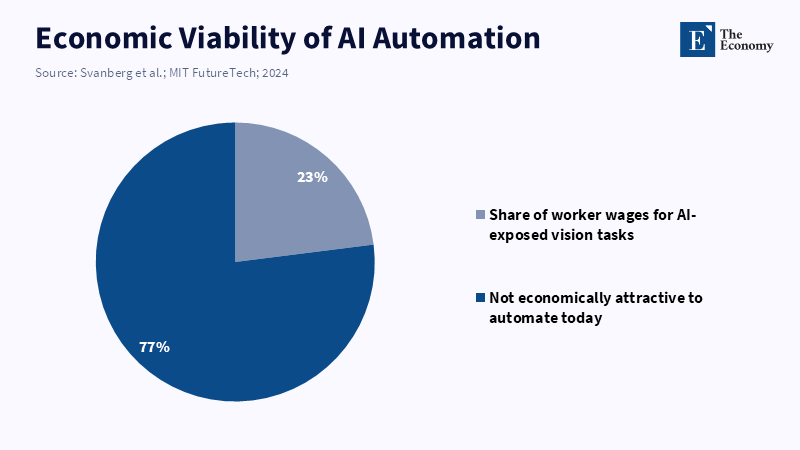
And the most critical number in the AI labor debate is not the price of a chatbot plan. It's 23 percent. In 2024, a study from MIT showed that for computer-vision tasks, only 23 percent of workers were cheaper to automate than to retain as labor. That number breaks through the convenient narrative that AI labor costs will go down fast enough to render human labor irrelevant. That data point accounts for why companies can be shedding jobs, purchasing AI tools and still not yet experience a clear cost advantage. The market simply is not monitoring a straightforward transfer of work from humans to machines. It's monitoring a costly transfer of work from low-cost trials to expensive production platforms. The specter is even clearer: AI labor was offered as a cheaper alternative to staffing, but during this era, where it is being deployed, it ranges instead as infrastructure, overhead and a fluctuating production cost.
AI labor costs are now a market problem, not a labor story
Reframe the argument. It isn't a question of whether AI is "doing more" today than three years ago. It can. The question is whether AI labor costs can get cheap, consistent and reliable enough to substitute for human labor in mainstream business practice. This distinction is important now because the AI market is transitioning from trial use to budget discipline. Firms that once viewed AI as a small line-item on a software bill of materials are increasingly finding that it's a production bill of materials. Tokens, cloud bills, data prep, integrations, security review, model errors—all of these layers sit between a demo and a bottom line. The result is a short-term mismatch: AI can seem cheap at the point of use, even while its whole infrastructure remains fairly capital and compute-intensive.
And that's why the Nvidia echo worked in the business press: Catanzaro, who mentioned his company's compute spend dwarfed labor costs, wasn't saying AI had no future, but instead pointing out the current market dynamics: AI labor is still constrained by the hardware that powers it, high energy demands, scaling data centers and pricing schemes that obfuscate underlying consumption costs. Flat subscriptions, for one, allow problems to go undetected: the light user overpays; the heavy user underpays; and the provider eats the difference until the limits change, the prices do, or users are nudged toward pay-as-you-go models. Companies face the flip side of this: automation increases their use of AI and pushes costs from fixed software charges to variable production costs.
And that’s why it's better to interpret this moment as a short-term anomaly. AI is still fundamentally capital-and compute-intensive, while many pricing models haven't been adjusted for high consumption levels. The low upfront cost of flat subscriptions obscures the fact that hardware, energy, cooling, data storage and maintenance all add up behind each individual query. Certain firms, then, are now treating AI not so much as a simple labor substitute but as a complementary tool whose price point still needs to be fully understood.
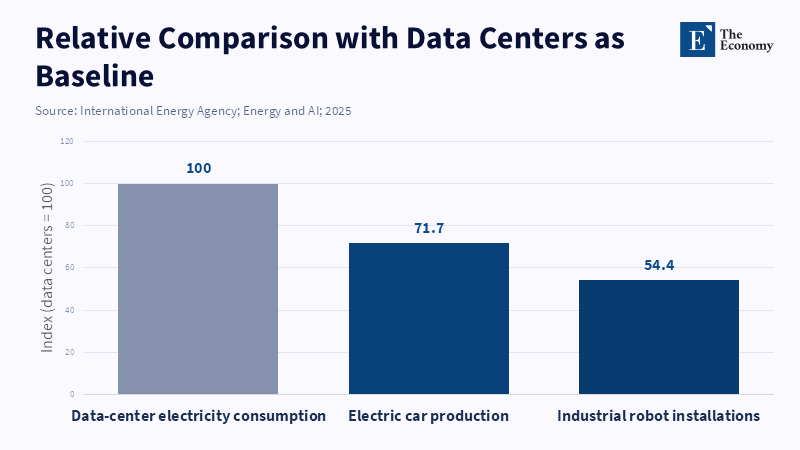
The scope of this build-out reinforces this: IT spending worldwide is projected to reach $6.31 trillion in 2026, with demand for AI hardware, software and cloud services leading this increase, according to Gartner. McKinsey predicts that by 2030, AI-related data centers alone will cost $5.2 trillion in capital investment, while the International Energy Agency anticipates a greater than doubling of data center electricity consumption, to approximately 945 terawatt hours in 2030. These figures don't demonstrate that AI won’t succeed; rather, they indicate that cheap AI labor is not an inherent principle of technology. Who actually pays the price for the hardware, power, cooling, data and monitoring necessary for each 'instantaneous' answer dictates the final price.
Reasons why AI labor costs will not decline as software costs
The mistake people make is treating A. I. as ordinary software. Unlike traditional software, which is an economies-of-scale proposition, fixed costs are high and marginal costs are low. Once it is built, another customer can be served at very little marginal cost. AI definitely looks like that in the interface, but very different back office: There is a prompt, a query, an agent action, a code run, an image, a tool call. The cost is tiny for you, maybe, but not zero. And when it is repeatedly repeated in support, coding, marketing, finance, compliance, legal, internal search, tiny costs become a line item and if it rises to the dozens or hundreds, it is an operating expense. AI labor costs definitely go up with usage and that accountability does not need to be headline by headline, but task by task.
MIT's computer-vision evidence is helpful since it sets the cost of automation against how much of the human labor it's replacing. An automated vision system capable of inspecting ingredients in a bakery may be cost-effective if the baker spends 2 hours per day on inspection—but not if it's only 10 minutes of a 10-hour baking day. Meaning, even simple knowledge work models can push costs up above what the firm would pay for a human. The bot might draft a dozen client emails, or classify a handful of memos, or produce a few minutes of a customer-service call—but the firm will be paying for setup, review, training, integration, security, exception handling and the upfront work it took to trust the new process.
This doesn't mean AI is weak. It means the unit of analysis is wrong. Jobs are bundles of tasks and only some tasks can be migrated to AI at an obvious gain. Stanford 2025 AI Index reports that adoption of AI is accelerating around the globe. In 2024, 78 percent of the organizations are using AI, far exceeding the 55 percent in 2023. However, adoption doesn't correlate to value. McKinsey global survey in 2025 indicated that 88 percent of respondents report regular use of AI in at least 1 function, while just about 1/3 report enterprises are currently beginning to scale AI and 39 percent report some enterprise-level EBIT impact and the majority of them under 5percent of EBIT. A lot of AI users, but a small number of AI operators in the market.
That gap is where human effort continues to be stubbornly worthwhile. Human labor isn't free, but it is adaptable. An experienced worker can change gears, catch a peculiar outlier, ring up a customer, fix a defective process and shoulder responsibility when the solution isn't obvious. AI doesn't eliminate those requirements; it can shift them around. Cheap model outputs might generate a review overhead. A quick agent may generate a compliance overhead. A coding assistant might generate a debugging overhead. The cost of AI labor, then, isn't just the bill. It is the bill plus the human stratum that enables the output to be safe, functional and accountable.
Why have markets been assigning tasks and not eliminating jobs
What will determine the next phase of the market is not whether AI is "less expensive than human" in a generic sense—that's too imprecise. It will come when labor costs for certain AI applications become more predictable and less expensive at scale. As it stands today, the market isn't determining whether AI is cheaper than humans in general. It's trying to figure out which jobs are cheap enough, repetitive enough and low-risk enough to automate. That's a more precise question, but the more valuable one. A customer-support transcript, a first draft and a document-classification job might pass muster. A risky decision-making workflow with legal, financial, or market-reputation hazards might not. Cost debate, then, must progress from vague assertions about employment to precise calculations about tasks.
We do have evidence of real productivity gains from bounded work. Among customer support reps, for instance, a well-designed AI assistance enabled them to address more cases per hour, especially among less experienced workers. However, the evidence seems to point toward augmentation rather than replacement. The tool simply increased human productivity; it did not demonstrate the human layer's obsolescence.
The value gap is starting to become clearer as well. Stanford's 2025 AI Index reports a sharp increase in business AI usage, with 78 percent of companies running AI projects in 2024, compared to 55 percent in 2023. McKinsey's 2025 survey confirms the same broad use but limited enterprise-wide financial impact, with a mere 39 percent reporting a measurable EBIT impact. The market is thus not lacking for AI adoption. It is lacking in proven AI economics.
This is also why certain companies may axe marginally helpful AI tools, eliminate agentic processes, or shift some work back onto human teams. This isn't a rejection of AI. This is standard cost control. If a company substitutes salaries for computer bills, integration work, review queues and correction of mistakes, then it hasn't historically reduced human labor costs, just shifted where they are recorded.
Policy must price AI-labor cost before displacing it
Policymakers should see AI labor costs as a market-transparency question, not solely as a question of employment. Public discourse often seeks to gauge how many jobs AI will displace; that question is important, but it comes too late. The more urgent question is how firms will gauge the true costs of AI work before any displacement begins. If boards, regulators and citizen agencies only observe the subscription price, they will undervalue the economic cost and exaggerate the rate of automation. A preferable disclosure standard would call for firms to reveal the total expense per easy-to-automate task, including compute, integration, human review, correction, data management and energy. This does not entail hamstringing AI. It entails an honest accounting.
Employers should maintain the same framework within the organization that they require from vendors. AI purchase decisions should never be based on the number of seats and the number of tools. They should be based on task economics. What task is automation doing? How many human hours is it actually saving? What is the cost of failure? How much review still remains? What happens when utilization doubles? What happens when the vendor shifts from flat pricing to usage pricing? Those are not technical details. They are the crux of the labor decision.
The inevitable criticism is that this analysis underestimates the rate at which AI costs will fall. It doesn't. Costs will. Hardware will become more capable. Smaller models will improve. Inference will become more efficient. But cost reduction alone doesn't resolve the issue, because we also experience increasing demand as tools become cheaper. More teams use AI, more agents operate in the background, more tasks are attempted and more outputs require review. Efficiency can reduce the unit cost without reducing aggregate expenditure. Which is why the next serious debate won't be about whether AI labor will displace human labor. It will be about what cost base, what scope and with what residual human oversight in the loop.
The opening number. If only 23 percent of exposed wages in one appropriately measured AI bucket are already economical to automate, then we are not facing a classic labor swap. We are facing a sorting problem. Some can be automated in short order. Some will remain human by economic necessity. Many, perhaps most, will be functions dehybridized, with AI taking over the reading and doing the number crunching, with humans remaining the judge, the trust factor and hopefully—the ultimate accountability. The response is easy: stop treating AI labor dollars as a given and treat them as a line item. The winners won't be the firms that automate the quickest: They will be the ones who know precisely when it will be cheaper to have a human, when it will be cheaper to use AI and when "cheapest" will turn out to be a better job design.
The views expressed in this article are those of the author(s) and do not necessarily reflect the official position of The Economy or its affiliates.
References
Apotheker, J., Beauchene, V., de Bellefonds, N., Forth, P., Franke, M.R., Grebe, M., Kataeva, N., Kirvelä, S., Kleine, D., de Laubier, R., Lukic, V., Luther, A., Martin, M., Walters, J. and Schweizer, C. (2025) The Widening AI Value Gap: Build for the Future 2025. Boston: Boston Consulting Group.
Brynjolfsson, E., Li, D. and Raymond, L.R. (2025) ‘Generative AI at Work’, The Quarterly Journal of Economics, 140(2), pp. 889–942.
Gallagher, B. (2025) ‘AI vs. Humans: The True Cost of Work — Energy, Water, and Dollars Compared’, Medium, 22 February.
Gartner (2026) ‘Gartner Forecasts Worldwide IT Spending to Grow 13.5% in 2026, Totaling $6.31 Trillion’, Gartner Newsroom, 22 April.
International Energy Agency (2025) Energy and AI. Paris: International Energy Agency.
Maslej, N., Fattorini, L., Perrault, R., Gil, Y., Parli, V., Kariuki, N., Capstick, E., Reuel, A., Brynjolfsson, E., Etchemendy, J., Ligett, K., Lyons, T., Manyika, J., Niebles, J.C., Shoham, Y., Wald, R., Walsh, T., Hamrah, A., Santarlasci, L., Betts Lotufo, J., Rome, A., Shi, A. and Oak, S. (2025) Artificial Intelligence Index Report 2025. Stanford, CA: Stanford Institute for Human-Centered Artificial Intelligence.
Mikic, U. (2026) ‘AI Costs: Virtual Employees or Human Workers?’, LinkedIn, April.
Mills, M. (2026) ‘AI Can Cost More Than Human Workers Now’, Axios, 26 April.
Monetizely (2025) ‘Human vs AI: How to Compare Pricing and Make Smart Workforce Decisions’, Monetizely, 21 July.
Narayan, N. (2026) ‘AI Is More Expensive Than Human Workers Due to Compute Costs, Says Nvidia Executive’, SME Futures, 28 April.
Noffsinger, J., Patel, M., Sachdeva, P., Bhan, A., Chang, H. and Goodpaster, M. (2025) ‘The Cost of Compute: A $7 Trillion Race to Scale Data Centers’, McKinsey Quarterly, 28 April.
Rogelberg, S. (2026) ‘“The Cost of Compute Is Far Beyond the Costs of the Employees”: Nvidia Executive Says Right Now AI Is More Expensive Than Paying Human Workers’, Fortune, 28 April.
Singla, A., Sukharevsky, A., Hall, B., Yee, L., Chui, M. and Balakrishnan, T. (2025) ‘The State of AI in 2025: Agents, Innovation, and Transformation’, McKinsey & Company, 5 November.
Svanberg, M.S., Li, W., Fleming, M., Goehring, B.C. and Thompson, N.C. (2024) ‘Beyond AI Exposure: Which Tasks Are Cost-Effective to Automate with Computer Vision?’, MIT FutureTech Working Paper, January.
Wullman, I. (2026) ‘The Revolution That Got Expensive: AI Isn’t Replacing Workers — It’s Draining Budgets’, Ynetnews, 27 April.
Keith Lee is a Professor of AI/Finance at the Gordon School of Business, part of the Swiss Institute of Artificial Intelligence (SIAI). His work focuses on AI-driven finance, quantitative modeling, and data-centric approaches to economic and financial systems. He leads research and teaching initiatives that bridge machine learning, financial mathematics, and institutional decision-making.
He also serves as a Senior Research Fellow with the GIAI Council, advising on long-term research direction and global strategy, including SIAI’s academic and institutional initiatives across Europe, Asia, and the Middle East.