[AI Labor vs. Human Labor] Why the AI Labor Transition Will Be Slower Than the Hype

His work examines the broader socioeconomic consequences of artificial intelligence, including labor markets, public finance, demographic change, and institutional adaptation.
He holds a PhD in Mathematical Finance from Boston University, and previously earned an MSc in Finance and Economics from the London School of Economics. He completed his undergraduate studies in Economics at Seoul National University under the Korea Foundation for Advanced Studies scholarship program.
Authored On
Modified
AI will reshape work before replacing it
Big transitions are always slow and uneven
Policy must manage partial automation early

Every major technology shift begins with a promise of replacement and, for many years, concludes in a messy coexistence. Cloud computing did not replace on-premise servers. Industrial robots did not replace human factory jobs. Renewable energy did not eliminate fossil fuels. Each innovation altered the economics of the legacy system long before it fully displaced it. It's the same story now playing out around AI labor. On some sophisticated AI teams, the cost of compute now exceeds employee costs and this explains why headcount is not enough. The winning formula will be hybrid workflows, fragmented automation and delays in fully replacing workers,as well as patchy adoption across industries. That is not a failure; that is the ordinary life cycle of a general-purpose tool as it moves from the World of Wonders to budgets, protocols, habits and risk management.
The transition of labor to AI will go through a lengthy intermediate stage
The public debate still presents AI as a direct race against a human worker. That's an oversimplification. In reality, firms face a selection of options—AI or workers? Or AI plus workers, or AI on top of existing software, or AI under scrutiny, or up to a more restricted range of tasks, or used by workers who still decide how—to name a few. Capability is important, but the total cost of ownership is more so. Consider the model bill, cloud bill, data bill, cyber risk, time lost checking outputs and correcting errors and the expense of retraining customers and staff. When added up, the labor transition to AI looks slower and more uneven. It's not enough to get AI to write, code, search, or classify—the technology must do it with low error, unambiguous ownership and at a price that is less than business as usual.
So, the strongest evidence points to adoption without full displacement. One U.S. survey found that 23% of employed Americans reported using generative AI at work at least once in the last week in late 2024, but only 9% use it every day at work. The same study estimated that AI helped with 1-5% of all work hours and saved 1.4% of all work hours. This is fast diffusion, but shallow depth. It reveals a tool spreading across desks before it can rebuild the firm. A later Federal Reserve analysis found that about 18% of U.S. firms had adopted AI by the end of 2025, whereas 41% of workers indicated using generative AI at work. The difference is the point. Workers can experiment faster than firms can reinvent.
The same pattern plays out in surveys of larger companies. McKinsey reported that 78 percent of the firms it polled were using AI in at least one business function in 2024, versus 55 percent in 2023. More than 80 percent said generative AI had not yet yielded a measurable effect on enterprise-level EBIT. This is not paradoxical. It is the reality of a newly available capability still seen as unproven to run the operating model. AI can assist a sales team by writing draft emails, it can assist a lawyer by reading documents and it can assist a programmer by testing code. Outright substitution, capable of replacing people in tasks, however, demands that process changes happen, data flows, auditors check and confidence is built. Therefore, the AI labor transition may well have a large "middle band", where roles evolve prior to their disappearance.
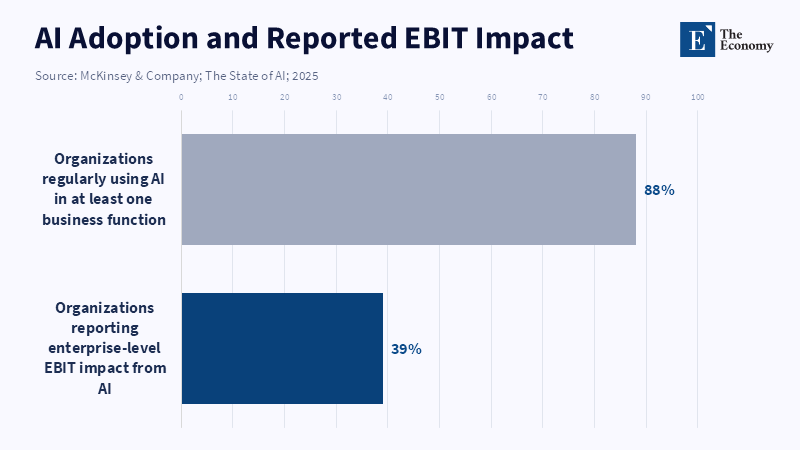
All of this illustrates why AI work will transition in and not out of the cloud
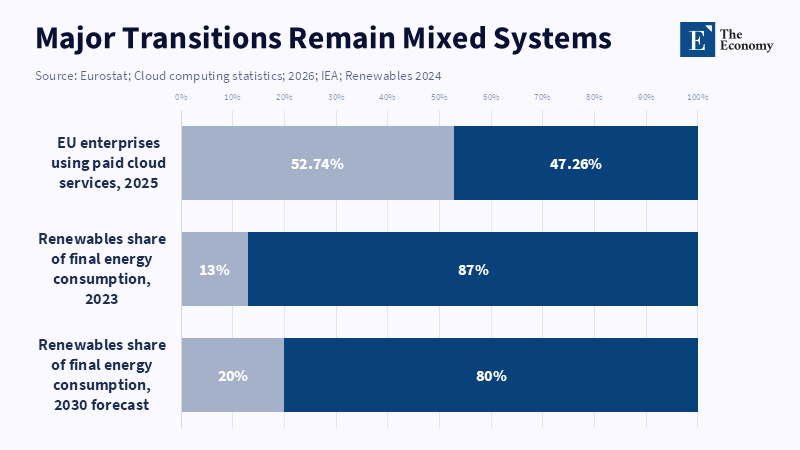
It can be seen that, above all, cloud computing still represented a stark warning. It had a convincing cost story. It lessened the number of firms that needed to possess a server room, the personalization and upkeep of computer equipment and the expansion of data storage. Not only that, but it made the implementation of programs more scalable and suitable for this wide range of technology. However, cloud computing did not render on-site server systems obsolete. According to Eurostat, 45.2 percent of enterprises in the EU purchased cloud services in 2023 and 52.74 percent in 2025. Although there was huge growth, it was not widespread adoption. Even then, in 2025, a huge fraction of the EU retailers still clung to their pre-cloud practices, with a proportion of 45.2 percent using paid cloud services in Greece, Romania and Bulgaria. Nothing was hindering cloud computing as such; it was economic growth, the way, the risk-averse nature of corporations, concrete legacy data storage solutions, skills in the local labor stock and a reluctance to change.
OECD's 2024 digital economy data make the same point. Across OECD firms with 10+ employees, 2023 cloud use was 49%. AI use was an average of just 8 percent, with big differences across sectors, size of firms and other variables. Cloud had been spreading for many years. It was also less difficult to purchase than AI, because often it would replace infrastructure without changing the judgment of the worker. Even then, the change was incremental. AI asks much more: it not only changes where computing takes place, but how it takes place, who edits, who checks, who signs, who is liable and who learns. If cloud, a long-established and useful system, still coexists with on-premise infrastructure, then the AI labor transition will almost certainly coexist with human labor for a long time. The same can be seen inside firms that want reach similar to a public cloud without entirely migrating to a public cloud: some firms have created hybrid systems built from existing servers, linking the local infrastructure throughout locations to replicate the reach of the global cloud platforms while keeping most of the services on-premise, for reasons not only of economics but of command, safety, data sensitivity, corporate culture and lack of motivation to rebuild a system already working. This, too, should be the lesson for AI labor: availability does not compel adoption. Often, firms will import the benefits of some new system and retain the old underneath.
This matters for policy because a slow pace is not the same as a safe pace. The use of models at one level of tasking does not preclude large-scale re-engineering of tasks at another. Partial use may paradoxically lead to increased inequality. Large firms can perhaps subsidize private models, build private tubes and keep teams to quantify output. Small firms must probably use free tools and scrape away human IT. Senior staff parlay resultant power; junior staff lose entry-level jobs. The policy error would be to wait for mass destruction before policy action. The better target is the middle layer, where tasks are already being rewired. Policymakers should measure AI task use, not simply job loss. Firms should record context when AI influences hiring, training, testing, appraisal and pay. Workers should be trained not simply to elicit a model, but to assess it. They should also be trained to judge when not to trust a model.
Robots and renewables; demonstrating that cheap is not enough
Industrial automation presents the same trend in physical labor. Robots have become smarter, cheaper and more ubiquitous. In 2024, China accounted for 54 percent of the world's industrial robot installations; the five largest robot markets represented 80 percent of installations. In manufacturing, the global average robot density was 177 robots per 10,000 employees. Asia had 204, Europe had 148 and the Americas had 131. This is a lot of robots. But factories continue to operate on a large scale. Robots flourish in high-volume, stable environments with capital. They are slower to spread in small plants, mixed production, in maintenance and in food-handling operations and where the wage is sufficiently low to extend the payback period.
This is the obvious point about the AI labor transition. Even where automation is effective, it does not filter through the labor market equally. It depends on the price of labor, the price of capital, the quality of management and whether there is a task-to-machine fit. In countries where human wages are low, like parts of India and China, many tasks are, however, performed by humans—even if there is a robot on the scene. Not because the managers are unaware of robots, but because a machine must pay for itself through local wages, downtime, maintenance, power and finance. AI's hurdle is the same in offices. A model might help draft a report or e-mail—but if a trained secretary has to check, write and present to the client and bear the liability, then the gains diminish.
You learn this again in another way with energy transitions. The cost of solar panels and wind turbines has fallen significantly. Investment in clean energy was on track to reach approximately USD 2 trillion in 2024, with spending on renewables, grids and storage larger than the money spent on oil, gas and coal. Despite this, fossil fuels still rule the world because our existing assets, grids, vehicles, contracts and politicians have been around for so long. Using its more traditional primary energy approach, the Energy Institute estimated that in 2023 fossil fuels held 81 percent of the market share, compared to IEA's forecast that the market share in renewables was expected to increase from 13 percent of final energy consumption in 2023 to almost 20 percent in 2030. As in the first phase of the industrial revolution, this is a case of quick growth and slow replacement. New production capacity is created first. Existing infrastructure is phased out later.
A policy agenda for a more gradual AI labor transition
The first policy change is to cease thinking of AI adoption as an on/off switch. On the labor side, the AI worker transition has four stages. The first is access (publicly available tools). The second is controlled use (cost boundaries for AI-supported work). The third is workflow redesign (moving tasks around multidisciplinary teams). The fourth is headcount change. Most firms are currently in the first two stages; some are entering the third; very few are at the fourth at scale. Public policy is likely to follow this sequence. Tax credits, grants and procurement should favor measurable workflow effects—not AI smoke and mirrors. Public agencies should monitor task shift, task gain and time-warp review overhead and the C-suite should require cost per project, errors and human oversight stats, in order to weigh in on the AI savings claims.
Second, you have to safeguard the entry gates of work. Delayed displacement does not mean no damage. Nonetheless, it can wear out the tasks at which fledgling workers garner experience. As AI writes the memo, tidies the data, develops the primary code and recapitulates the client file, young staff may cease to get the exercise that transforms them into seasoned staff. This is already a danger in law, consulting, marketing, software and finance. Agencies should be encouraged to construct apprenticeships around AI, not around the archaic task staircase. A Junior could achieve this by contrasting draft models, assessing arguments and refining products, but only if the agency regards inspection as cultivation, not cleaning. The AI labor transition will be more just if it forges new experience circuits before it does away with old ones.
But this view is bound to be challenged. Critics will note that the costs of models are plummeting, agent systems are rapidly advancing and firms will soon have no option but to adapt to automation. That might be only partly right: costs will certainly plummet. Some tasks will definitely be one-off. Customer support, code support, document review, language translation and routine content work are all already beholden. But history should temper firm thinking in a straight line: Cloud technology did not displace servers. Industrial robots did not displace factory workers. Renewable sources did not displace oil. Every transition changed the prices of existing systems prior to ending them. AI will do the same: the real question is not 'can AI displace some work?' It can. The real question is, 'Will displacing work be more cost-effective, risk-minimizing and productively directed toward a human-machine partnership?
The right call to action, therefore, is practical—not defensive. Policymakers should create an AI labor transition map reflecting uses by sector, task, firm size and wage level. Administrators should mandate transparent rules on whether AI is allowed to draft, decide, consult, or act. Employers should calculate the total cost and premium, not only the subscription cost. Workers should be re-educated to judge, review and design processes, because these skills will be worth more as machines generate additional first drafts. The initial cost gesture is significant because it punctures the myth of immediate replacement. AI is not free labor. It is a novel production system that has bills to pay, risks to absorb and bottlenecks to clear. The nations and companies that grasp it will resist it less. They will implement it incrementally and, where justified, in depth and where validated, equitably and where remaking work becomes critical.
The views expressed in this article are those of the author(s) and do not necessarily reflect the official position of The Economy or its affiliates.
References
Advisory Ranking (2025) ‘Top 20 Workforce Strategy Advisory 2025’, Advisory Ranking, 28 April.
Allen, J.S. (2026) ‘Monitoring AI Adoption in the U.S. Economy’, FEDS Notes, Board of Governors of the Federal Reserve System, 3 April.
Bick, A., Blandin, A. and Deming, D.J. (2026) ‘The rapid adoption of generative AI’, Management Science.
Energy Institute, KPMG and Kearney (2024) Statistical Review of World Energy 2024. 73rd edn. London: Energy Institute.
Eurostat (2026) ‘Cloud computing — statistics on the use by enterprises’, Statistics Explained. Luxembourg: European Commission.
International Energy Agency (2024a) Renewables 2024: Analysis and Forecast to 2030. Paris: International Energy Agency.
International Energy Agency (2024b) World Energy Investment 2024. Paris: International Energy Agency.
International Federation of Robotics (2025) World Robotics 2025: Industrial Robots. Frankfurt am Main: International Federation of Robotics.
McKinsey & Company (2025) The State of AI in 2025: Agents, Innovation, and Transformation. New York: McKinsey & Company.
Mills, M. (2026) ‘AI can cost more than human workers now’, Axios, 26 April.
OECD (2024) OECD Digital Economy Outlook 2024, Volume 1: Embracing the Technology Frontier. Paris: OECD Publishing.
Ranking News Editor (2026) ‘Beyond the Numbers: Interpreting Rankings in Complex Institutional Environments’, The Ranking News, 16 March.
Rogelberg, S. (2026) ‘“The cost of compute is far beyond the costs of the employees”: Nvidia executive says right now AI is more expensive than paying human workers’, Fortune, 28 April.
His work examines the broader socioeconomic consequences of artificial intelligence, including labor markets, public finance, demographic change, and institutional adaptation.
He holds a PhD in Mathematical Finance from Boston University, and previously earned an MSc in Finance and Economics from the London School of Economics. He completed his undergraduate studies in Economics at Seoul National University under the Korea Foundation for Advanced Studies scholarship program.