Data Center Jobs Need a Local Test, Not a Ribbon-Cutting Myth

Working across research, policy, and data-driven analysis, the Editorial Board ensures that published pieces reflect a consistent institutional perspective grounded in quantitative reasoning and long-term structural assessment.
Authored On
Modified
Data center jobs are real, but most local gains happen during construction
After launch, many software and operations jobs can be done remotely
Dense regions should approve data centers only when land, power, and local jobs justify the trade-off

To build just one data center- say a 250,000 square-foot facility-may employ 50 workers. At maximum capacity, it might house 1,500 construction workers. This is the true policy challenge: data center jobs are real, but temporary and unevenly local in type and location. They are born as cranes, cables, steel and tsilled trades. They become a locked, energy-hungry server farm. And long after that last, humming tower is switched on. After the cranes leave, it is the smaller number that matters most. In far-flung regions with empty space, frail tax bases and ample, inexpensive power, this can be a worthwhile exchange. In city centers, it's likely to be a costly bargain. Are data center jobs good? Or are local jobs the right price for local land, water, power, grid capacity and local subsidies that data centers covet?
Data Center Jobs are Real, But Their Geography Is Limited
This is where the discussion becomes too binary. Supporters tend to think of each new data center as a new auto plant. Detractors see it as an abandoned warehouse. Either view misses the broader picture: Data center jobs arrive in waves, each calling for different skill sets. Construction workers are physical, requiring plumbers, electricians and security personnel, all relatively local trades. Once the building opens, there's a first, smaller set of local jobs. These include the critical infrastructure operators, hardware specialists, network technicians and on-site security guards. These can represent good-paying jobs, opening avenues for those without college degrees. Data centers can also stimulate growth in local trades’ training, spur local demand for power engineers and attract the necessary supporting industries-cooling systems, cabling, backup power generators and security solutions.
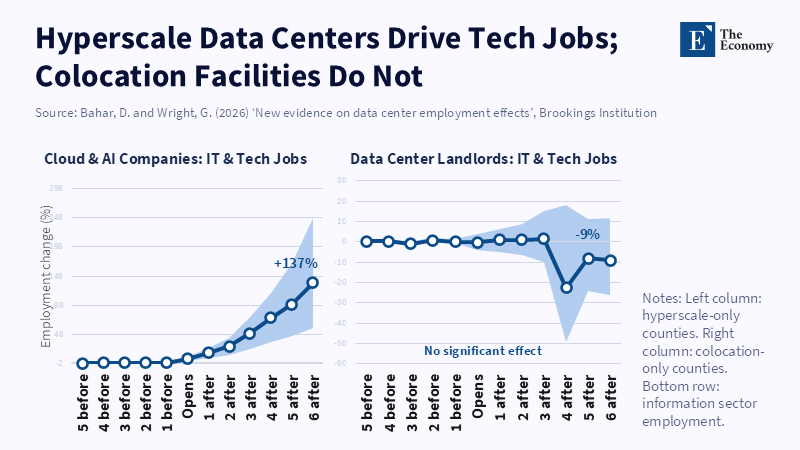
But the following wave of jobs is less local. It requires digital skills: cloud operations, workload routing, cybersecurity, customer service and high-end hardware engineering. These can be carried out from any other city or even country. A server farm in a rural U.S. County can be handling global clients, the software operations team managing its infrastructure may be in Ireland, Bangalore, Seoul, Seattle, or Warsaw. The phrase "jobs at the data center" needs to be defined more precisely. When a municipal authority approving a site due to its perceived value as an IT hub receives a construction boom, a limited number of new jobs at the site and an increase in tax revenue, the long-term economic benefit is apt to fall far short of what was hoped for, namely, continued job creation, skill development and growth in the IT sector.
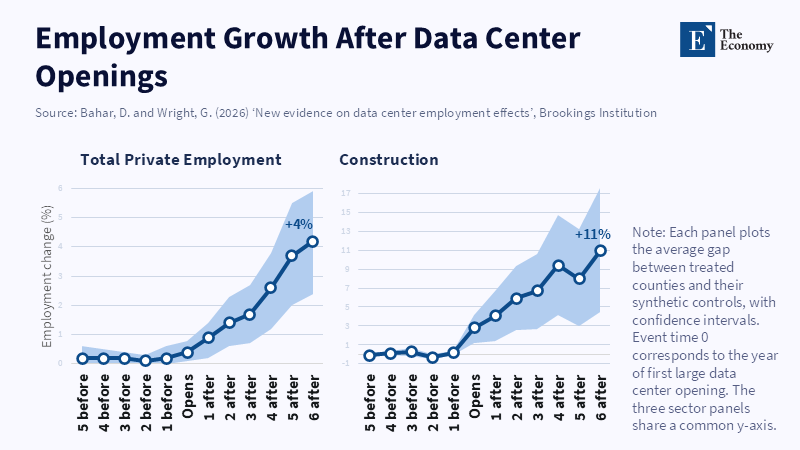
Clarity is key here. Clusters that encourage the creation of multiple data centers can create economies of scale that support local suppliers, builders and specialized laborers in a particular region; if two or more major server farms are present, a local market for specialized services-cabling, cooling systems, construction equipment and engineering services-can take hold. In Asia, Europe and in places such as Canada, Japan and Australia, similar forces bring about higher employment levels for the professional workforce, administrative employees and service technicians. Yet a solitary facility may do little more than offer a new tax-paying presence in an ideal downtown location that adds nothing more than employment for its builders.
The Local Jobs Test for Data Centers
The primary policy focus should be on a local job test, not at the state level, not for a nation as a whole, but specifically for the local jurisdiction. Each proposal should be required to state the number of stable positions within a reasonable commute to the site; those of outside workers, regional professionals and other personnel kept after the first three years; the difference between fixed capital costs and employment impacts, something still quite difficult when calculating property taxes. A construction worker moving between two or three data center projects over a decade technically has real employment, but the city shouldn't assume that this counts as a newly arrived worker for every project. The public requires a higher degree of accuracy.
This test should also account for the future land use. This is where a purely American scenario is unrealistic in northern Europe, Japan and South Korea. In some parts of the United States, land is not the binding constraint. In Western Europe, Japan and South Korea, it often is. However, densely populated economies are forced to consider the trade-offs more closely: sacrificing homes, industrial parks, recreational areas, hospitals and schools for this kind of installation may not be justified by the jobs it creates. It's true that a building that occupies 250,000 square feet can still be justified when cheap land is available, but such facilities in crowded areas can easily take up over 100,000 square feet and be an uneconomical choice due to the constrained nature of local grid power, land and water resources.
Because of these factors, incentives need to be redefined. Currently, most financial support packages are tied to capital expenditures. This is poorly designed for data centers, which are inherently capital-intensive installations. A business might spend millions on land, computer hardware, cooling infrastructure and power distribution while hiring a small team of local employees. When the public provides financial support through tax breaks or grid upgrades, a return greater than a press release should be expected. Financial support must be conditioned on a range of factors, including local training, full-time wages, apprenticeships, heat reuse, clear power agreements and ensuring the local power consumers don't bear the burden. Promises of software or IT job creation must be specifically documented in all binding agreements, rather than being left vague.
Why Dense Economies Need a Different Bargain
The general case for the utility of data centers is compelling. The world is hungry for digital services, especially AI that relies on cloud capabilities, computation for advanced processing tasks and data for research, financial activities and online learning. Digital services will continue to gain importance. However, this should not lead to the assumption that this is an inherent benefit to the local environment. Infrastructure is valuable, but so is land. A comprehensive network of data centers depends on power, water, fiber optic cables, cooling mechanisms, transportation networks and sufficient surrounding space near densely populated areas. Global power consumption for data centers in 2024 is estimated at 415 terawatt-hours, a figure predicted to double by 2030. These figures reflect a critical part of the infrastructure needs and the city’s role in overall power and urban planning.
Many Japanese and Scandinavian cities are already leading the way in data center development and management. Singapore decided against additional construction after several sites were approved. The European Union has required operators to disclose their power, water and heat consumption. Japan and South Korea face a harder siting problem because power-ready land near major cities is scarce, expensive and politically contested. America remains one of the only places still negotiating location based on elaborate state incentives. Elsewhere, the urban or industrial context in a concentrated economy does not justify placing large-scale computing capacity in the middle of it without evaluating its impact on land prices, grid power and the demand for local housing. This reasoning should extend to project-level analysis. Sacrifice a parcel of industrially zoned land or an apartment block, perhaps every 10 years in the case of a remote, low-density location, but not every year in the heart of a city.
This requires a recalibration of how the public bargains with the data center industry. Regulation should not block potential sites, including boomtowns aiming to bring in several server farms. But it should give preference to sites that utilize existing brownfields, are powered by low-carbon electricity sources, can utilize wasted thermal energy and will host higher-value employment activities. Urban sites that support server farms with fewer than 5-6 employees and are large electricity consumers should not receive subsidies. Regulations should be even more ambitious, connecting tax and energy subsidies to infrastructure investments that are low-emission, require highly educated workers and are jobs-focused. However, minor sites with a low number of employees that use refurbished land, re-use thermal energy and are connected to renewable sources should not be hampered by regulation.
Better Policy for Data Centers
Three simple steps are necessary. First, require every site to clearly outline the proportion of capital (construction jobs) to operational (full-time jobs), along with a distinction between local, regional and remote workers and the projected dates of those positions. Second, see water, land, grid and subsidies as public resources-these should be able to justify a project by providing measurable efficiency gains. Third, encourage clustering. Networks of 5 or more server farms can be considered entities with demonstrable value to the local area, in the areas of job creation, construction labor needs and job training. Small sites that offer no local jobs should lack any form of subsidy, so they can develop and vanish without significant public scrutiny.
This intervention is limited in scope, but important. The key to making it successful will lie in training community colleges, apprenticeship programs and community workforce development centers in how to develop and support positions that are actually available within server farms, rather than abstract "AI jobs." These training centers must develop workers who can fill roles as electrical technicians, maintenance specialists for cooling systems, forklift operators, fiber optic cable technicians, cybersecurity professionals and facility managers. Businesses will need to demonstrate to the government that there is real demand for the infrastructure jobs that these roles represent by identifying named personnel within the office of record before construction subsidies are awarded. Such positions constitute the vast majority of server farms' valuable jobs and minimize the risk of indirect harm caused by over-regulation. Increases in jobs as workers are displaced from one server farm to another must be framed as the benefits of this particular site, not exaggerated to include more substantial job gains.
Will such a stricter test necessarily impede the development of artificial intelligence? Possibly and that might not matter. Weak approvals could lock in a region with energy commitments for a quarter-century and a shortfall in job creation for the following ten years. The revenue from data centers, even if jobs are not created locally, is hardly an automatic rationale for development dollars. A city or state's reliance on a high capital-to-job ratio among taxable facilities as its key metric of development and success is a political decision. One particular risk that many people seem more worried about is the potential of low-labor, high-power sites to attract huge subsidies with no public consequence. This is a separate but no less valid problem. The data center is not the issue; it is whether it can create sufficient jobs for the level of resources that it consumes.
The views expressed in this article are those of the author(s) and do not necessarily reflect the official position of The Economy or its affiliates.
References
Bahar, D. and Wright, G. (2026) ‘New evidence on data center employment effects’, Brookings Institution, 4 May.
European Commission, Directorate-General for Energy (2025) Assessment of the energy performance and sustainability of data centres in the EU: First technical report. Luxembourg: Publications Office of the European Union.
Goetzel, D., Muro, M. and Methkupally, S. (2026) ‘Turning the data center boom into long-term, local prosperity’, Brookings Institution, 5 February.
Golding, D. (2025) ‘Data Centers Bring Jobs and I’m Tired of Pretending They Don’t’, LinkedIn Pulse, 17 June.
Igoe, S. (2026) ‘Data Centers are said to create jobs, but people need to know: what kind and how many?’, Nature Forward, 4 February.
Infocomm Media Development Authority (2024) Green Data Centre Roadmap. Singapore: IMDA.
International Energy Agency (2025) Energy and AI. Paris: IEA.
Joint Legislative Audit and Review Commission (2024) Data Centers in Virginia. Richmond, VA: JLARC.
Shehabi, A., Smith, S.J., Hubbard, A., Newkirk, A., Lei, N., Siddik, M.A.B., Holecek, B., Koomey, J.G., Masanet, E.R. and Sartor, D.A. (2024) 2024 United States Data Center Energy Usage Report. Berkeley, CA: Lawrence Berkeley National Laboratory. DOI: 10.71468/P1WC7Q.
Tozzi, C. (2025) ‘How Many Jobs Do Data Centers Create? It Depends’, Data Center Knowledge, 28 August.
Working across research, policy, and data-driven analysis, the Editorial Board ensures that published pieces reflect a consistent institutional perspective grounded in quantitative reasoning and long-term structural assessment.