Washington Reaffirms Shipbuilding Revival Drive, Confronting Industrial Constraints and Legislative Uncertainty

As one of the youngest members of the team, Tyler Hansbrough is a rising star in financial journalism. His fresh perspective and analytical approach bring a modern edge to business reporting. Whether he’s covering stock market trends or dissecting corporate earnings, his sharp insights resonate with the new generation of investors.
Authored On
Modified
U.S. Reiterates Shipbuilding Ambitions Under AMAP
Skepticism Mounts Over Structural Limitations of U.S. Shipbuilding Industry
Executive–Legislative Discord Clouds Prospects for Leveraging Allied Shipyards
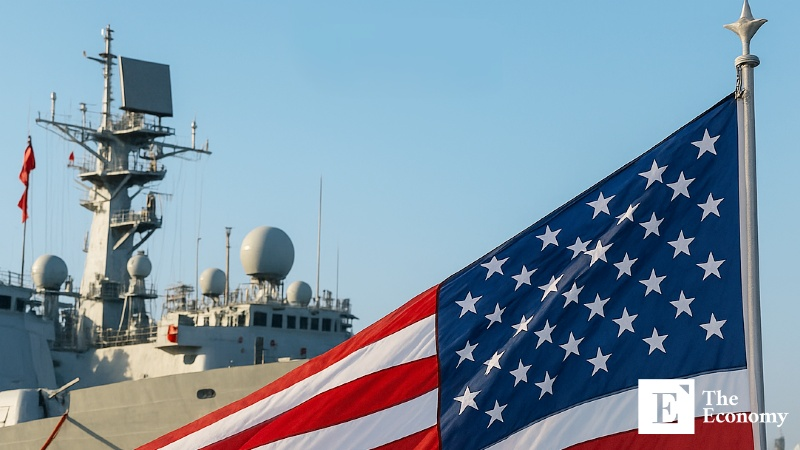
The White House has once again underscored its determination to revive the U.S. shipbuilding industry through the America’s Maritime Action Plan (AMAP). The blueprint seeks to fortify domestic industry by tightening regulations on foreign vessels and cargo while laying the groundwork for a sectoral resurgence through federal support and allied technology and capital. Yet experts assess that the Donald Trump administration’s initiative faces long odds of delivering meaningful results.
U.S. Unveils Measures to Bolster Domestic Shipbuilding
According to maritime industry sources on the 24th, the White House on the 13th unveiled AMAP. The plan serves as the implementation roadmap for objectives outlined in the “Restoring Maritime Dominance” executive order signed by President Trump in April of last year and is widely interpreted as a blueprint for “Make American Shipbuilding Great Again (MASGA),” a core pillar of U.S.–Korea strategic cooperation. The United States stated in the AMAP document that it has thus far secured at least $150 billion in dedicated investment for the domestic shipbuilding sector. A substantial portion of that funding is believed to have been mobilized under MASGA, raising the likelihood that the capital will be deployed in joint projects with South Korean shipbuilders.
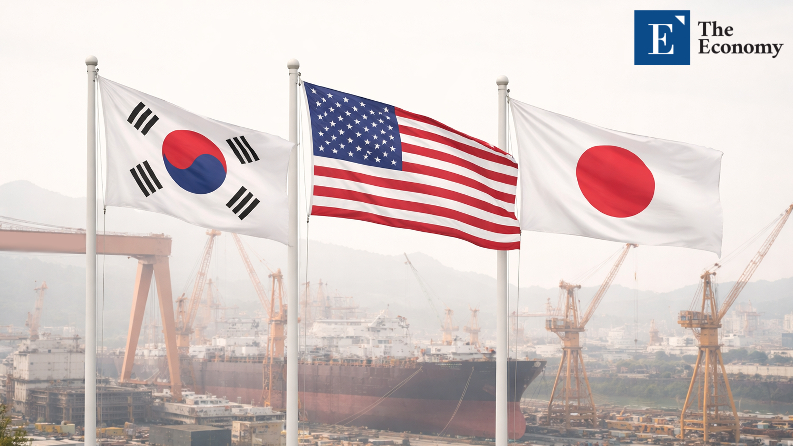
Washington also formally designated South Korea and Japan as key partners and codified a “Bridge Strategy.” The strategy permits foreign shipbuilders to construct initial vessels in their home countries when multiple ship procurement contracts are signed. The measure reflects the limited capacity of U.S. shipyards to build large oceangoing vessels. Should the framework materialize, allied shipyards such as those in South Korea would be able to construct early batches domestically. Nevertheless, AMAP makes clear that the ultimate objective remains onshoring—the relocation of manufacturing and service capabilities back to the United States.
AMAP further includes provisions to impose fees of $0.01 to $0.25 per kilogram of cargo weight on foreign-built commercial vessels. Additional measures include a land port maintenance tax of 0.125 percent of cargo value on goods entering via Canada and Mexico, as well as supplementary fees of $50 to $140 per ton on Chinese-built ships. The plan also encompasses the establishment of Maritime Prosperity Zones, reforms to shipbuilding workforce training and education, and improvements to the Title XI federal ship financing program, among other industrial revitalization measures.
The Stark Reality of U.S. Shipbuilding
Among experts, pessimism is mounting over whether the administration’s revival strategy can yield tangible gains. Colin Grabow, associate director at the Cato Institute, a U.S. libertarian think tank, argued in a post published on the institute’s website on the 19th that AMAP’s targets are “unrealistic.” In a prior commentary, Grabow noted that the U.S. commercial shipbuilding industry has effectively forfeited its competitiveness. As of 2024, U.S. shipyards account for a mere 0.04 percent of global market share, and over the past decade have delivered fewer than three large oceangoing commercial vessels per year on average.
Price competitiveness has likewise eroded sharply. The Aloha-class container vessels currently under construction at U.S. shipyards carry a per-unit price tag of $334.5 million—roughly six times the $55 million cost of comparable vessels built in China. Tankers that can be constructed overseas for $47 million require at least $220 million at U.S. yards. Construction timelines also lag significantly. The most recent container ship delivered by a U.S. yard took more than 40 months from keel laying to delivery, whereas South Korean shipyards during the same period delivered similarly sized vessels in under six months. President Trump’s shipbuilding revival agenda represents an aggressive attempt to overcome these entrenched constraints.
Compounding the challenge is the historical track record of prior federal shipbuilding support policies. The Construction Differential Subsidy program introduced in 1936 stands as a case in point. Designed to narrow the cost gap between domestic and foreign ship construction by subsidizing up to half of U.S. build costs, the program nonetheless failed to secure durable competitiveness for the industry. Even before the subsidies were withdrawn, the sector faced mounting pressures. Following the program’s termination in 1981, annual vessel output at U.S. shipyards—previously around 15 to 20 ships under the subsidy regime—declined to largely single-digit levels for decades thereafter.
Even if AMAP were to boost production volumes, questions remain over whether the administration’s broader objectives can be fully realized. The U.S. government contends that expanding commercial shipbuilding will lower costs and improve delivery schedules for naval vessels. Historical precedent, however, suggests risk. Federally supported commercial shipbuilding in the past absorbed large pools of skilled labor, delaying naval ship deliveries and inflating costs. Expanded subsidies for large commercial vessels could therefore adversely affect naval construction. A similar dynamic applies within the commercial segment itself: should capital and labor concentrate in large shipyards, smaller yards that have cultivated competitiveness in niche markets could face heightened pressure.
Allied Strategy in Focus, Congressional Variable Looms
Market consensus increasingly holds that leveraging allied shipyards represents the most viable pathway for reviving U.S. shipbuilding. Procuring modules or completed vessels from highly capable shipyards in South Korea and Japan is viewed as a more pragmatic and cost-efficient security strategy. The challenge lies in the divergence between the executive branch’s push for allied cooperation and the legislature’s inertia. The Naval Readiness Assurance Act, introduced in February of last year and designed to permit construction and maintenance of U.S. Navy and Coast Guard vessels at allied shipyards, has yet to clear either the House or Senate floor, or even the committee stage. Typically, legislation in the U.S. Congress takes approximately eight to nine months from introduction to enactment.
The Stimson Center, a Washington-based think tank, assessed that while constructing U.S. vessels in allied countries is strategically sound, entrenched interests within the domestic shipbuilding sector could impede implementation. Additional uncertainty stems from the fact that the bill was introduced by Republican lawmakers in both chambers. With President Trump’s approval ratings trending downward and projections suggesting potential Democratic gains in the November midterm elections, the legislative outlook remains fluid.
In effect, AMAP transfers the shipbuilding revival agenda to Congress in the form of a de facto legislative package. Even with the administration formalizing its policy direction, key initiatives such as the Bridge Strategy risk remaining declaratory if legislation stalls. A market expert noted, “Given that the Naval Readiness Assurance Act has struggled to advance through Congress, there is a tangible risk that the Bridge Strategy codified in AMAP could likewise face delays in institutionalization,” adding that the extent to which President Trump’s vision of leveraging allied shipyards can be realized remains uncertain.
As one of the youngest members of the team, Tyler Hansbrough is a rising star in financial journalism. His fresh perspective and analytical approach bring a modern edge to business reporting. Whether he’s covering stock market trends or dissecting corporate earnings, his sharp insights resonate with the new generation of investors.
Similar Post