Trump Pushes Ahead With 15% Tariff Despite Supreme Court Rebuff, Confronting Mounting Obstacles to ‘Plan B’

Siobhán Delaney is a Dublin-based writer for The Economy, focusing on culture, education, and international affairs. With a background in media and communication from University College Dublin, she contributes to cross-regional coverage and translation-based commentary. Her work emphasizes clarity and balance, especially in contexts shaped by cultural difference and policy translation.
Authored On
Modified
‘New Tariffs’ Take Effect as Backlash Builds
Legal Controversy Over Trade Act Section 122
Dispute Over ‘Balance of Payments Crisis’ Requirement
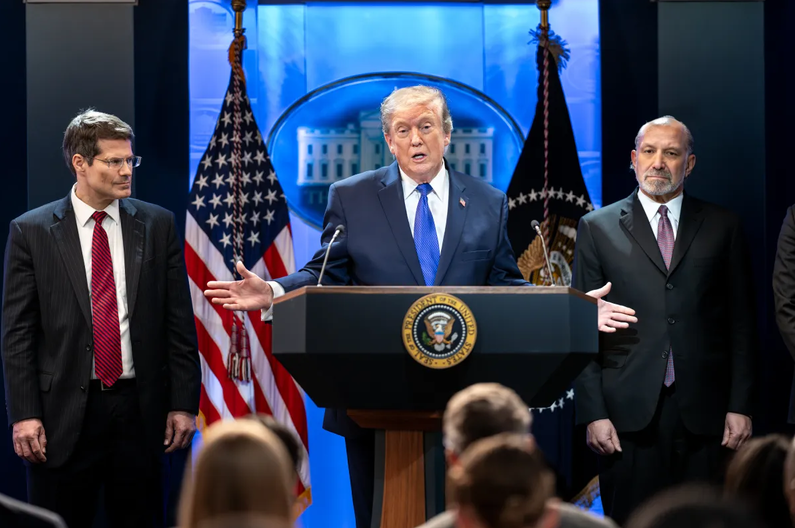
After the U.S. Supreme Court invalidated the reciprocal tariffs imposed under the International Emergency Economic Powers Act (IEEPA), President Donald Trump announced that he would newly impose a 15% tariff under Section 122 of the Trade Act of 1974. However, critics argue that the new tariffs are likewise vulnerable to legal challenge. Section 122 authorizes the president to impose tariffs on imports for the purpose of correcting balance of payments deficits. Trade and legal experts note that, because the provision has never previously been invoked and has never been interpreted by a court, it is highly susceptible to litigation.
Alternative Legal Authority and Prospect of Fresh Court Battles
On the 23rd (local time), CNN reported that while President Trump is advancing a new global tariff regime, the legal foundation itself remains fragile and could once again face judicial intervention. The crux lies in the Trade Act authority he has put forward as “Plan B.” After the sweeping tariffs imposed under IEEPA were ruled unlawful, President Trump pivoted to Section 122 of the Trade Act. According to the Congressional Research Service (CRS), Trump is the first president to invoke Section 122 as a basis for imposing tariffs.
The principal vulnerability is that the provision was not designed to address the trade deficit concerns long cited by the Trump administration. Enacted during the administration of President Richard Nixon in 1974, Section 122 permits the president to impose temporary tariffs only in the event of a “large and serious balance of payments deficit.” By contrast, the Trump administration has consistently justified its tariff policy over the past year on the basis of the trade deficit.
The two concepts are distinct. A trade deficit refers to the gap in goods trade, whereas the balance of payments encompasses the overall equilibrium of external transactions, including capital flows and financial movements. The balance of payments is the most comprehensive external accounts indicator, incorporating trade in goods and services as well as investment and capital transfers. Economically, it consists of the current account (CA), financial account (FA), and capital account (KA), satisfying the identity CA+FA+KA=0. At present, the United States’ balance of payments deficit is effectively close to zero, as trade deficits are offset by capital inflows.
Section 122 may also be invoked if deemed necessary to counter a risk of a sharp depreciation of the dollar. Given the dollar’s status as the world’s primary reserve currency and the continued strength of capital inflows, the statutory conditions for invoking Section 122 appear difficult to establish. Andrew McCarthy, a former federal prosecutor and conservative legal commentator, wrote in National Review that “the United States’ balance of payments is in equilibrium and no crisis exists,” adding that “this new tariff may be even more clearly unlawful than the IEEPA tariffs.” Bloomberg likewise noted that legal experts believe Trump’s new tariffs and their legal basis could once again return to the Supreme Court.
The Trump administration is aware of this vulnerability. In filings submitted ahead of the Supreme Court’s ruling, it acknowledged the distinction, stating that “a trade deficit is conceptually distinct from a balance of payments deficit” and that Section 122 would be “difficult to apply clearly” in the present context. Even while defending the IEEPA-based reciprocal tariffs before the Supreme Court, attorneys for the president argued that the president’s concern centered on the trade deficit rather than the balance of payments, rendering Section 122 inapplicable.
Hardline Trade Stance Signals Further Pressure Through Sections 301 and 232
From an effectiveness standpoint, the landscape is equally challenging for the administration. Unlike IEEPA, which President Trump previously relied upon, Section 122 is subject to a 150-day time limit. As a result, the 15% tariff is set to expire on July 24, and any extension would require congressional approval. Senate Minority Leader Chuck Schumer has already stated that he will seek to block any extension beyond 150 days. This constraint limits the president’s ability to rapidly raise tariffs against specific countries or deploy them as leverage in negotiations.
Accordingly, the administration has indicated that within the 150-day window it intends to utilize Section 301 of the Trade Act and Section 232 of the Trade Expansion Act to establish a more durable tariff framework. Section 232 authorizes the president to restrict imports, including through tariffs, if they are deemed to threaten national security, following an investigation and report by the Department of Commerce. Section 301 empowers the Office of the United States Trade Representative (USTR) to impose retaliatory measures, including tariffs and import restrictions, in response to unfair foreign trade practices. This approach reflects a strategy of layering country- and product-specific tariffs atop a baseline tariff regime and underscores the administration’s determination to maintain a tariff-centric trade policy in its second term.
Nevertheless, prevailing assessments hold that converting these measures into a permanent tariff structure within a short timeframe will prove difficult. In particular, Section 301 entails a quasi-judicial process requiring proof of unfair practices, submission of corporate comments, public hearings, and economic impact analysis, with investigations typically taking six months to over a year. Trade officials broadly agree that completing investigations into major global trading partners within the 150-day timetable set by President Trump is physically unfeasible.
Moreover, just as the Supreme Court took issue with the expansion of executive authority beyond statutory intent in the IEEPA-based reciprocal tariffs, similar reasoning could be applied to Sections 232 and 301. Critics further contend that the new tariff measures effectively attempt to circumvent the Supreme Court’s ruling, heightening the risk of illegality. Although President Trump asserted after the decision that he had become “stronger,” the dominant assessment is that his available policy options have narrowed considerably.
Corporate Refund Lawsuits Mount as Europe Halts Trade Pact Ratification
With the Supreme Court declining to recognize the IEEPA tariffs, a new dispute has emerged over whether previously collected tariff revenues must be refunded. The Trump administration collected more than $133 billion in IEEPA tariff revenues through mid-December last year, yet the Supreme Court’s ruling did not address the issue of reimbursement. On Wall Street, estimates of potential refunds vary. Morgan Stanley projected that under a “partial or delayed refund” scenario, repayments could reach $84 billion to $85 billion, while a “minimal refund” scenario could total around $56 billion. Another estimate suggests that IEEPA tariff revenues subject to refund could exceed $175 billion.
A wave of lawsuits from U.S. companies that paid the tariffs has already begun. On the 23rd, FedEx filed suit in the U.S. Court of International Trade in New York seeking reimbursement of the tariffs it paid under President Trump’s measures. In its 11-page complaint, FedEx named U.S. Customs and Border Protection (CBP), CBP Commissioner Rodney Scott, and the U.S. government as defendants, demanding a full refund of all IEEPA tariffs remitted to the United States. In September last year, FedEx stated that U.S. trade policy would reduce its fiscal 2026 operating income by $1 billion, equivalent to 16% of its operating income in the preceding year.
Even before the Supreme Court formally ruled the reciprocal tariffs unlawful, nearly 1,000 companies had already initiated refund litigation in anticipation of such a decision. These include major corporations such as Costco, Reebok, Puma, Patagonia, Uniqlo, and Toshiba. EssilorLuxottica and Goodyear Tire & Rubber have also filed suit.
Legislation mandating tariff refunds has likewise been introduced. A bill jointly sponsored by 22 Democratic senators, including Andy Kim (New Jersey), Ron Wyden (Oregon), Edward Markey (Massachusetts), and Jeanne Shaheen (New Hampshire), would require the administration to refund all unlawfully collected reciprocal tariffs within 180 days, including interest. In a press release, Senator Kim stated that “this administration took more than $1,700 per household from American families,” adding that “they must return the money.”
Trade agreements concluded under President Trump’s prior tariff framework are also subject to reassessment. European Union officials have indicated the possibility of suspending ratification of last year’s agreement with the United States, while the Indian government has indefinitely postponed trade talks. The Australian government is likewise reviewing its response. In a statement, Australian Trade Minister Don Farrell said, “Australia believes in free and fair trade,” adding that “we have consistently opposed these unjustified tariffs.” Trade uncertainty is intensifying at a sensitive juncture, with President Trump expected to meet Chinese President Xi Jinping in the coming weeks. Although the two countries agreed to a trade truce last year following reciprocal retaliatory tariffs, observers note that the new tariff regime could once again reshape the negotiating landscape.
Siobhán Delaney is a Dublin-based writer for The Economy, focusing on culture, education, and international affairs. With a background in media and communication from University College Dublin, she contributes to cross-regional coverage and translation-based commentary. Her work emphasizes clarity and balance, especially in contexts shaped by cultural difference and policy translation.
Similar Post