China’s Strategic Move: Turning Population Crisis into Industrial Dominance via ‘Robot Police’

Stefan Schneider brings a dynamic energy to The Economy’s tech desk. With a background in data science, he covers AI, blockchain, and emerging technologies with a skeptical yet open mind. His investigative pieces expose the reality behind tech hype, making him a must-read for business leaders navigating the digital landscape.
Authored On
Modified
Expanding Public Safety Experiments Including AI Traffic Police
Attempting to Resolve Police Shortages Through Automation
Accelerating Technological Advancement Based on Field Deployment Data
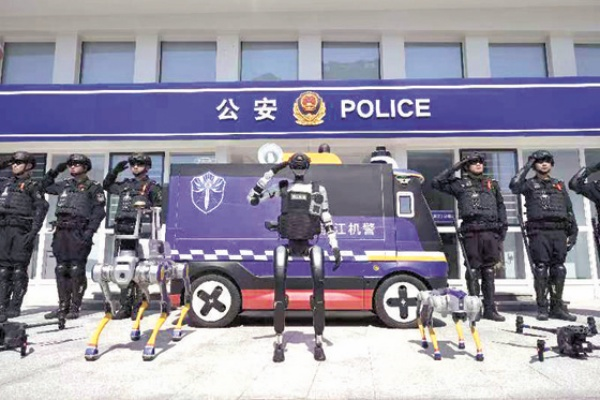
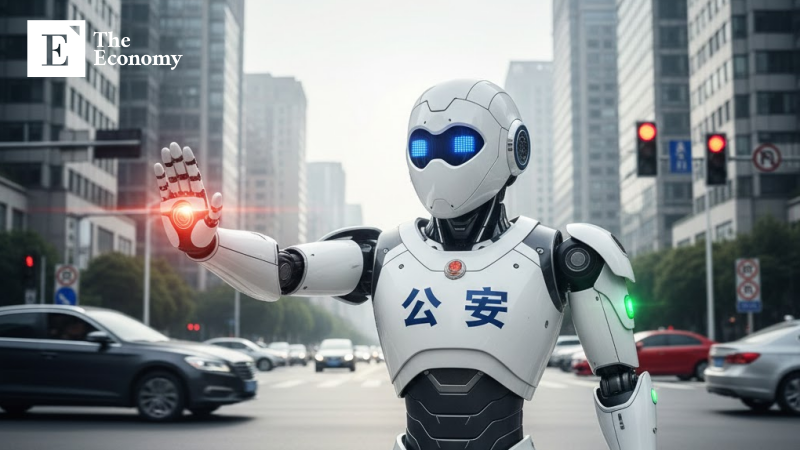
The Chinese government has launched a full-scale automation of public services by deploying 24-hour robot police in major strategic cities. Robot dogs, dressed in uniforms and marching alongside human officers, have appeared in major commercial districts, while humanoid robots equipped with Artificial Intelligence (AI) control traffic using hand signals on the streets. Industry analysts suggest that China’s national survival strategy—aimed at addressing the shortage of public security personnel caused by the population crisis through automated devices—has entered a stage of collecting real-world data and formalizing public safety experiments.
The Eve of the ‘Automated Policing’ Era
According to local Chinese media, the Chinese government recently began accelerating the automation of public services by deploying 24-hour AI robot police in the busy districts of major hub cities such as Anhui, Chengdu, and Hangzhou. This is interpreted as the fruit of ‘Made in China 2025,’ a core national strategy pursued since 2015, and a clear intent to preoccupy the ‘Embodied Intelligence’ market by bringing robots onto the actual field. A public security official stated, “Robot police can work without rest even in harsh weather conditions,” adding, “We expect them to minimize the physical fatigue experienced by human officers on dangerous roads.”
Robots active in the field have reached a level close to nearly replacing human tasks. The ‘Intelligent Police R001,’ deployed on the streets of Wuhu, Anhui Province, last January, performs simple repetitive tasks that human traffic police avoid 24/7. It sends signal commands and warning messages such as “For your safety, please ride your bicycle in lanes where vehicle traffic is prohibited!” to citizens attempting to enter car lanes on bicycles at crowded intersections. Officer Zhang Zihao, on-site, introduced R001 as a “new colleague,” saying, “Thanks to the robot, human officers can now focus on situations that require more complex judgment.”
Surveillance systems utilizing quadrupedal technology have also entered the practical application stage. In June last year, a robot dog patrolling in step with a police special forces unit armed with rifles appeared at the Wukersong Wanda Plaza, a large commercial complex in western Beijing, attracting significant public attention. In a situation where large crowds gathered for a concert by popular singer Wang Leehom, the robot dog performed surveillance by filming the surroundings in real-time through an omnidirectional camera mounted on its back. The sight of the robot dog deployed alongside a German Shepherd, an actual police dog, was recorded as a symbolic case demonstrating the cooperation between traditional policing methods and cutting-edge technology.
The aggressive deployment of robot police by Chinese authorities coincides with the market's growth trend. According to global investment bank Morgan Stanley, China's robot market is expected to more than double from $47 billion in 2024 to $108 billion by 2028. The Development Research Center (DRC) of the State Council of China also observed that the scale of the intelligent device industry, including humanoids, will reach $60 billion by 2030 and exceed $150 billion by 2035.
Focus on Efficient Management of Urban Population
Behind the rush to introduce robot police lies a rapid decline in the labor force. In its ‘Intelligent Device Industry Report’ at the end of last year, the DRC defined this as “a process of conducting high-level ‘social experiments’,” noting that “robots are rapidly spreading to sectors with severe labor shortages, such as elderly care facilities, public transportation hubs, and logistics warehouses, as well as public safety sites.” The explanation is that if citizens become accustomed to intelligent devices by encountering robot police on their daily commute, it can significantly lower the psychological resistance that occurs when robots are later introduced to places like homes or hospitals.
Furthermore, the automation of policing measures reflects the reality that the Chinese leadership's method of managing the populace is shifting toward ‘thorough control through technology.’ While previous generations conformed to the state through the fruits of economic growth, the current order is maintained through a sophisticated ‘whip’ consisting of AI surveillance networks and robot police. With technology capable of capturing specific individuals and tracking their movements just by their gait being mounted on robot police, citizens are left with no choice but to comply with a system monitored by machines. This suggests that China’s unique method of control—aimed at quieting social unrest and efficiently managing the urban population amidst an intensifying tech war and economic hardship—has reached its peak.
The Chinese government has adopted a strategy of fueling market growth through full-scale subsidies and direct purchase policies. According to Omdia, global humanoid robot shipments last year slightly exceeded 14,500 units, of which over 13,000 units were produced in China. Most of China’s production was absorbed through direct purchases by the Chinese government. China has entered the stage of guaranteeing stable sales for companies by purchasing large quantities of domestically produced robots and deploying them for public sector exhibitions or actual patrol duties, thereby creating a state-led ‘forced market.’
Price competitiveness is also secured based on astronomical subsidies and an inexpensive supply chain. The price of Unitree’s G1 robot is set at $13,500, while robot component suppliers in the Wujin District of Changzhou, Jiangsu Province, estimate the production cost of the robot to be less than $1,000 per unit. The strength of this low-cost supply chain leads back to large-scale practical application and data collection. For instance, Shanghai operates the world's first large-scale heterogeneous robot training base through the ‘National-Local Joint Humanoid Robot Innovation Center (Guodi Center)’ and is accumulating real-time data. The Guodi Center’s plan is to lead global automation standards by establishing a database of more than 10 million cases within the year.
The ‘New Communist Party’ Aiming for Automation Standards
As a result of mobilizing national capabilities, technological advancement is also proceeding very rapidly. CCTV’s New Year’s special program ‘Chunwan,’ which recorded a peak viewership of 40% with more than 1 billion viewers, was a solo stage proving the dazzling changes in China’s robot industry. Unitree's robots performed a joint show with students from the Tagou Martial Arts School in Henan Province, showcasing amazing techniques such as somersaults, sparring, and jumping up to 23 meters to rotate and land. Added to this were drunken fist movements reminiscent of martial arts stars like Jackie Chan, and a performance of falling as if drunk and then springing back up from the floor, which was sufficient to draw applause from the audience.
This technological leap is noteworthy in that it was achieved in just one year. Compared to last year's program, where 16 robots could not even exit the stage without the help of human dancers, this year is evaluated as a non-stop advancement. Wang Xingxing, CEO of Unitree, emphasized, “Every movement can be timed accurately to the 1/100th of a second, and the speed of the robots is also about 5 to 10 times faster than last year.” He further added, “This is the result of investing two months in catapult design alone and undergoing hundreds of millions of training sessions on a simulation platform.”
‘Bionic’ technology, which reproduces the emotional domain of humans, also appears to have reached its peak. The grandson robot that appeared in the comedy skit ‘Grandma’s Favorite’ on Chunwan perfectly learned and implemented the movements of a child laughing loudly or rubbing their eyes and crying. The bionic robot, modeled after the appearance of the lead actress, was equipped with 30 motors in its face, with 12 motors concentrated around the mouth to achieve synchronization of mouth shape and voice. The appearance of robots performing even the roles of actors suggests that the AI humanoid ecosystem envisioned by China is ready to penetrate all areas of human life.
China is now aiming its sights at global robot hegemony using overwhelming data and patent rights as weapons. Currently, China holds more than 32,000 patents, accounting for about 68% of humanoid robot patents worldwide, and the localization rate of core components has reached 75%. Through this, China has been able to maintain its position as the world's largest industrial robot market for 11 consecutive years. This is the background behind why China's ambition to form a market worth $1.5 trillion by introducing more than 100 million robots after 2045 has emerged as a key variable that will determine the landscape of the global automation industry, combined with the AI technology governance system known as the ‘New Communist Party.’
Stefan Schneider brings a dynamic energy to The Economy’s tech desk. With a background in data science, he covers AI, blockchain, and emerging technologies with a skeptical yet open mind. His investigative pieces expose the reality behind tech hype, making him a must-read for business leaders navigating the digital landscape.
Similar Post