“Violation of Donor Intent” vs. “Harassment of a Competitor” Musk-Altman Legal Battle Intensifies, With OpenAI’s For-Profit Transition at the Core

Aoife Brennan is a contributing writer for The Economy, with a focus on education, youth, and societal change. Based in Limerick, she holds a degree in political communication from Queen’s University Belfast. Aoife’s work draws connections between cultural narratives and public discourse in Europe and Asia.
Authored On
Modified
Musk continues arguing in court that OpenAI violated the purpose of his donation
OpenAI, desperate to secure funding, effectively moved toward commercialization over several years
OpenAI flatly rejects Musk’s claims as “sabotage aimed at supporting Grok’s growth”
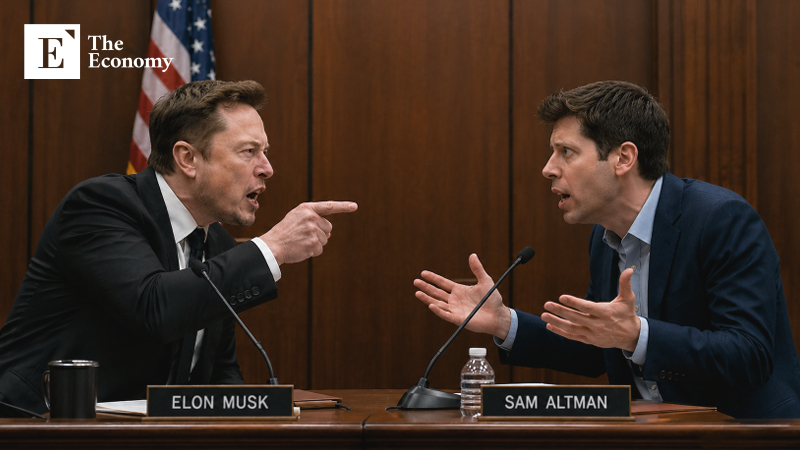
Elon Musk, chief executive officer (CEO) of Tesla, and Sam Altman, CEO of OpenAI, have entered a heated legal battle. Musk claims OpenAI has effectively transformed into a for-profit company through its conversion into a Public Benefit Corporation (PBC), thereby undermining its founding mission and the purpose of his donation. OpenAI, by contrast, maintains that Musk’s claims amount to nothing more than anti-competitive conduct intended to harass a rival.
Musk Takes the Stand and Launches Offensive Against OpenAI
According to The Wall Street Journal (WSJ) on the 28th (local time), Musk appeared that day at a trial held in federal court in Oakland, California, and told jurors, “The other side will try to make this case complicated, but the essence is very simple,” adding, “My view is that stealing a charity cannot be tolerated.” He went on to say, “If I lose this case, every charity in America could be at risk.”
Musk’s remarks stem from a position he has maintained for years: that OpenAI betrayed its founding purpose and deceived both him and the public. In court that day, Musk emphasized that he played a central role in OpenAI’s early founding and that the rationale behind its establishment was the development of safe artificial intelligence (AI) through a nonprofit organization. He argued that Google co-founder Larry Page, who had been leading AI development at the time, had made remarks suggesting insufficient concern over safety issues, prompting Musk to conclude that a separate organization was necessary.
Regarding the conflicts that emerged during OpenAI’s early years, Musk stressed that he “sought to secure control in order to keep the organization on the right path of developing safe AI,” adding that “personal gain was not the objective.” In 2017, while still involved with OpenAI, Musk had demanded that greater control be granted to an individual in order to preserve OpenAI’s direction in AI development. OpenAI, however, rejected the demand, judging that concentrating authority in one individual could undermine the independence and public-interest character of a nonprofit organization.
OpenAI’s Path Toward Commercialization
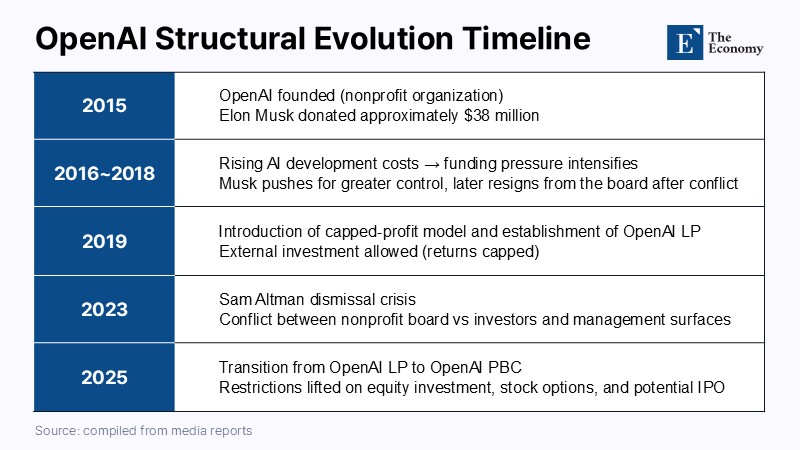
Musk’s central claim is that OpenAI effectively transformed into a for-profit company, thereby violating the purpose of the initial funding—$38 million—that he donated at the time of its founding in 2015. OpenAI, originally established as a nonprofit organization, came under the burden of enormous AI development costs from around 2016, while internal debate continued over the organization’s direction. Musk’s demand for greater control also came at this time. After the dispute, Musk formally stepped down from OpenAI’s board in 2018, and OpenAI chose to reduce the influence of any single individual and maintain nonprofit-centered independence.
Even afterward, however, the need to attract large-scale investment grew rapidly, and OpenAI ultimately introduced a capped-profit structure in 2019, establishing OpenAI LP, a limited partnership. The nonprofit OpenAI Inc. (now the OpenAI Foundation) retained control at the top, while limited returns for outside investors were permitted. After that, as commercially viable services such as ChatGPT emerged, the center of gravity in OpenAI’s management strategy gradually shifted from technology disclosure toward products and services. In effect, a system took hold in which the for-profit entity handled substantive business operations.
Capital demand also expanded at remarkable speed. As global AI competition intensified, the need to secure large-scale computing infrastructure grew, exposing the limits of the existing model. In particular, the 2023 ouster of Altman as CEO revealed the conflict between the nonprofit board and investors and management, publicly highlighting governance-related problems. Thereafter, internal discussions over structural reform continued within OpenAI, and the PBC conversion proposal emerged as a leading alternative. A PBC is a type of for-profit corporation in the United States that, like a nonprofit entity, specifies the pursuit of public benefit as a corporate objective in its charter. For OpenAI, which faced significant legal and reputational risks that made a direct for-profit conversion effectively impossible, it represented an attractive “detour.”
In fact, OpenAI reorganized its for-profit subsidiary structure in May last year, converting the existing OpenAI LP into OpenAI PBC. The OpenAI Foundation sits at the top, with OpenAI PBC beneath it handling actual business operations and fundraising. As a result, the fundamental funding model also changed. With equity investment now possible, participation by institutional investors and strategic investors (SI) broadened, while the door opened to large-scale fundraising and even a potential initial public offering (IPO). Musk argues that OpenAI lost its original founding purpose through this series of changes.
OpenAI Firmly Dismisses Musk’s Claims
OpenAI, however, maintains that Musk’s claims amount solely to “harassment of a competitor.” Earlier this month, it also requested that multiple state governments investigate Musk. On the 6th, CNBC reported that “OpenAI sent letters under the name of Chief Strategy Officer (CSO) Jason Kwon to the attorneys general of California and Delaware, asking them to investigate anti-competitive conduct by Musk and his associates.” In the letter, OpenAI cited reporting by the U.S. weekly magazine The New Yorker and criticized Musk’s side for tracking Altman’s movements, including his flights, and spreading false allegations related to sexual misconduct. It also argued that these attacks were an attempt to obstruct OpenAI’s efforts to realize artificial general intelligence (AGI) with human-level intellectual capabilities.
OpenAI sharply stated, “Musk’s actions are designed to seize the future of AGI from those legally obligated to ensure that AGI benefits all of humanity,” adding that he seeks to “hand that future to a competitor that has no mission-driven principles and rejects responsibility for safety.” OpenAI further pointed to the planned IPO of SpaceX, a company under Musk’s control, arguing that Musk’s legal offensive is ultimately intended to benefit Grok, the AI model of xAI, OpenAI’s competing platform and a SpaceX affiliate.
Similar arguments continued in court on the 28th. William Savitt, OpenAI’s lead attorney, said, “Musk supported OpenAI’s for-profit transition from the beginning, and what Musk wanted was not whether OpenAI remained nonprofit, but control of OpenAI,” adding, “After the founders rejected this, Musk founded a separate AI company and later filed this lawsuit as part of a harassment strategy intended to impede OpenAI’s progress.” He also rejected Musk’s claim that he contributed substantially to OpenAI’s founding. Savitt argued that the real work was done by the co-founders, while Musk occasionally appeared to offer advice or rebuke them for moving too slowly. Savitt also pointed out that among donations received by OpenAI from 2016 to 2020, donors other than Musk accounted for a much larger share, and that Musk is the only OpenAI donor who claims to have been promised that OpenAI would remain nonprofit.
Aoife Brennan is a contributing writer for The Economy, with a focus on education, youth, and societal change. Based in Limerick, she holds a degree in political communication from Queen’s University Belfast. Aoife’s work draws connections between cultural narratives and public discourse in Europe and Asia.
- Previous "Pivoting Toward High Value and Premium Segments" — Samsung Electronics Reshapes Home Appliance Strategy, Can It Challenge Europe’s Established Brands?
- Next German Auto Industry Enters Downturn as Chinese Demand Evaporates, EV Weakness Deepens; Berlin Redirects Industrial Strategy Toward Defense Sector
Similar Post