“Import Barriers” Under Scrutiny as India Accelerates FDI Expansion, With Regulatory-Execution Gaps Emerging as the Central Challenge

Authored On
Modified
Comprehensive overhaul of FDI policy centered on strategic industries
Rising operational uncertainty and compliance costs for foreign firms
Calls grow for administrative reform grounded in on-the-ground consistency

India has moved to the center of industry debate over import restrictions and quality and safety standards. As annual inflows of foreign enterprises continue to expand significantly, the country has entered a phase of recalibrating its legal and institutional framework to redesign the investment environment. Yet friction has surfaced in the course of enforcement, including certification delays, disputes over penalties, and tightened security standards. While corrective steps such as partial withdrawal of certain safety regulations, opening of the nuclear power sector, and consolidation of labor laws are proceeding in parallel, ensuring consistency in implementation at the operational level remains widely cited as the foremost challenge.
Systematizing Regulation to Accelerate Global Capital Inflows
According to Indian outlet Rediff, the Indian government held an “International Cooperation Dialogue in the Steel Sector” in New Delhi on the 2nd. Diplomatic representatives from Korea and Japan who attended the event reportedly voiced unusually direct concerns about regulatory barriers in the Indian market. Lee Seong-ho, South Korea’s ambassador to India, noted that “many companies operating in India are encountering unexpected regulatory hurdles,” suggesting that such conditions could negatively influence future investment decisions. Participants consistently emphasized that quality control orders (QCOs) and safeguard measures, which they argue distort normal market competition, require more proactive intervention by the Indian government.
These public remarks coincide with India’s broader effort to formalize regulation within an institutional framework amid rising foreign participation. Since introducing its Consolidated Foreign Direct Investment (FDI) Policy in 2020, India has designated FDI as a core driver of economic growth, with periodic revisions and updates following. Most sectors now permit 100% FDI under the Automatic Route, and more than 90% of total inflows are channeled through this mechanism. While deregulation and streamlined approval procedures proceed in parallel, detailed provisions—including quality and safety standards—have been designed with increasing specificity.
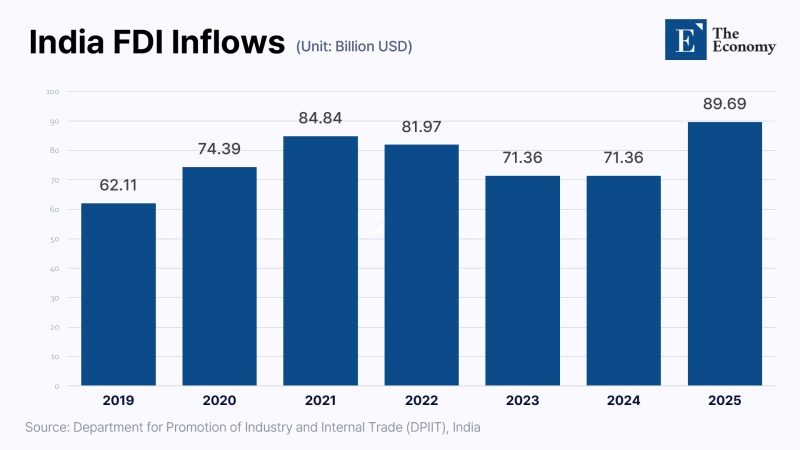
As a result of this proactive policy shift, foreign capital inflows have steadily expanded. Data from the Department for Promotion of Industry and Internal Trade (DPIIT) show that cumulative FDI inflows from April 2000 through September 2024 reached $1.0334 trillion. In the first half of fiscal year 2024–25 (through September 2024), FDI inflows totaled $42.1 billion, up approximately 26% from $33.5 billion in the same period a year earlier. By sector, services accounted for 16.2% ($116.7 billion), computer software and hardware for 15.0% ($108.4 billion), trading for 6.4% ($46.7 billion), and telecommunications for 5.5% ($40.0 billion).
This year, India’s foreign investment environment can be characterized as performance-linked and conditionally managed. The Production Linked Incentive (PLI) scheme introduced late last year disburses incentives only when predefined key performance indicators—such as output, value addition, and employment—are met, with provisions for withholding or clawback in cases of non-compliance. The federal budget for 2025–26 raised the FDI cap in the insurance sector from 74% to 100%, while sectors including space, telecommunications, and petroleum were opened to full foreign ownership. The aviation maintenance, repair, and overhaul (MRO) segment also permits 100% FDI under the Automatic Route. As expanded access and structured regulation advance simultaneously, foreign firms face both increased market entry opportunities and heightened compliance and adaptation burdens.
Risks of Policy Backfire if Design Falls Short
Adverse effects of regulatory refinement have already emerged. The most immediate example concerns instability in the enforcement of QCOs. With 191 QCOs currently applied to 773 items across leather, textiles, steel, petrochemicals, and machinery, critics argue that overlapping rules from raw materials to finished goods have created regulatory congestion. The Confederation of Indian Industry publicly described QCOs as “a supply chain risk rather than a tool for quality enhancement.” Even NITI Aayog, the government’s policy think tank, submitted a proposal calling the extension of QCOs to raw materials an abuse of policy intent and recommending their withdrawal. In November last year, the government formally acknowledged shortcomings in implementation and announced it would review the scope of QCOs.
The PLI scheme has likewise revealed gaps between policy ambition and execution. Although the program, launched in 2020, allocated a total of $36.2 billion, projections suggest the disbursement rate may reach only 16% by the end of this year. In semiconductors, $7.8 billion was allocated to 10 approved projects, yet actual disbursement remained around 15% as of early this year. Raghuram Rajan, former governor of the Reserve Bank of India and a professor at the University of Chicago, criticized the scheme, stating that “PLI effectively subsidizes private companies with taxpayer funds but lacks performance transparency,” adding that inconsistent implementation and weak verification mechanisms can themselves become sources of uncertainty.
Similar tensions have surfaced in the information technology sector. Reuters reported in January that the Indian government was considering introducing 83 new security requirements for smartphone manufacturers, including submission of source code and prior notification of major software updates. Major firms including Apple, Samsung Electronics, Google, and Xiaomi reportedly expressed concern that the measures are unprecedented internationally and could expose trade secrets. Requirements such as access to source code, retention of system logs for 12 months, and restrictions on software updates prior to government approval were described as directly affecting intellectual property protection and rapid response capabilities.
In tariff and tax enforcement, questions over interpretive consistency have come to the fore. In May last year, Indian tax authorities imposed $601 million in taxes and penalties on Samsung Electronics. The dispute centered on “remote radio heads” (RRHs) used in fourth-generation telecommunications base stations, which authorities classified as finished products subject to a 20% tariff. Samsung argued that RRHs lack independent signal transmission and reception functions and should be classified as components exempt from tariffs, but the claim was rejected. Such recurring discrepancies between regulatory design and enforcement contribute to perceptions of India as a market carrying legal and administrative risk.
Growing Demands for Effective Institutional Implementation
In response to mounting criticism, the Indian government has engaged in consultations with industry while withdrawing certain measures and refining others. A notable example is the full repeal in January of the “Machinery and Electrical Equipment Safety Regulation (OTR)” pursued by the Bureau of Indian Standards (BIS). In August last year, India had introduced “Scheme X,” a new conformity assessment requirement covering construction and machine tools, mandating factory inspections and technical documentation submissions. Exporters argued that the stringent conditions imposed excessive burdens. Korea’s National Institute of Technology and Standards formally raised the issue as a technical barrier to trade (TBT), and after two postponements, India ultimately withdrew the regulation.
In strategic sectors, policy shifts toward greater openness have gained momentum. In early February, Finance Minister Nirmala Sitharaman formally announced plans to open nuclear power generation to private participation. The government intends to amend the Civil Nuclear Liability Law, a longstanding obstacle to foreign investment that imposes unlimited liability on equipment suppliers in the event of an accident. The law had previously been cited as a key reason why companies such as GE Hitachi withdrew plans to enter the Indian market. Recent discussions between the Adani Group and the Uttar Pradesh state government regarding construction of eight 200MW small modular reactors (SMRs), along with expressions of interest from Reliance Industries, Tata Power, and JSW Energy in the “Bharat SMR” initiative, are seen as signals of private sector response to policy realignment.
Labor reform has also been pursued to enhance the effectiveness of legal restructuring. The government aims to consolidate 29 central labor laws into four overarching codes covering wages, industrial relations, social security, and occupational safety and health. The framework clarifies the legal status of platform workers and fixed-term employees and establishes a nationwide minimum wage structure. Nonetheless, skepticism remains, given that roughly 90% of India’s workforce operates in the informal sector. Without narrowing the gap between central reforms and state-level enforcement capacity, observers caution that the impact of legal integration may remain limited.
Experts broadly agree that even with regulatory withdrawals, sectoral liberalization, and legal consolidation, the critical issue lies in consistency and predictability of enforcement. While examples of regulatory suspension and large-scale investment openings demonstrate policy flexibility, the practical business environment is ultimately shaped by subordinate regulations, administrative interpretation, and state-level implementation. Ongoing dialogue between the government and corporations to adjust individual projects is viewed as a constructive development, but market participants maintain that the decisive factor for sustained investment is whether institutional improvements are applied uniformly on the ground.
Similar Post