War Reaches Data Centers as Middle East Conflict Shakes Global IT Infrastructure

Niamh O’Sullivan is an Irish editor at The Economy, covering global policy and institutional reform. She studied sociology and European studies at Trinity College Dublin, and brings experience in translating academic and policy content for wider audiences. Her editorial work supports multilingual accessibility and contextual reporting.
Authored On
Modified
Fears grow over damage to facilities supporting cloud and AI services
Drone strikes reported at AWS data centers in the Middle East
Cyber operations expand battlefield into full-scale “hybrid warfare”
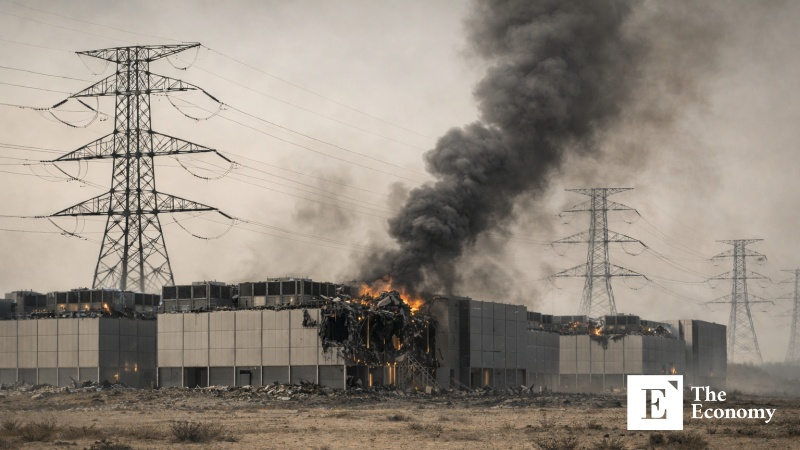
As the Middle East has emerged as a major hub for global artificial intelligence and cloud infrastructure, the outbreak of conflict has prompted major technology companies to move quickly into crisis response mode. Concerns over the safety of local offices and personnel have surfaced simultaneously, with some firms shifting operations to remote work while closely monitoring developments. At the same time, the stability of data centers in the region has become a major focus of concern. With cyberattacks and the deployment of AI technology increasingly influencing the nature of warfare, the scope of conflict is now expanding into the realm of digital infrastructure.
Service Delays Prompt Traffic Rerouting
According to market research firm IDC, global IT growth this year is expected to slow from 10% to 9%. The projection appeared in IDC’s report titled “The Impact of the Middle East War on Regional and Global IT Spending,” which assumes that the conflict will end within three months. While the war’s effects remain manageable for now, the report warns that a prolonged conflict scenario would inevitably increase uncertainty. It also predicts that resilience in data centers will become an even more critical factor in ensuring stable cloud service supply. Companies may accelerate distributed strategies such as multi-cloud deployments designed to strengthen disaster recovery capabilities.
Major global technology companies have already stepped up contingency responses amid the risk of a broader regional escalation. According to CNBC, Nvidia CEO Jensen Huang sent an email to employees on the 3rd announcing the temporary closure of the company’s Dubai office in the United Arab Emirates and a shift to remote work. Huang stated that all Nvidia employees and their immediate family members in areas affected by the conflict were safe, adding that the company’s crisis management team was working around the clock to support staff and families in the Middle East. Nvidia expanded its regional presence after acquiring Israeli networking firm Mellanox in 2019, making Israel one of its largest research and development centers outside the United States.
Google has likewise used the Middle East as a key base for its cloud and commercial operations and is currently developing the massive “ToHa2 Tower” complex in Tel Aviv, Israel. However, disruptions to air travel caused by the recent Iran-related conflict have left dozens of employees stranded in Dubai. The workers had remained there after attending the launch event for Google’s Accelerate sales program. The company said most of the employees involved were local staff rather than personnel from the United States, adding that safety measures had been implemented and staff were advised to follow guidance from local authorities. Google also noted that the situation in the Middle East was evolving rapidly and that the safety and well-being of employees in the region remained the company’s top priority.
The Middle East has become a critical hub where many large technology companies have concentrated AI and cloud infrastructure. As global firms continue building data centers and network facilities across the region, a wide range of digital services—including financial transactions, logistics systems, corporate operations, and public services—have become interconnected. In such an environment, disruptions at a single regional data center can quickly translate into global service instability. Reports during the current conflict of service delays and traffic rerouting in some Middle Eastern cloud regions have heightened concerns that the shock of war could spread into the operation of digital infrastructure.
Drone Attacks Disrupt Power Supply
Amazon Web Services (AWS), the cloud division of Amazon, also disclosed on its website on the 2nd that a data center in the United Arab Emirates had been struck by drones. In its notice AWS stated that the facility was experiencing localized power problems after emergency responders shut down power lines and generators following a fire. The company added that full service restoration in parts of the Middle East could take several hours. The day before, AWS had already reported that “objects” had fallen onto its UAE data center facilities, triggering a fire.
The damage was not limited to a single site. Amazon said two data centers in the United Arab Emirates were directly hit by drone attacks. In addition, an AWS facility in Bahrain was also reported to have suffered damage from a drone strike. Amazon explained that infrastructure in two regions affected by the ongoing Middle East conflict had sustained physical damage, resulting in structural harm, power supply interruptions at some facilities, and additional damage caused by firefighting operations. The physical attacks simultaneously affected internal equipment and power infrastructure inside the data centers, ultimately leading to service disruptions.
The recovery process is also expected to face challenges. AWS advised customers to back up critical data and, if possible, shift operations to AWS servers located in other regions. Some companies responded by moving workloads to alternative cloud regions in an attempt to maintain service continuity, but full restoration in the near term remains uncertain. Cloud services do not depend solely on servers inside data centers. Reliable operation requires multiple systems—including power supply networks, networking equipment, cooling infrastructure, and backup power systems—to function simultaneously. When structural damage and power disruptions occur at the same time, restoring stable operations inevitably becomes a prolonged process.

AI Used to Analyze Operational Scenarios
The international community has increasingly focused on the possibility that digital infrastructure—including data centers—could become strategic targets in modern warfare. Recent conflicts show a pattern in which military bases and energy facilities are no longer the only objectives, as networks, data systems, and AI-based platforms also come under attack. This shift reflects the concept of “hybrid warfare,” where physical strikes and cyber operations occur simultaneously. Security firms have warned that hacking groups linked to Iran are strengthening preparations for cyberattacks targeting major infrastructure in the United States.
The U.S. cyber defense system itself faces mounting pressure under these conditions. The Cybersecurity and Infrastructure Security Agency (CISA) is currently operating with only 38% of its workforce on rotating shifts due to ongoing budget disputes. Congress remains locked in political conflict over funding to reopen parts of the Department of Homeland Security (DHS), which includes CISA. Homeland Security Secretary Kristi Noem said the federal government would devote all available resources to monitoring and blocking national security threats in coordination with intelligence and law enforcement agencies. However, concerns persist that staffing shortages could weaken defensive capabilities.
Signs of cyberattack activity have already emerged. Global cybersecurity firm CrowdStrike reported that “Hydro Kitten,” a hacking group linked to Iran’s Islamic Revolutionary Guard Corps (IRGC), had begun preparing attacks targeting the U.S. financial sector. Adam Meyers, senior vice president at CrowdStrike, said in a statement that Iran-linked hackers and hacktivist groups had sharply intensified operations against organizations in the Middle East, the United States, and parts of Asia following U.S. airstrikes on February 28. Security firm Flashpoint also revealed that pro-Iran hackers had infiltrated Jordan’s key grain management system through phishing attacks.
Amid these developments, AI technology has emerged as another key variable shaping modern warfare. Reports indicate that U.S. Central Command used Anthropic’s AI model Claude to assist with intelligence gathering, target identification, and battle scenario simulations. Palantir’s data platform Gotham was also reportedly used to identify major military facilities and leadership hideouts of Iran’s Islamic Revolutionary Guard Corps. Following the news on the 2nd, Palantir’s share price rose 5.82% to $145.17. Analysts said the growing role of data analytics in military operations has simultaneously increased investor expectations for companies operating in the sector.
Niamh O’Sullivan is an Irish editor at The Economy, covering global policy and institutional reform. She studied sociology and European studies at Trinity College Dublin, and brings experience in translating academic and policy content for wider audiences. Her editorial work supports multilingual accessibility and contextual reporting.
Similar Post