[Rich Tax] AI-Driven Job Displacement and Widening Wealth Inequality Return ‘Billionaire Tax’ Debate to the Political Agenda

Siobhán Delaney is a Dublin-based writer for The Economy, focusing on culture, education, and international affairs. With a background in media and communication from University College Dublin, she contributes to cross-regional coverage and translation-based commentary. Her work emphasizes clarity and balance, especially in contexts shaped by cultural difference and policy translation.
Authored On
Modified
Expanding asset disparity and rising redistribution demands amid AI proliferation
Sanders pressures state-level tax hikes through the ‘Make Billionaires Pay Their Fair Share Act’
France and the UK see growing debate over taxing ultra-wealthy individuals amid fiscal strain

As artificial intelligence (AI) rapidly reshapes the structure of the labor market, discussions over taxing the ultra-wealthy have once again emerged as a central political agenda. As technological innovation generates enormous wealth that is increasingly concentrated among a small group of asset holders, pressure is also mounting to redesign redistribution mechanisms within the tax system. In the United States, Senator Bernie Sanders and New York City Mayor Zohran Mamdani have elevated the wealth tax debate into the policy arena, while fiscal pressures and rising social discontent are fueling expanding debate over taxing the ultra-rich in France and the United Kingdom.
Expansion of Wealth Tax Proposals in California and New York
According to major international media outlets including The Guardian and The Washington Post on the 4th (local time), Senator Sanders on the 2nd formally introduced the “Make Billionaires Pay Their Fair Share Act,” a bill that would impose a large-scale wealth tax on ultra-high-net-worth individuals, together with Representative Ro Khanna (Democrat, California). The bill centers on imposing a 5% annual tax on the net worth of U.S. billionaires. The estimated $4.4 trillion in revenue secured through the measure would be directed toward strengthening the social safety net for low- and middle-income households.
The proposed uses of the wealth tax revenue are notably expansive. In the first year after the bill’s implementation, every member of households earning $150,000 or less annually would receive a direct cash payment of $3,000 per person. For a four-person household, the payment would amount to $12,000. The proposal also includes guaranteeing a minimum annual salary of $60,000 for public school teachers across the United States and allocating funding to build or preserve more than seven million affordable housing units. In addition, the plan would expand Medicare coverage to include dental and vision services that had previously been excluded.
According to estimates released by Sanders’ office, if the bill were enacted, the net worth of Tesla CEO Elon Musk, currently the world’s richest individual, would decline from $833 billion to roughly $792 billion, resulting in approximately $42 billion in tax payments. Sanders stated, “Over the past 50 years, $79 trillion in wealth has moved from the bottom 90% to the top 1%,” adding that “the billionaire class no longer sees itself as part of the American community and instead seeks to rule like 18th-century monarchs.”
The figure who first brought the wealth tax debate into the forefront of U.S. political discourse is Mayor Mamdani. While announcing the preliminary budget proposal for fiscal year 2027 on the 17th of last month, he emphasized that “tax increases on wealthy corporations and individuals remain the top priority,” while also stating that “if that approach fails to materialize, we will pursue an alternative plan to raise property taxes by 9.5%.” New York City is currently projected to face a fiscal deficit of $5.4 billion over the next two years. City officials therefore view revenue expansion as unavoidable.
Mamdani has advocated since his mayoral campaign for imposing an additional 2% tax on high-income earners with annual income exceeding $1 million. However, the measure requires approval from New York Governor Kathy Hochul and the state legislature, and given the current political landscape, its prospects for passage remain low. This explains why Mamdani proposed a property tax increase as an alternative. Property tax is the only tax that the New York City mayor can adjust without approval from the state government. If property taxes rise, more than three million homes and apartments in New York, along with over 100,000 commercial properties, are expected to be affected. City authorities estimate that adjusting the tax rate could generate an additional $14.8 billion in revenue over the next four years.
French Public Opinion Unites Behind Super-Rich Wealth Tax
Debate over the introduction of a wealth tax is also intensifying in France, which is facing a severe fiscal crisis. France’s national debt expanded rapidly following the 2008 global financial crisis, the 2020 COVID-19 pandemic, and the 2022 war in Ukraine. During the pandemic, the French government continued large-scale fiscal spending to support economic stimulus and unemployment benefits. As a result, the fiscal deficit expanded to 9% of gross domestic product (GDP) in 2020, far exceeding the European Union’s Stability and Growth Pact recommendation of keeping deficits within 3% of GDP.
However, fearing public backlash from citizens who had grown accustomed to subsidies, the government struggled to scale back spending that had already been expanded. As both the state and its citizens effectively fell into fiscal dependence, the country’s economic conditions deteriorated rapidly. The national debt ratio, which stood in the 50% range of GDP in the early 2000s, more than doubled to 114.1% in the first half of last year. The fiscal deficit ratio also reached 5.8% of GDP, exceeding the EU’s recommended threshold of 3%.
Recognizing the severity of the situation belatedly, then–Prime Minister François Bayrou attempted a political gamble by pushing aggressive austerity measures that included pension cuts and reductions in public holidays. However, he lost a parliamentary confidence vote amid strong public backlash and was forced to resign just nine months after taking office in September of last year. Subsequently, newly appointed Prime Minister Sébastien Lecornu abruptly withdrew Bayrou’s proposal to reduce two public holidays in an effort to calm public sentiment, yet opposition to austerity had already spread nationwide. Anti-austerity demonstrations erupted across France, and in some regions the operation of public infrastructure such as hospitals and schools was suspended, effectively paralyzing state functions.
With policymakers unable to extend working hours while also facing constraints in reducing welfare benefits, left-wing parties began promoting the so-called “Zucman tax,” named after French economist Gabriel Zucman. The proposal would impose a minimum annual tax of 2% on all assets held by ultra-wealthy individuals with fortunes exceeding $115 million, including corporate shares and unrealized gains.
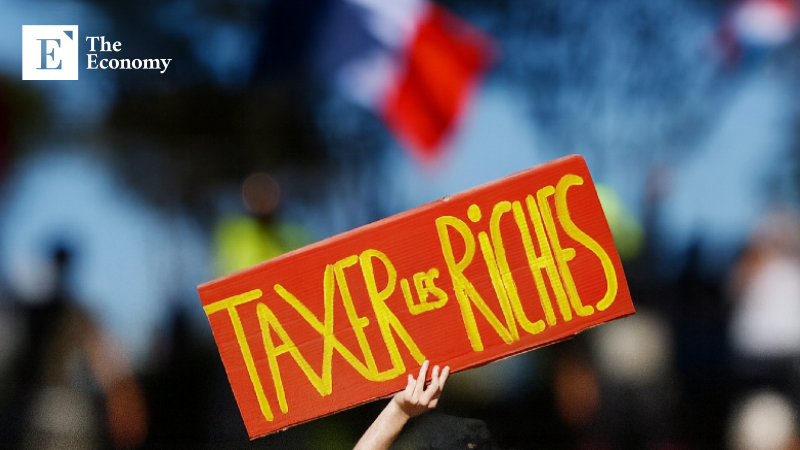
Left-wing politicians justified the proposal by arguing that “austerity plans represent a neoliberal conspiracy that exploits workers to enrich the wealthy,” while the public responded with mass demonstrations under the slogan “Tax the Rich.” However, the Zucman tax ultimately failed to pass the legislature. As an alternative, the French government has moved to secure revenue through a “differentiated contribution” applied to high-income earners with annual income exceeding $288,000. The government has also raised taxes on large corporations. The corporate tax increase, originally introduced as a temporary one-year measure, has reportedly been extended for an additional year.
Rising Wealth Tax Discussions in the United Kingdom
Like France, the United Kingdom is also facing fiscal pressures and has left open the possibility of introducing a wealth tax. Last year, the UK Prime Minister’s Office responded to reports about a wealth tax review by stating that it “cannot comment on future budgets,” while adding that “the Prime Minister has repeatedly emphasized that those with broader shoulders should bear greater responsibility.” Local media interpreted the remark as a signal that the government of Prime Minister Keir Starmer had not fully ruled out the possibility of introducing a wealth tax.
The debate over wealth taxation in the UK gained momentum following remarks by former Labour Party leader Neil Kinnock. In a television interview last year, he argued that applying a 2% tax rate to ultra-high-net-worth individuals holding assets exceeding $12.8 million could generate approximately $14.1 billion in annual revenue. Kinnock emphasized that “this measure could create a stable source of fiscal income while also sending a nationwide message that the government values fairness.” After labor groups issued statements supporting the introduction of a wealth tax, the debate expanded throughout both political circles and broader society.
Prime Minister Starmer and Chancellor of the Exchequer Rachel Reeves have repeatedly stated that they have no plans to introduce a wealth tax. However, the recent withdrawal of a welfare reform proposal has reduced fiscal flexibility, reviving discussions about additional tax increases targeting high-income individuals. The Financial Times (FT) reported that “while the Treasury remains cautious about introducing an entirely new form of wealth tax, it is open to considering increases in existing tax rates,” adding that “such measures could ultimately lead to a higher tax burden for high-income groups.”
According to the Organisation for Economic Co-operation and Development (OECD), only three countries in Europe currently impose a wealth tax: Switzerland, Spain, and Norway. Most European countries introduced wealth taxes in the past but later abolished them after facing tax resistance and capital flight, and have since struggled to reintroduce the legislation. Switzerland includes all net assets—such as real estate, yachts, artworks, Bitcoin, stocks, and overseas assets—in its tax base and imposes an annual wealth tax of roughly 1%. This contributes significantly to Switzerland’s tax revenue, accounting for approximately 1.16% of the country’s GDP and 4.26% of total tax revenue.
The recent resurgence of wealth tax discussions is closely linked to the expansion of AI technologies. AI-driven automation is rapidly reshaping the structure of labor markets while simultaneously intensifying job insecurity and income inequality. In particular, the concentration of economic gains from technological innovation among a small number of corporations and investors is accelerating this debate. The AI industry grows through massive capital investment and data accumulation, a process that has dramatically expanded the wealth of technology founders and major investors, while automation simultaneously exerts downward pressure on labor demand. Economists widely agree that these changes are beginning to disrupt the existing social contract. The growing argument is that a portion of the wealth generated by technology firms should be redistributed to society through the fiscal system. Various policy ideas—including universal basic income, data dividends, and an AI productivity tax—are being discussed in the same context.
Siobhán Delaney is a Dublin-based writer for The Economy, focusing on culture, education, and international affairs. With a background in media and communication from University College Dublin, she contributes to cross-regional coverage and translation-based commentary. Her work emphasizes clarity and balance, especially in contexts shaped by cultural difference and policy translation.
Similar Post