[U.S.–Iran War] Washington and Tehran Brace for Protracted Conflict as Energy Crisis and Allied Burden Loom

As one of the youngest members of the team, Tyler Hansbrough is a rising star in financial journalism. His fresh perspective and analytical approach bring a modern edge to business reporting. Whether he’s covering stock market trends or dissecting corporate earnings, his sharp insights resonate with the new generation of investors.
Authored On
Modified
Signs of a Prolonged War Drive Oil Surge as Strait of Hormuz Closure Disrupts Markets
Production Cuts by Major Oil Producers Intensify Pressure on Europe, South Korea, and Japan
Prospect of U.S. Support Requests Raises Concerns Over Mounting Burden on Allies
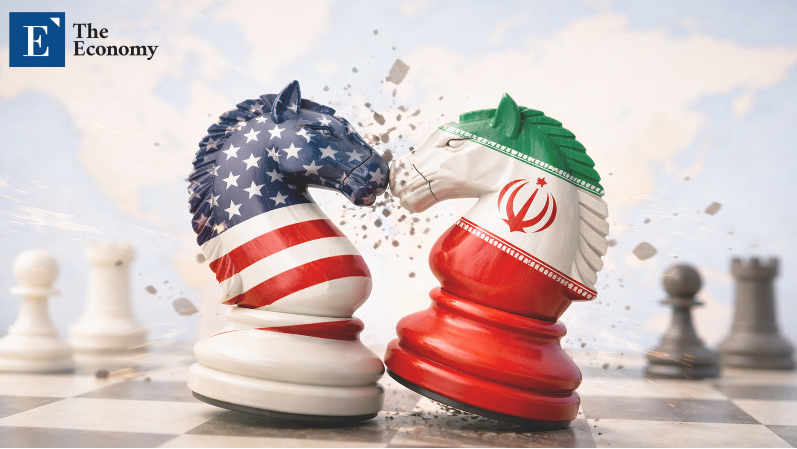
The Middle East conflict that began with U.S. and Israeli airstrikes on Iran is showing signs of evolving into a protracted war, amplifying instability across the international community. The closure of the Strait of Hormuz has sent global oil prices soaring, while production cuts by key Middle Eastern oil producers are accelerating, increasing the damage to countries heavily dependent on imported crude. Concerns are also emerging that if Washington formally seeks support, the burden on allied nations in Europe and East Asia could rise significantly.
Rising Fears of a Prolonged U.S.–Iran Conflict
According to a report by the Wall Street Journal (WSJ) on the 8th (local time), global investors are increasingly worried that the oil shock triggered by the Middle East war could unfold in a manner similar to the surge that followed Russia’s invasion of Ukraine in 2022. On that day, Brent crude—the global benchmark—rose 16.19% to $107.70 per barrel on the ICE Futures exchange in London, while U.S. West Texas Intermediate (WTI) jumped 18.98% to $108.15. During the outbreak of the Russia–Ukraine war in 2022, oil prices climbed from about $90 per barrel to as high as $120.
These concerns stem largely from the growing likelihood that the confrontation in the Middle East will become prolonged. At present, Iran is gradually losing its ability to launch ballistic missiles. The United States and Israel, which have secured air superiority, have been destroying mobile missile launchers whenever they emerge from tunnels or underground facilities. U.S. President Donald Trump said at a recent White House event that “whenever Iran launches a missile, we strike the launcher within four minutes.” He added that Iran’s anti-aircraft weapons and air defense networks had been removed and that its air force “no longer exists,” claiming that Iran’s missile stockpile and launch capability had been reduced by about 60% and 64%, respectively. If this trend continues, the more than 2,000 ballistic missiles Iran possesses could effectively become unusable.
The key variable remains Iran’s offensive drone capability, an area in which the country is widely regarded as an advanced power. Iran is believed to possess more than 10,000 Shahed drones capable of carrying a 30-kilogram bomb and flying roughly 2,000 kilometers, enabling strikes across the Middle East. Considering Israel’s intelligence-gathering capabilities, Iran’s drone production capacity could shrink rapidly in the future. However, the possibility that Iran may develop tactics to deploy a smaller number of drones more efficiently remains a significant variable. Some analysts have even raised concerns that Iran’s threat to the Strait of Hormuz could persist for more than a year. The narrow waterway connecting the Persian Gulf and the Gulf of Oman serves as a vital energy chokepoint through which roughly 20% of global seaborne crude shipments pass.
Diplomatic solutions have also proven elusive. On the 5th, President Trump stated that it would be unacceptable for Mojtaba Khamenei, the son of Ayatollah Seyyed Ali Khamenei, to be considered the next supreme leader of Iran and suggested he could intervene in the succession process, as he had attempted in Venezuela. Iran’s supreme leader, Ali Khamenei, was killed in U.S. and Israeli airstrikes on the 28th of last month. Trump also demanded Iran’s “unconditional surrender” as a condition for negotiations.
However, the Assembly of Experts—the constitutional body responsible for selecting Iran’s supreme leader—announced in a statement on the 9th that Mojtaba had been elected as the country’s new supreme leader. Even before his father’s death, Mojtaba had expanded his influence through close ties with the Islamic Revolutionary Guard Corps (IRGC), a military organization directly under the supreme leader, and the pro-government Basij militia, establishing himself as a key hardline figure. Experts believe the decision was likely intended to strengthen regime cohesion during wartime. Vali Nasr, an Iran and Shia Islam specialist at Johns Hopkins University, told the New York Times (NYT) that “the choice of Mojtaba reflects continuity with his father and the judgment that he was best prepared to consolidate power quickly compared with other candidates.”
Alarm Among Energy-Importing Nations
If the war drags on and oil prices continue to rise, countries with high dependence on imported energy are expected to face severe economic shocks. Europe, Japan, and South Korea represent the most prominent examples. Data from institutions such as the International Energy Agency (IEA), Eurostat, and the U.S. Energy Information Administration (EIA) indicate that these regions rank among the most import-dependent for crude oil worldwide. Japan and South Korea produce almost no domestic crude and rely on imports to meet most of their demand, while Europe’s dependence on imports of crude and petroleum products reaches 97.7%.
The crisis confronting these countries could intensify over time as major Middle Eastern oil producers accelerate production cuts following the outbreak of war. Kuwait’s state-owned oil company, Kuwait Petroleum Corporation (KPC), invoked a force majeure clause on the 7th and announced it would halt sales of petroleum products. The closure of the Strait of Hormuz has led to a shortage of vessels capable of transporting oil, while storage facilities have reached capacity. Kuwait, located at the innermost point of the Gulf, must pass through the Strait of Hormuz to export its crude. The force majeure clause allows companies to suspend or delay contractual obligations in the event of uncontrollable disruptions such as war or natural disasters.
On the same day, Abu Dhabi National Oil Company (ADNOC), the state-run oil firm of the United Arab Emirates (UAE), indicated that it had effectively begun reducing production, stating that it was “actively managing output from offshore fields to meet storage demand and ensure operations can resume normally without prolonged delays.” Elsewhere in the region, Iraq’s Sarsang oil field, operated by U.S. company HKN Energy, suspended roughly 30,000 barrels per day of production after an Iranian drone strike. Saudi Arabia’s state-owned oil giant Aramco also temporarily halted operations at its Ras Tanura complex, home to one of its largest refining facilities. Qatar likewise invoked a force majeure clause after its largest liquefied natural gas (LNG) production facility came under attack.
Emerging Security Risks and Growing Pressure for Allied Support
The burden on the international community could rise further if the United States formally begins requesting support from its allies. Washington is currently focusing on the possibility of cooperation with European nations. During a meeting with German Chancellor Friedrich Merz on the 3rd, President Trump said several European countries, including Germany, had assisted in the war against Iran, while expressing strong resentment toward the United Kingdom and Spain for refusing to provide support. However, the European countries that responded to Washington’s request have largely avoided direct military intervention, instead offering indirect assistance such as granting access to air bases while urging diplomatic solutions.
Analysts also suggest that pressure on South Korea could increase if the United States deploys ground troops. In the past, Washington has repeatedly requested support from Seoul whenever it conducted military operations in the Middle East. During the 1991 Gulf War, South Korea dispatched a medical support unit and an air transport unit at the request of the United States. In the 2003 Iraq War, Seoul sent the Zaytun Division, and in the 2010 Afghanistan war it deployed the Oshino unit. These units were tasked with security, reconstruction, and medical support missions in their respective deployment areas. Experts believe that given South Korea’s heavy reliance on imported energy and its diplomatic relationship with Iran, any support it provides in this war would likely remain more limited than in previous conflicts.
Some Asian countries, including Japan and Taiwan, are already grappling with heightened regional security concerns even before considering support for the United States. According to a recent Reuters report citing Japanese government sources, Tokyo requested on the 3rd that Washington guarantee it would not redeploy U.S. military assets stationed in the Indo-Pacific to other regions. During a closed-door meeting attended by lawmakers from the ruling Liberal Democratic Party on the 2nd, participants reportedly raised questions about how Asia’s defenses would be maintained if ships and missiles currently deployed to deter China were shifted to the Middle East front. Chen Kuan-ting, a member of Taiwan’s parliament from the Democratic Progressive Party serving on the Foreign Affairs and National Defense Committee, told Reuters that “we hope the operation ends quickly and remains limited so that resources can soon return to Asia.” He added that Taiwan must prepare for the possibility that China could intensify “coercive actions” against the island while the United States focuses on the Middle East crisis.
As one of the youngest members of the team, Tyler Hansbrough is a rising star in financial journalism. His fresh perspective and analytical approach bring a modern edge to business reporting. Whether he’s covering stock market trends or dissecting corporate earnings, his sharp insights resonate with the new generation of investors.
Similar Post