"Even Gold Is No Longer Safe": Middle East Tensions Fuel Market Turmoil as Oil Prices Surge and Fears of Protracted War Intensify

Authored On
Modified
Safe-Haven Assets Lose Ground as Gold and U.S. Treasuries Weaken Amid U.S.–Iran Clash
Strait of Hormuz Blockade Sends Global Oil Prices Soaring, Industry on High Alert
Prolonged Conflict Expected to Heighten Pressure on Global Markets

The traditional formula of “safe-haven assets” in global financial markets is beginning to fracture. As military tensions escalate across the Middle East following U.S. airstrikes on Iran, assets that historically preserved value during geopolitical crises—including gold and U.S. Treasuries—are now facing mounting instability. At the same time, the conflict between the two countries has triggered a sharp rise in global oil prices, inflicting severe repercussions across the global industrial sector.
Decline in Safe-Haven Asset Prices
According to investment banking industry sources on March 9, U.S. Treasury and gold prices both weakened over the past week. The yield on the benchmark 10-year U.S. Treasury note climbed to 4.131 percent during the period. The weekly increase of 0.17 percentage points marked the largest jump in roughly a year since April last year. Concerns over the massive fiscal burden associated with the United States’ wartime spending weighed on demand for Treasuries. In principle, Treasury yields move inversely to bond prices.
During the same period, gold prices fell 1.25 percent, while platinum plunged 9.59 percent. The decline has been widely attributed to the blockade of the Strait of Hormuz. The narrow waterway, located between the Persian Gulf and the Gulf of Oman, is widely regarded as one of the most critical chokepoints for global energy security. Most crude oil and gas exports from major Middle Eastern producers must pass through the strait before reaching the Indian Ocean. Approximately 20 percent of the world’s seaborne crude shipments transit the Strait of Hormuz.
Iran’s elite military force, the Islamic Revolutionary Guard Corps (IRGC), had earlier vowed at the end of last month—immediately following the U.S. attack—that it would “burn every vessel passing through the strait.” Since then, the number of ships traversing the waterway has plummeted. Bloomberg reported that commercial vessel traffic through the Strait of Hormuz, which had previously ranged between 40 and 50 ships per day at the end of February, has fallen to nearly zero in both directions since the beginning of March, effectively placing maritime activity in a state of “near-total standstill.” There have also been a growing number of incidents in which vessels passing near the strait were caught in Iranian attacks.
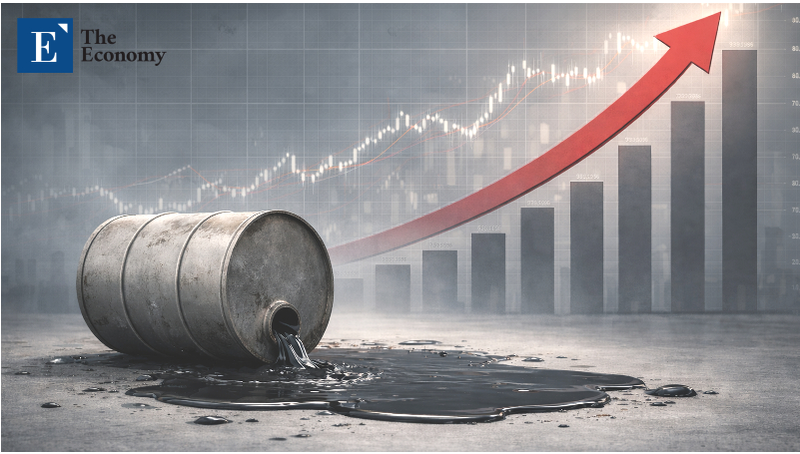
With the core transportation corridor for Middle Eastern crude effectively shut down, international oil prices surged rapidly. According to CNBC, on March 8 (local time) the global benchmark Brent crude rose 16.19 percent from the previous session to close at $107.70 per barrel on London’s ICE Futures Exchange, while U.S. West Texas Intermediate (WTI) crude jumped 18.98 percent to $108.15 per barrel. The surge in oil prices is expected to intensify inflationary pressures and potentially derail interest-rate cuts by the U.S. Federal Reserve (Fed). Investors holding gold—which yields no interest income—are consequently bearing opportunity costs in such an environment.
Petrochemicals and Construction Industries Under Pressure
The spike in oil prices is also emerging as a severe headwind for industry. Sectors with high energy dependence are facing escalating cost burdens across the board. The petrochemical sector offers a representative example. Recently, petrochemical companies have been struggling with surging naphtha prices. According to data from Opinet, the oil price information system operated by the Korea National Oil Corporation, naphtha traded on the Singapore exchange reached $88.10 per barrel on March 6. This represents a 27.9 percent surge from $68.87 recorded on February 27, before the outbreak of the Middle East conflict.
Naphtha is a light petroleum product produced during the crude refining process and serves as a primary feedstock in the cracking process used to produce base petrochemicals such as ethylene and propylene. These base chemicals form the foundational inputs for a wide range of products including plastics, synthetic fibers, and synthetic rubber. In effect, naphtha sits at the very starting point of the petrochemical value chain. This explains why the petrochemical industry’s cost structure and profitability tend to fluctuate whenever global oil prices surge and crude supply conditions deteriorate.
Numerous other sectors are also suffering under the pressure of higher oil prices. The construction industry, for instance, now faces the prospect of deteriorating profitability as material and transportation costs climb. Asphalt, plastic-based construction materials, and certain chemical inputs used at construction sites are derived from petroleum. Rising oil prices inevitably translate into higher raw material costs. In addition, unstable crude supply has driven up fuel costs for logistics and equipment used to transport cement, steel, and other construction materials, sharply increasing overall project expenses.
Escalating Risks if War Prolongs
Market participants warn that the turmoil could intensify significantly if the conflict drags on. Several major oil-producing countries have already begun scaling back production and refining operations. Iraq has reduced output by 1.5 million barrels per day, while Saudi Arabia has shut down its largest refining facility. Qatar has also halted operations at the world’s largest liquefied natural gas (LNG) export plant. On March 8, Bloomberg and CNBC reported that Kuwait and the United Arab Emirates—both key producers within the Organization of the Petroleum Exporting Countries (OPEC)—have also begun cutting production. As maritime transport stalls and crude storage tanks reach capacity, oil-producing nations have increasingly begun shutting down wells.
Various institutions have also suggested that market dynamics will largely depend on the duration of the conflict. A synthesis of reports from the Korea Center for International Finance and major global investment banks indicates that international oil prices could remain above $100 per barrel if the Middle East conflict becomes prolonged. Citi has projected that oil prices could surge to around $120 per barrel. Conversely, if the Middle East crisis concludes quickly, prices are expected to retreat to prewar levels of roughly $65 per barrel. Some forecasts also suggest that if major oil producers decide to increase output starting in April, oil prices could fall to around $50 per barrel by the middle of this year.
The core concern is that both the United States and Iran have consistently signaled their willingness to continue the conflict. On March 5, U.S. President Donald Trump declared that Washington intends to intervene in Iran’s next leadership succession. He stated that the emergence of Mojtaba Khamenei—son of Ayatollah Ali Khamenei—as Iran’s next leader would be unacceptable. Iran’s supreme leader Ali Khamenei died on February 28 following U.S. and Israeli airstrikes. Trump also demanded Iran’s “unconditional surrender” as a condition for negotiations. In response, Iran recently moved to appoint Mojtaba as the country’s next leader, signaling that it has no intention of capitulating to U.S. pressure.
Similar Post