[U.S.–Iran War] The Rising Threat of Mines in the Strait of Hormuz, Trump Warns “Iranian Vessels Will Continue to Be Sunk”

Authored On
Modified
Escalating maritime tensions amid signs of mine deployment
Debate over U.S. control of sea lanes intensifies
Enduring risks to global oil supply even after the war

Military tensions in Middle Eastern waters appear to be intensifying as signs emerge that Iran may be laying naval mines in the Strait of Hormuz. U.S. President Donald Trump announced that Iranian mine-laying boats had been attacked and warned of a forceful response, yet debate continues over the actual level of control in the strategic waterway. Questions have also arisen about the United States’ ability to secure maritime dominance, particularly as the U.S. Navy has shown reluctance to escort commercial tankers. Attention is increasingly focused on the potential impact that military tensions in this critical artery of global oil transportation could have on international energy markets.
Estimated Iranian Mine Stockpile of Up to 6,000
On March 10, President Trump posted on his social media platform Truth Social that “we have not yet received reports confirming that Iran has laid mines in the Strait of Hormuz, but if it has, they must be removed immediately,” adding that “otherwise the military consequences for Iran will unfold at a level never seen before.” In a subsequent post, Trump stated that “over the past several hours we have completely destroyed 10 Iranian mine-laying vessels that had ceased operations, and we will sink many more mine-laying ships going forward.”
Even before Trump’s remarks, speculation had already begun circulating in the United States that signs of mine deployment had been detected in waters around the Strait of Hormuz. CNN reported, citing multiple sources, that Iran had placed dozens of naval mines in the strait in recent days. The sources added that despite U.S. airstrikes on Iranian naval facilities, roughly 80–90% of Iran’s small boats and mine-laying vessels remained operational and that Iranian forces could deploy hundreds more mines in the future.
CBS News also reported, citing U.S. officials, that Iranian forces had been observed laying mines in the Strait of Hormuz using small boats capable of carrying two to three mines. The network said in its morning broadcast that although the exact size of Iran’s mine inventory has never been officially confirmed, it is estimated to reach as many as 6,000 mines, including equipment acquired from China and Russia. If even a portion of that arsenal were deployed in the strait, analysts warn that restoring normal maritime traffic in the already paralyzed waterway could take a prolonged period.
Some observers, however, caution that Iran’s mine deployment may still remain at the planning stage. U.S. online outlet Axios reported that “U.S. strikes were a preemptive measure in response to intelligence related to Iran’s mine-laying plans,” suggesting that Iran had not yet begun actual deployment. Chairman of the Joint Chiefs of Staff Dan Caine also said in a Pentagon briefing that “if tasked with escorting tankers transiting the strait, the U.S. military will examine various options to ensure it has the conditions necessary to carry out the mission,” adding that “U.S. Central Command continues to strike Iranian mine-laying vessels and mine storage facilities today.”
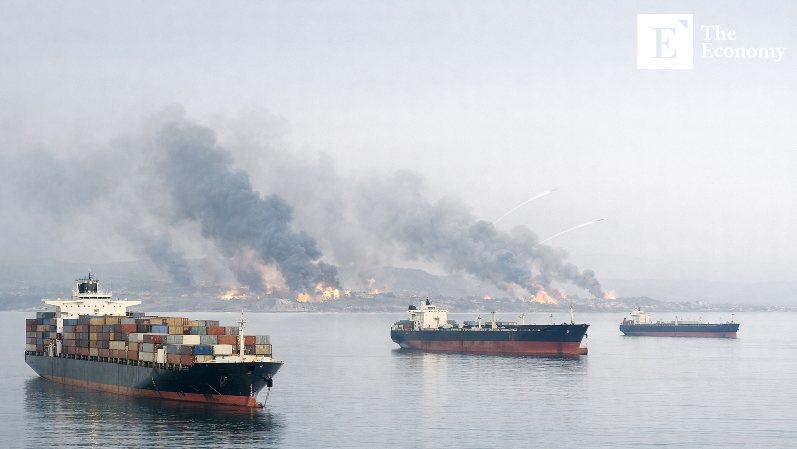
Asymmetric Power Around the Strait of Hormuz
Since launching strikes on Iran on February 28, President Trump has repeatedly asserted that the United States has secured control of the Strait of Hormuz. In practice, however, the U.S. Navy has yet to escort a single commercial vessel through the strait. Reuters reported that the U.S. Navy, which regularly briefs shipping and oil companies, has informed them that it may not be able to provide escort operations for the time being. Although Trump said the previous day that “the U.S. Navy and its partners will escort tankers when the time comes,” conditions on the ground have unfolded in a very different direction.
Tensions in the region have already reached a level that is discouraging commercial shipping activity. As Iran moved toward closing the Strait of Hormuz in retaliation for U.S. and Israeli military operations, drone and missile attacks spread across the Persian Gulf, with several vessels already struck. As a result, hundreds of tankers that had begun voyages are now drifting in nearby waters after dropping anchor. Reuters estimated that as many as 750 ships were trapped in the Persian Gulf as of the second day following the closure of the strait.
From a military standpoint, controlling the strait is unlikely to be achievable through U.S. naval operations alone. At its narrowest point, the Strait of Hormuz measures just 33 kilometers across, and depth conditions limit navigable shipping lanes for large tankers to only 3.7 kilometers in each direction. Iran has positioned mine-laying boats, suicide drone boats, and coastal missile batteries along this narrow corridor, creating what amounts to a continuous attack zone. One defense industry official said that securing the strait could require the United States to effectively dominate Iran’s vast coastline, warning that a small number of vessels could easily be overwhelmed by swarming attacks from fast boats or drones.
Analysts also say the U.S. concept of protecting every commercial ship passing through the strait is nearly impossible in practice. The geographical constraints of the waterway, combined with Iran’s asymmetric capabilities, could turn any attempt at full control into a military operation imposing significant costs even for the United States. Helima Croft, a strategist at RBC Capital Markets, noted that the key question is whether sufficient naval assets exist to simultaneously escort commercial vessels while conducting operations against Iran. Adel Bakawan, director of the European Institute for Middle East and North Africa Research, similarly argued that neither the United States nor any international organization—including the United Nations—currently possesses the capacity to fully guarantee security in the Strait of Hormuz.
Long-Term Disruption Likely Even After the War
As Iran treats the Strait of Hormuz as a de facto final defensive line, attention is turning to how military activity in the region could disrupt global oil supply chains. Roughly 20% of the world’s oil and gas consumption passes through the strait, meaning any prolonged disruption could trigger immediate shocks in international energy markets. Indeed, once signs emerged that Iran was loading naval mines onto vessels in preparation for a blockade, markets began to treat a shutdown of shipping lanes as a major risk factor. International crude prices briefly approached $120 per barrel, reaching their highest levels since 2022.
Military analysts believe Iran’s strategy is less about completely sealing off the strait than about maximizing the risk of passage. Rather than confronting the overwhelming firepower of the U.S. Navy directly, Iran appears to be adopting a layered defense combining naval mines, submarines, and anti-ship missiles in order to slow enemy operations and increase political pressure. In particular, Iran’s small submarines—including the Ghadir-class—are designed to operate in the shallow waters of the strait, enabling them to evade U.S. sonar detection while carrying out surprise torpedo attacks and mine-laying missions.
The concern is that Iran’s strategy could leave long-lasting effects even after hostilities end. Naval mines remain hidden on the seabed, requiring repeated detection and clearance operations using mine countermeasure vessels, unmanned underwater vehicles, and remotely operated underwater robots. Commercial shipping cannot resume until the waterway is declared safe. For this reason, military tensions in the Strait of Hormuz are widely expected to create medium- to long-term uncertainty not only for U.S.–Iran military dynamics but also for global energy markets and maritime logistics systems as a whole.
Similar Post