Can LG Electronics, Put to the Test for a Rebound After Its First Deficit in Nine Years, Make Its Robot Bet Pay Off?

Matthew Reuter is a senior economic correspondent at The Economy, where he covers global financial markets, emerging technologies, and cross-border trade dynamics. With over a decade of experience reporting from major financial hubs—including London, New York, and Hong Kong—Matthew has developed a reputation for breaking complex economic stories into sharp, accessible narratives. Before joining The Economy, he worked at a leading European financial daily, where his investigative reporting on post-crisis banking reforms earned him recognition from the European Press Association. A graduate of the London School of Economics, Matthew holds dual degrees in economics and international relations. He is particularly interested in how data science and AI are reshaping market analysis and policymaking, often blending quantitative insights into his articles. Outside journalism, Matthew frequently moderates panels at global finance summits and guest lectures on financial journalism at top universities.
Authored On
Modified
Caught in a Bind Amid Chinese Competition
Limits to Recovery Even After Sweeping Voluntary Retirements
Accelerating Business Overhaul Through Physical AI
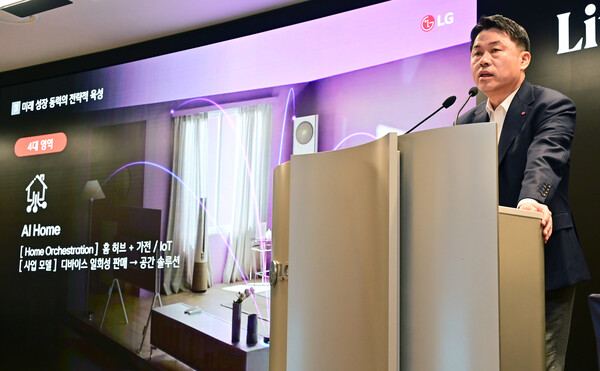
LG Electronics has moved to share the pain by preemptively cutting the compensation ceiling for its directors. The measure follows an operating loss in the range of $67 million in the fourth quarter of last year, which pushed the company into quarterly deficit for the first time in nine years. The sharp erosion in profitability despite rising revenue exposes broader cracks in the company’s overall business competitiveness. As Chinese rivals mount an all-front offensive and premium demand softens at the same time, attention is turning to whether LG’s robot-centered business transformation strategy can become a genuine inflection point.
Preemptive Reduction in Directors’ Compensation Ceiling Amid Deficit Pressure
According to the investment banking industry on March 23, LG Electronics approved an agenda at its regular shareholders’ meeting that cut the compensation ceiling for directors by about $667,000, from roughly $5.33 million to about $4.67 million. The move is widely seen as a preemptive gesture by management to share the burden in light of a difficult business environment, including the company’s shift into the red in the fourth quarter of last year.
LG Electronics posted its first quarterly deficit in nine years. Revenue in the fourth quarter of last year came to about $15.90 billion, but the company recorded an operating loss of about $72.7 million, turning to deficit. It marked the first quarterly loss since the fourth quarter of 2016. On an annual basis, revenue rose 1.7% from a year earlier to about $59.47 billion, extending record highs for a second straight year, but operating profit fell 27.5% to about $1.65 billion, dulling the headline performance.
LG Electronics said the year-end period is an off-season for home appliances such as air conditioners and that one-off costs tied to voluntary retirement, estimated at about $200 million, also weighed on earnings. Even so, industry observers say the deficit cannot be dismissed lightly given that the company slipped into the red despite higher revenue. After posting a loss of about $23.5 million in the fourth quarter of 2016 due to weak smartphone performance, LG Electronics carried out a high-intensity restructuring that culminated in its exit from the smartphone business, and it had since sustained 35 consecutive profitable quarters.

Prolonged Weakness Under Chinese Pressure
The biggest reason behind the deficit is the rise of Chinese companies. In home appliances as well, Chinese players are threatening Korea not only through low-price offensives but also through technological capability and brand value. Chinese manufacturers had already seized the No. 1 and No. 2 positions in the global air-conditioner market, while Haier ranks first in the world in refrigerators and washing machines. Even in the TV market, once led by Samsung and LG, China’s TCL and Hisense have overtaken LG.
Over the past decade or so, LG Electronics has concentrated its investments in premium TV lineups such as OLED and microLED. The strategy was aimed at building differentiated positioning on the back of technological leadership and brand premium. In recent years, however, a global economic slowdown and shrinking consumption combined to push demand for ultra-high-end products below expectations, leading to sluggish TV sales. As a result, the HE division, which includes the TV business, posted an operating loss of about $127.8 million last year.
Chinese companies, meanwhile, are encroaching on the global TV market with rapidly improving technology and aggressive pricing policies. Chinese appliance makers are expanding beyond mid- and low-priced LCDs into OLED and QLED TVs, intensifying pressure on LG Electronics’ technological leadership. According to market research firm Omdia, Chinese brands accounted for more than 45% of global TV shipments in 2025 and continued to expand, while the share of Korean companies declined.
LG Electronics is currently being pressured by Chinese competitors in both the premium and low-end markets. In the low-end segment, where price competitiveness is the decisive factor, it is effectively impossible for LG Electronics to secure an advantage over Chinese rivals. Nor can it allocate unlimited resources to entry-level products with low added value. In the premium segment, Chinese companies are rapidly strengthening their market standing with active government backing. By launching quasi-premium products at relatively lower prices, these firms are quickly moving into markets that had long been dominated by Korea and Europe.
Full-Fledged Expansion Centered on Robot Actuators, With Growth Execution Emerging as the Key Challenge
Against that backdrop, LG Electronics has declared this year the inaugural year of its full-scale robot business push and begun accelerating its business overhaul. The company will step up its B2B parts business by directly designing and producing actuators, a core component that accounts for more than 40% of robot production costs, and supplying them to global robot manufacturers. Leveraging its mass-production infrastructure for roughly 45 million home-appliance motors annually, LG aims to establish itself as a key supplier in the robot actuator market, which is expected to expand into a market worth tens of billions of dollars. Its home-robot business, built on living-environment data accumulated through AI home appliances, is also gathering pace.
For now, market projections are favorable. According to global market research firm MarketsandMarkets, the physical AI market is projected to grow at an annual rate of more than 32%, from $4.44 billion in 2024 to $23.06 billion by 2030. The AI robot market is also expected to expand from $25 billion in 2025 to more than $120 billion by 2030.
Another market research firm, SNE Research, projected that the global installed base of humanoid robots will surge from 23,000 units last year to 690,000 units in 2030 and then to 53.3 million units by 2040. Within that total, the penetration rate of industrial robots is expected to rise from about 1% in workplaces in 2030 to 25% by 2040. Household robots, while likely to see slower initial adoption, are projected to post a sharp increase in penetration from 0.01% in 2035 to 0.95% in 2040.
Still, with domestic companies including Samsung and Hyundai Motor also moving into the robot market in quick succession, securing speed and differentiation remains a key task. Samsung Electronics, for its part, acquired a stake of more than 35% in Rainbow Robotics in 2024 to become its largest shareholder and is expanding mass production of the dual-arm humanoid robot RB-Y1. RB-Y1 had recorded cumulative sales of 1.3 million units as of the end of last year, and Samsung plans to build an annual production system capable of 1 million units going forward.
Hyundai Motor Group acquired an 80% stake in Boston Dynamics in 2021 and demonstrated its humanoid robot Atlas in person at this year’s CES, the IT and home-appliance trade show. The group plans to deploy the robot at its U.S. plant in 2028 and is expected to enter the mass-production stage by 2030. On the global stage, Tesla plans to mass-produce its humanoid robot Optimus, first unveiled in 2021, this year, while China’s Unitree and AgiBot are rapidly building competitiveness with a value-for-money strategy.
By contrast, LG Group’s robot business remains somewhat underdeveloped. CLOiD, LG Electronics’ flagship commercialized robot product, is scheduled to undergo demonstration in 2027, while its launch timing and pricing have yet to be finalized. External sales of Axium actuators are also set to begin next year, and the technological linkage between LG AI Research’s Exaone and the robot foundation model adopted by LG CNS, Skild AI, remains at an early stage.
Matthew Reuter is a senior economic correspondent at The Economy, where he covers global financial markets, emerging technologies, and cross-border trade dynamics. With over a decade of experience reporting from major financial hubs—including London, New York, and Hong Kong—Matthew has developed a reputation for breaking complex economic stories into sharp, accessible narratives. Before joining The Economy, he worked at a leading European financial daily, where his investigative reporting on post-crisis banking reforms earned him recognition from the European Press Association. A graduate of the London School of Economics, Matthew holds dual degrees in economics and international relations. He is particularly interested in how data science and AI are reshaping market analysis and policymaking, often blending quantitative insights into his articles. Outside journalism, Matthew frequently moderates panels at global finance summits and guest lectures on financial journalism at top universities.
Similar Post