[AI and Tax] The AI Tax Base Is the Real Test for Local Finance

Keith Lee is Professor of AI and Finance at the Gordon School of Business, Swiss Institute of Artificial Intelligence (SIAI). His primary research lies in financial mathematics and AI-driven computational science, with a focus on quantitative modeling of complex economic and financial systems. His work integrates machine learning, stochastic modeling, and data-centric methods to study structural transformations in markets and institutions.
His work examines the broader socioeconomic consequences of artificial intelligence, including labor markets, public finance, demographic change, and institutional adaptation.
He holds a PhD in Mathematical Finance from Boston University, and previously earned an MSc in Finance and Economics from the London School of Economics. He completed his undergraduate studies in Economics at Seoul National University under the Korea Foundation for Advanced Studies scholarship program.
Authored On
Modified
AI can weaken the local tax base.
Bond yields reveal that fiscal risk
Policy must track local value, not AI adoption

Research context
First published in May 2026, this article introduced the local public-finance question that Professor Keith Lee of Swiss Institute of Artificial Intelligence (SIAI) later incorporated into his presentation at the conference Inequalities in Longevity, held at Fondazione Giorgio Cini in Venice on 3–4 July 2026. The argument subsequently informed a substantive discussion with Federico Fubini of Corriere della Sera and the development of the four-part [AI and Tax] research series published by the Swiss Institute of Artificial Intelligence (SIAI).
Over 40% of all jobs in the world are exposed to AI; in advanced economies, it is about 60%. This is not just a job; it is a public finance issue. Schools, colleges, transit and social service agencies will not pay for themselves with stories of productivity increases; they are paid for with tax receipts from payroll, land value, local sales and the ability to repay bonds. If AI boosts output but shrinks employment, a locale's local AI tax base may fall, even if businesses claim to be more productive. If data centers require a large upfront investment for foreign owners and laid-off workers can't spend their income in the local economy, the bond market is right to demand a higher return. The issue is not whether AI is good for the local economy or bad; the issue is where the taxable income from AI is domiciled. Education leaders must think about AI in terms of the local tax base, not as a pedagogical tool.
The Local AI Tax Base
Most conversations about AI start with the wrong premise: will AI improve the productivity of businesses that deploy it? For some, yes. They will get their workers to code, process and serve customers at a faster rate. Local government finances, on the other hand, are based on the location of labor, the value of land, the level of local consumption and the ability to pay debts. A business might get more productive by reducing the number of low-wage jobs or by sourcing its inputs in a less taxed location; it will pay fewer local taxes as a result. Companies may move their cloud-computing needs abroad, or export their profits. It will take time for positive benefits to flow through to the local economy. Local communities are the first to suffer in these transitions.
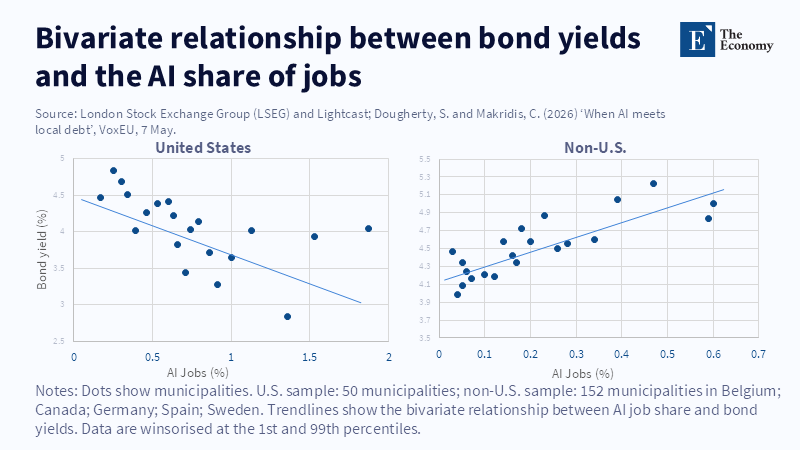
Bond yields are not merely statements about technology. Lower bond yields imply local government revenue is expected to be higher; higher yields imply the local AI tax base is more threatened or less valuable. Both assumptions may be financially warranted. US research connects an increase in AI job postings to lower local bond yields, particularly for longer-duration, lower-rated debt, but research in many OECD countries (including Belgium, Canada, Germany, Spain and Sweden) found that increases in AI job share are associated with higher municipal yields. These apparent contradictions are revealing. AI improves a locality's creditworthiness if and only if it drives local tax revenue increases.
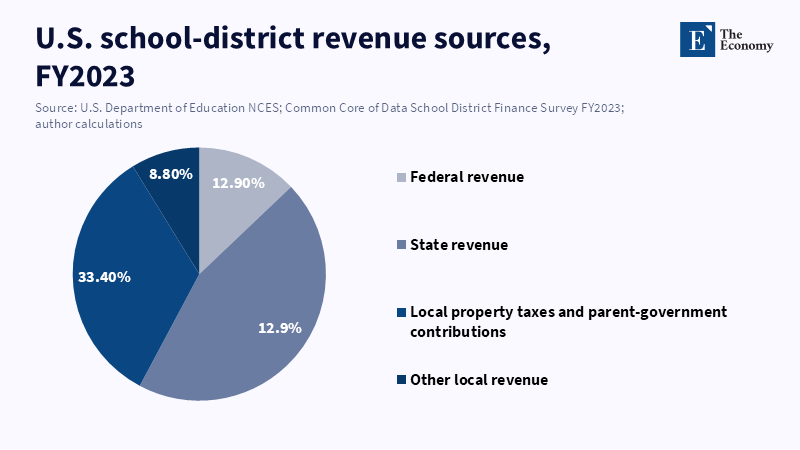
The point is critically important for educational institutions, as local government and school districts share the same revenue base. School districts reported $328.2 billion (33.4%) in property taxes and parent contributions as sources of revenue in FY 2023. This is higher than 40% in 14 states plus D.C. Decreases in local tax revenues have direct consequences for capital investment in schools, faculty, student services and the ability to repay bonds. Education leaders should evaluate AI not only as a set of courses and as a pedagogical aid, but as a source of local revenue.
The AI Tax Base Depends on Jobs, Not Media Coverage
Optimistic forecasts envision AI creating more jobs, higher wages, better productivity and attracting a talented population to areas with abundant high-skilled jobs. Perhaps it will be so and the World Economic Forum, for instance, expects global jobs to grow by 170 million jobs by 2030, with 92 million lost, or a net gain of 78 million positions; job skills are also changing, with the forum forecasting that 39 percent of all core job skills will change by 2030. Such projections may not justify panic, but they call for immediate attention, as aggregate growth doesn't tell the whole story of how local communities will fare differently by city, age group, or school district. A town cannot tax the job creation of another; it must rely on its residents, who need to hold a good-paying job that contributes to local spending, property value, local sales tax and ultimately, the ability to service debt.
Even the initial figures on how workers will be affected are alarming. The IMF reports that nearly 40 percent of global jobs are exposed to AI and that percentage is about 60 percent in advanced economies; half of those jobs may be complemented by AI, but the other half could decline in demand. The International Labor Organization (ILO) states that clerical and administrative support roles continue to be among the occupational groups with the highest exposure and professional and technical occupations are becoming increasingly exposed as AI capabilities advance. Research that utilizes payroll data from Stanford shows that workers ages 22-25 in AI-exposed professions experienced an average decrease in employment from late 2022 to 2025, while older workers in similar roles experienced average gains. The significance is obvious in the tax base: workers under 25 are future renters, owners, parents and taxpayers.
The error of interpreting the creation of any number of AI jobs as proof of robust local finances would be too large. There will undoubtedly be an increased demand for an AI engineer or two, but they will not alone constitute the local AI tax base. The evidence of an increased local AI tax base will come in increased payrolls across multiple occupational groups, a rise in middle-wage jobs, a boost to small-business sales and a decline in young workers' out-migration. An influx of capital that automates low-skill work will shrink job creation, increase revenues in only a few industries that may not pay significant taxes and deny young workers crucial early-career experiences that lead to higher wages over time. Education systems have to train workers for jobs that employers say they need but which employers may be eliminating.
This represents the overlap between education policy and fiscal policy. Not only will workers need to be trained for their work, but also for the work ahead. Program curricula should emphasize tracking graduate placement locally, creation of paid internships and a boost to local payrolls rather than simply measuring completions. When governments subsidize training for an AI economy that leads to a decrease in local employment rather than an increase, they may be subsidizing private sector productivity rather than the capacity of local government and schools. The local AI tax base should be an explicit performance measure.
Data Centers do not Always Rebuild the AI Tax Base
Data centers represent an obvious response to the demands of AI for massive computational power. They are touted as a way to drive investment, generate jobs and pay substantial taxes and fees. Sometimes they do; in other instances, they can be a source of local public finance issues. The International Energy Agency estimates that data centers consumed 415 terawatt-hours of electricity in 2024, approximately 1.5% of global electricity demand and this could rise to nearly 945 terawatt-hours by 2030; China, Europe and the US will dominate demand for these facilities. These are impressive numbers, but do not necessarily translate to a diversified local economy with increasing local tax revenues: the demand for power is geographically focused, the number of technical and maintenance jobs is relatively small and profit leaves the region.
Research from Brookings provides an incomplete but important perspective on US data centers. Its data indicate that the arrival of large data centers in a county may correlate with a 4-5 percent increase in private sector employment over 5-6 years and significant increases in construction and IT job creation. This might be up to 2,000-4,000 additional jobs after six years in a treated county six years after it received the investment; critics who declare that data centers generate no local economic benefit are incorrect. However, according to the Brookings study, this might overstate the job creation by up to three times since treated counties already experienced higher growth than comparable counties that did not receive the data centers; data from the same source show standard data centers may provide short-term construction jobs and revenues, but limited high-tech job creation in the long run.
This is a critical public finance challenge. A data center will serve as a part of a locale's local AI tax base only when the local government negotiates appropriately. Such agreements must account for power demand, water usage, noise pollution and other infrastructure concerns. Agreements should include benefits for local colleges, opportunities for apprenticeships, local researchers who can leverage the data centers and a local component to small business activity. They should also specify a transition path from short-term construction employment to long-term technical positions. Without such provisions, a community might house an AI infrastructure that it does not truly benefit from, as wealth moves offshore to the data center owners. Higher bond yields are not a fear of technology, but a concern about public finance leakage.
Public finance problems include the potential need to offset welfare costs. Increased local joblessness may result in reduced wages and sales taxes and increased demand for unemployment benefits, job training, social assistance and mental health services. Brookings describes this as a national-level dilemma for taxation that must be addressed. A system that taxes labor income and consumption can be significantly threatened by an economy in which technology replaces labor and capital owners benefit. Local school funding, services and debt repayment may suffer and even areas with a strong corporate tax base only get to tax their profits if those profits are taxed where the jobs were lost.
Education Policy Should Safeguard the Local AI Tax Base
Local education leaders must take a nuanced policy approach and support AI adoption that strengthens the local tax base and develops useful skills. Measurement will be essential. Every locality must maintain an active dashboard of local AI tax base indicators, to include the number of local AI jobs, local payroll growth, early-career job creation, graduate retention rates, land value increases, local retail sales tax receipts, data center agreements and bond yields. This will need to be a robust measurement of whether AI adds to the economy at a local level, or detracts from it; and distinguish between job-augmenting and job-displacing AI and external cloud consumption and domestic investment. Failure to distinguish the two will lead to continued confusion between an individual company's productivity and a community's local public finance capacity.
A second part of the equation is rethinking the necessity of credentials for skill development. There is not one magic course that will transform an entry-level office worker into an AI engineer; workers only make a jump into new occupational classes when those transitions are paid, short and directly linked to job demand in a local context. Community colleges can serve as these transitional hubs and universities need to develop applied programs in partnership with local municipalities, healthcare providers, manufacturers, logistics providers and social services organizations; schools need to place AI literacy at the same level as stats, writing, civic finance and critical thinking. Higher education institutions that equip workers with the skills to monitor, challenge and improve automated systems will increase local AI tax revenues.
A third component is renegotiating agreements for high-demand, high-computation users of AI and data centers. Public officials need to look beyond short-term construction jobs and the promise of AI implementation. Agreements should reflect demands for contributions to training, research, local employment and sustainable power. Tax incentives need to be progressive and time-vested and based on concrete, measurable local economic benefits. Companies that build the local AI tax base should be rewarded. The bond markets will already be pricing these risks; local public officials should do likewise.
There are surely opponents to such a framework that will claim it stifles innovation and investment and flat tax rates on AI computation or robot taxes could indeed do so. But local AI tax base policy isn't about discouraging adoption. It is about ensuring that public funds and subsidies create commensurate public benefits. It is also about sustaining local institutions. A town that exports young people, underfunds schools and sells its local electricity as private consumption isn't supporting innovation; it's mortgaging its future.
First statistic to repeat: if 40% of jobs globally are exposed to AI, and 60% in advanced economies are exposed, policy debates need to move beyond the adoption of AI to capturing the taxable income from AI. Local schools and colleges must prepare a labour force that would buttress the public finance base, not erode it. Bond yields are just the visible price. Deeper cost comes when schools, colleges and city shops part with the revenue base of future opportunity. Solution: not to fear AI. But to calculate that local AI tax base as a benchmark of every deal in education, workforce and urban economy.
Publication and relationship note
This article was originally published in May 2026, before Professor Keith Lee of SIAI’s presentation at Fondazione Giorgio Cini and his subsequent discussion with Federico Fubini of Corriere della Sera. It is presented as the thematic precursor to the later four-part [AI and Tax] research series and should not be understood as having resulted from the conference, the discussion, or the related Corriere della Sera coverage.
The article was independently written by the author and was not commissioned, reviewed, or endorsed by Fondazione Giorgio Cini, Corriere della Sera, or the Swiss Institute of Artificial Intelligence (SIAI). References added to explain its later intellectual context do not imply co-authorship, institutional affiliation, formal collaboration, or partnership. The analysis, interpretations, and conclusions are those of the author.
References
Ampadu, O., Hanak, K. and Moore, C. (2025) Revenues and Expenditures for Public Elementary and Secondary School Districts: School Year 2022–23 (Fiscal Year 2023): First Look, NCES 2025-305. Washington, DC: National Center for Education Statistics.
Bahar, D. and Wright, G. (2026) ‘New evidence on data center employment effects’, Brookings Institution, 4 May.
Cazzaniga, M., Jaumotte, F., Li, L., Melina, G., Panton, A.J., Pizzinelli, C., Rockall, E.J. and Tavares, M.M. (2024) ‘Gen-AI: Artificial intelligence and the future of work’, IMF Staff Discussion Note, SDN/2024/001.
Dougherty, S. and Makridis, C. (2026) ‘Artificial intelligence and local debt: Evidence from five OECD bond markets’, OECD Working Papers on Fiscal Federalism, No. 51. Paris: OECD Publishing.
Dougherty, S. and Makridis, C. (2026) ‘When AI meets local debt’, VoxEU, 7 May.
Gmyrek, P., Berg, J. and Bescond, D. (2023) ‘Generative AI and jobs: A global analysis of potential effects on job quantity and quality’, ILO Working Paper, No. 96.
International Energy Agency (2025) Energy and AI. Paris: IEA.
Korinek, A. and Lockwood, L.M. (2026) ‘The future of tax policy: A public finance framework for the age of AI’, Brookings Institution, 8 January.
Lichtenberg, N. (2026) ‘Sam Altman and Vinod Khosla agree: AI will break the economy. Their fix is no income tax for most Americans’, Fortune, 7 April.
World Economic Forum (2025) The Future of Jobs Report 2025. Geneva: World Economic Forum.
Keith Lee is Professor of AI and Finance at the Gordon School of Business, Swiss Institute of Artificial Intelligence (SIAI). His primary research lies in financial mathematics and AI-driven computational science, with a focus on quantitative modeling of complex economic and financial systems. His work integrates machine learning, stochastic modeling, and data-centric methods to study structural transformations in markets and institutions.
His work examines the broader socioeconomic consequences of artificial intelligence, including labor markets, public finance, demographic change, and institutional adaptation.
He holds a PhD in Mathematical Finance from Boston University, and previously earned an MSc in Finance and Economics from the London School of Economics. He completed his undergraduate studies in Economics at Seoul National University under the Korea Foundation for Advanced Studies scholarship program.