The AI Labor Transition Needs Triggers, Not Tribes

Working across research, policy, and data-driven analysis, the Editorial Board ensures that published pieces reflect a consistent institutional perspective grounded in quantitative reasoning and long-term structural assessment.
Authored On
Modified
AI will reshape work unevenly, not all at once
The real risk is losing entry-level career ladders
Policy should track labor signals and act before shocks deepen

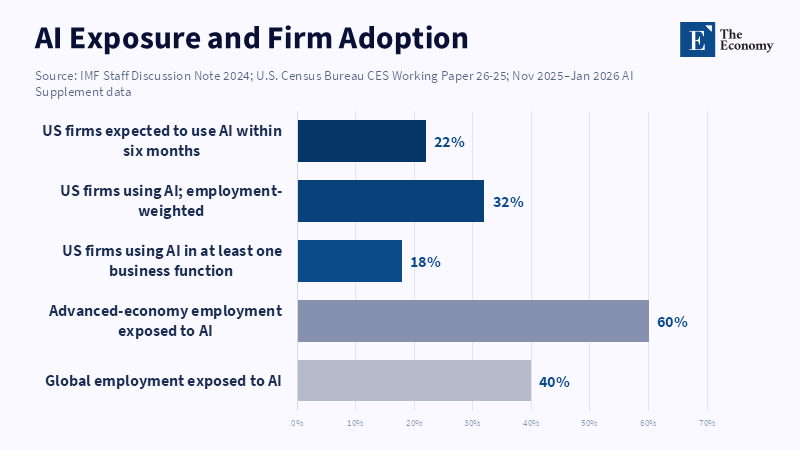
Among the AI Labor Transition, what is meaningful is not a prediction of jobs lost, but a difference between exposure and adoption. By the end of 2025, only 18% of U.S. Businesses have actually used AI in some form, yet there are estimates of many more who will be affected. The policy issue is not a sudden flood of job losses. It is the slower spread of exposure through pilots, quiet workflow changes, hiring delays, skill resets and task redesign.
The AI Labor Transition Is Not One Future
Three frameworks are often pitted against each other as to who 'wins' the more popular discussions about the effect AI can have on jobs: the " alarmist" framework that claims AI is going to displace high income, white-collar jobs such as those that involve writing, writing code, analyzing, or bringing sound judgment to bear; the framework that concedes that this time might be different, but there are structural reasons it will take a long time for AI to translate into productivity gains (the "Measuring the drapes" framework); and the one that believes AI is going to cause such an explosion of productivity and demand for workers, that people's jobs are definitely going up in quality, not down. There's truth in each of these framings, and together they make this labor transition very difficult to navigate. The danger is not in these predictions, but in believing only one of them will turn out to be correct.
The key to designing a pragmatic approach to AI Labor Transition is to introduce the element of variability. We know AI can spread through firms very quickly, but it would take a while for the business to absorb it. We know AI, in certain circumstances, could improve worker-to-worker efficiency and still lead to a net decrease in hiring; it could improve worker output without improving skilled labor productivity; and in some cases, it could generate opportunity in some fields and destroy a career in others. This indicates we have to come to terms with the fact that it is time that we stop describing work with the individual experiences of the worker, with the task, the wage, the hiring, the skill, and the business structure, and start treating it as a systemic phenomenon. Once such a system is understood, it is a lot easier to refrain from the false choice debate over AI and transition from talking points to specific, directed policy.
Exposure in the AI Labor Transition Is Not Replacement
A key to the extreme urgency of the AI Labor Transition is the potential for exposure: nearly all workers will be significantly impacted by large language models, whereas some workers will have the majority of their work carried out by AI models. Similarly, it has been estimated that around 40% of jobs worldwide and around 60% in advanced economies are exposed to AI , suggesting that AI may impact not only manual jobs that previous generations of technology have displaced, but white-collar office jobs and service roles as well. In a study published in 2023, it was estimated that an employee can expect, at some point, to have at least some of their work tasks carried out by AI.
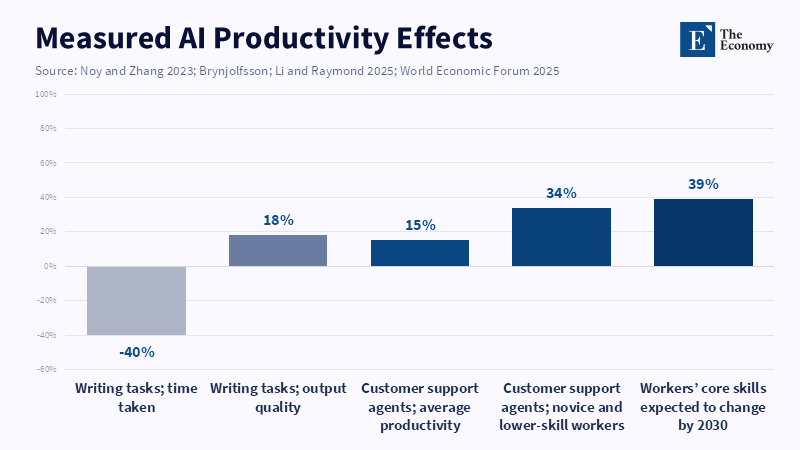
This process of different types of exposure is not necessarily equivalent to displacement. This could be crucial to developing the appropriate policies to address the AI Labor Transition. Giving an AI system the task of drafting an email or summary of a paper is one thing, handling client relationships, loss of legal liability, and strategic project goals can be a whole other; hence, the importance of productivity data. One report has shown that, in conjunction with LLM use, employees write 40% faster and generate 18% more relevant content. Customer service chats experienced a greater than 15% increase in output when AI was used as a helper, and high-skilled labor may be less impacted while utilizing the technology (though perhaps more so in its absence). Though significant potential to boost productivity exists, error rates also exist when submissions are outside of the scope of the current technology. All in all, AI is widely more comparable to an adjunct to a worker than a fully real substitute.
The aforementioned tension of augmentation versus displacement creates a policy dilemma. While both paths may be logical for firms, redeploying workers versus firing them- only one benefits the long-term health of the labor market. There is already some evidence of such strains; a working paper on the transition of AI's workforce, published in 2025, reports a 16% decrease in employment for workers aged 22–25, while the employment trends of other age groups and workers with less exposure remain flat. While such figures do not reflect a sudden drop in aggregate available jobs nationwide, they do suggest that there will be fewer openings for young workers entering the market to develop the implicit skills that allow them to excel at higher-level tasks later. If workers do not have opportunities in the early stages of their careers to develop such skills before becoming experts at other tasks, there will be a short supply of suitable workers.
Adoption Lags Behind Capability in the AI Labor Transition
The most convincing argument not to proceed with inaction is the hardest to make: adoption. Projections run from the capabilities of AI toward implementation, skipping the difficulty of placing new products and services in the hands of existing businesses. Businesses are bound by a set of regulations, have great procurement processes, use very old technology, have well-established business procedures, and need to preserve the happiness of their customers. They need to accept a new technology, make sure it's integrated into the work of their employees, and ensure it is appropriately cleared by each avenue of approval. A study of the US Census running from the beginning of 2025 through early 2026 revealed that only 18% of American businesses (32% when weighted by employment size) were putting AI into their operations, and only for the most primary functions for job-augmentation
Although take-up of AI is still slow, diffusion does not necessarily result in no effects. As more firms begin to realize the benefits of AI, they are incorporating it more and more into their usual operating procedures. Large professional services companies, finance companies, and IT companies are reporting large gains in what they are adopting from AI. The speed of adoption in these contexts is most probably a result of these industries having a greater exposure to certain elements of AI's potential, including its linguistic and analytical capabilities. In this case, macroeconometric data may not be as useful a metric; we need to look closer to the parameters that define the task in question: rate of job generation at entry level in heavily exposed jobs, level of wages by age cohort, worker switching between jobs, investment in workforce upgrading/training at the task level within the firm, and at the business level. On the other hand, the risk of intervening in what may turn out to be exaggerated claims of AI impact is not worth the expenditure. The projected contributions of AI to aggregate productivity to be gained over the next 10 years are small, as many tasks with AI exposure are not as easily automatable as one might think. We shouldn't completely disregard these calls for broad-based taxation/worker retraining, but nor should we allow concerns about structural job losses in narrowly specific fields like design, paralegal work, customer service, translation, entry-level coding, or data analysis to be all-consuming in the face of more vague calls to action.
Policy for the AI Labor Transition Must Be Trigger-Based
The right policy for the AI Labor Transition is a trigger approach. It updates ongoing, real-time data of the labor market. Instead of measuring business, it should measure AI use by business function and link it to employment levels, pay trend, age, job, and place, thereby making business leaders liable for their choices for cutting entry-level roles jobs at the entry-level when AI adoption reduction happens. Such data will not have negative repercussions for business, as it will not expose individual businesses, but it will have the right information to determine whether and where public dollars can be used, differentiating between substitution and augmentation, and facilitating direct training efforts instead of broad reskilling programs to accept discontinued work.
The priority is not only mid-career repair. It is the creation of new career-entry paths. The World Economic Forum estimates that by 2030, 39% of workers will have to change their skill set, and 59% of workers will have to be retrained. Not by short online courses, but through a renewed social contract with business to set up new apprenticeships in AI-affected areas. Any enterprise using AI to trim down its Junior staff must still channel some way for a new worker to find a foothold, by offering paid apprenticeships, government-funded first-year work and training, or tax breaks on its employment costs, depending on the levels it actually adds. Any enterprise profiting from hundreds of years of human effort should now be asked to foster the human expertise that will be demanded in the future.
More than an amorphous policy built on "panic," we will need insurance for specific cohorts of labor if our economy must transition. If specific jobs see contracting wages and hours of employment as AI enters them, we should support fast movement into adjacent roles. A customer support worker, for instance, should be advanced into quality control, operations, sales, or customer success. A junior analyst above should be trained as a model reviewer, data steward, or compliance agent. This does not mean preserving every job title, but envisioning the normal changes of life within occupations with a safety net.
By far the hardest policy problem is political. Countries that are unwilling to grapple with AI as a general-purpose technology will under-prepare for the effects. Countries that focus only on the opportunity will over-prepare for the effects of AI risk. What is most difficult is designing an objective-measurement domain and transparent trigger mechanism with shared accountability across business and government to steer AI development. Now is the time to begin investing in this measurement dashboard, creating junior positions, and applying wage insurance before the job destruction hits the headlines. The AI revolution won't arrive instantaneously as a one-time, significant event; it will arrive slowly through a series of signals that can be predicted by one who observes them. Those who are attuned to those signals can avoid the distractions of the policy guessing that one expects will overlook the signals.
The views expressed in this article are those of the author(s) and do not necessarily reflect the official position of The Economy or its affiliates.
References
Acemoglu, D. (2024) ‘The Simple Macroeconomics of AI’, NBER Working Paper Series, No. 32487. Cambridge, MA: National Bureau of Economic Research.
Bonney, K., Breaux, C., Dinlersoz, E., Foster, L., Haltiwanger, J. and Pande, A. (2026) ‘The Microstructure of AI Diffusion: Evidence from Firms, Business Functions, and Worker Tasks’, CES Working Paper, No. 26-25. Washington, DC: U.S. Census Bureau.
Brynjolfsson, E., Chandar, B. and Chen, R. (2025) ‘Canaries in the Coal Mine? Six Facts about the Recent Employment Effects of Artificial Intelligence’, Stanford Digital Economy Lab Working Paper. Stanford: Stanford University.
Brynjolfsson, E., Li, D. and Raymond, L.R. (2025) ‘Generative AI at Work’, The Quarterly Journal of Economics, 140(2), pp. 889–942.
Cazzaniga, M., Jaumotte, F., Li, L., Melina, G., Panton, A.J., Pizzinelli, C., Rockall, E.J. and Tavares, M.M. (2024) ‘Gen-AI: Artificial Intelligence and the Future of Work’, IMF Staff Discussion Note, No. 2024/001. Washington, DC: International Monetary Fund.
Chui, M., Hazan, E., Roberts, R., Singla, A., Smaje, K., Sukharevsky, A., Yee, L. and Zemmel, R. (2023) The Economic Potential of Generative AI: The Next Productivity Frontier. New York: McKinsey Global Institute.
Dell’Acqua, F., McFowland III, E., Mollick, E.R., Lifshitz-Assaf, H., Kellogg, K., Rajendran, S., Krayer, L., Candelon, F. and Lakhani, K.R. (2023) ‘Navigating the Jagged Technological Frontier: Field Experimental Evidence of the Effects of AI on Knowledge Worker Productivity and Quality’, Harvard Business School Technology & Operations Management Unit Working Paper, No. 24-013.
Eloundou, T., Manning, S., Mishkin, P. and Rock, D. (2024) ‘GPTs are GPTs: Labor Market Impact Potential of LLMs’, Science, 384(6702), pp. 1306–1308.
Noy, S. and Zhang, W. (2023) ‘Experimental Evidence on the Productivity Effects of Generative Artificial Intelligence’, Science, 381(6654), pp. 187–192.
Tawil, T. (2026) ‘The AI Labor Debate: Three Views on the Future of Work’. Washington, DC: Carnegie Endowment for International Peace.
World Economic Forum (2025) The Future of Jobs Report 2025. Geneva: World Economic Forum.
Working across research, policy, and data-driven analysis, the Editorial Board ensures that published pieces reflect a consistent institutional perspective grounded in quantitative reasoning and long-term structural assessment.