Iran’s Resolve for a ‘Fight to the Death’ Expands the Front to Gulf Allies, Putting Trump’s Middle East Strategy to the Test

Authored On
Modified
Full-scale confrontation triggered by the elimination of Iran’s top leadership
Tehran declares retaliatory intent through displays of mass drones and missiles
Fears of Iran–Gulf escalation as attacks extend even to mediator Oman
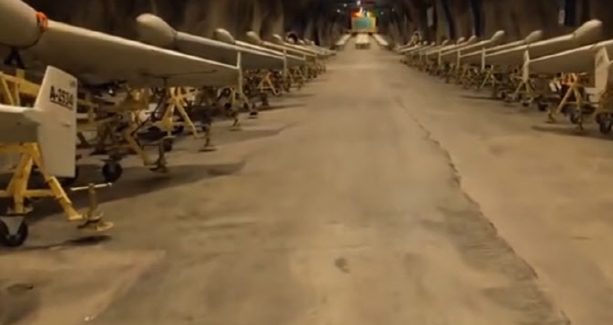
As the United States intensifies pressure by deploying advanced weaponry in successive strikes against Iran, Tehran has responded by releasing footage of large numbers of suicide drones and missiles deployed inside underground tunnels, staging a conspicuous display of military power. With its leadership suffering devastating losses, Iran appears to be signaling its readiness for a protracted conflict by showcasing its asymmetric capabilities. Iran’s retaliatory campaign is now rapidly spreading beyond Israel to U.S. military bases and critical civilian infrastructure across neighboring Gulf states, pushing the Middle East into an unprecedented state of tension. Analysts say the strategy is designed to expand the economic and security burden on regional states, thereby narrowing Washington’s military and diplomatic options while broadening the conflict’s international ramifications.
Iran’s Overt Display of Drones and Missiles
According to CNN and Iran’s Fars News Agency on the 3rd (local time), the Islamic Revolutionary Guard Corps (IRGC) released footage through state media the previous day showing a massive weapons tunnel. The video revealed large quantities of weapons arranged in orderly rows inside the underground facility. The tunnel walls were adorned with Iranian flags and a portrait of Ayatollah Ali Khamenei, Iran’s supreme leader who was killed in the recent strike.
The footage shows countless drones lined up inside a seemingly endless tunnel. Triangular-shaped drones appear first, aligned in a single direction, believed to be the Shahed-136 suicide drones developed by Iran.
Drones have emerged as one of Iran’s primary offensive tools in the current war. Since hostilities began on the 28th of last month, Iran has launched drone attacks against buildings and military facilities in Israeli territory. Videos circulating on social media show Iranian drones striking Israeli high-rise buildings before exploding and engulfing the structures in flames.
Missiles positioned in standby formation were also visible inside the tunnel. Each missile launcher vehicle carried four missiles. Iran possesses a wide array of missile systems, including the Shahab-1 with a range of 300 kilometers and the Soumar cruise missile capable of striking targets up to 2,500 kilometers away. According to Reuters, roughly 40,000 U.S. troops stationed across the Middle East fall within the range of Iranian missiles.
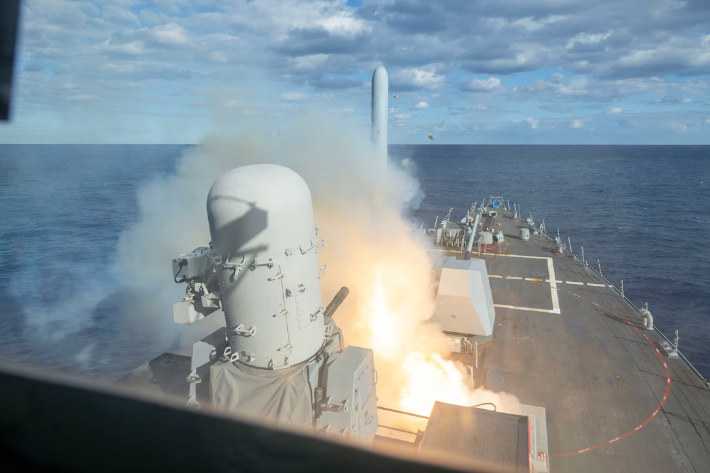
Escalating U.S.–Iran Confrontation
Arsenals and stockpiles are typically treated as classified information during wartime, yet Iran chose to publicize them on a large scale. The move is widely interpreted as part of Tehran’s propaganda campaign against the joint military operations conducted by the United States and Israel. According to the U.S. Joint Chiefs of Staff, President Donald Trump ordered the attack on Iran at 3:38 p.m. Eastern Time on the 27th of last month through Defense Secretary Pete Hegseth. The United States and Iran had held a third round of nuclear negotiations in Geneva, Switzerland, on the 26th, but Trump concluded that Tehran had no intention of abandoning its nuclear weapons ambitions and opted for military action.
Trump delivered a brief directive to U.S. forces: “Operation Epic Fury is approved. No aborts. Good luck.” A joint force composed of the Army, Navy, Air Force, and U.S. Space Command then launched the operation after completing preparations under strict secrecy. The strikes began at 1:15 a.m. Eastern Time on the 28th, corresponding to 9:45 a.m. local time in the region.
The United States and Israel simultaneously initiated military operations named “Epic Fury” and “Roaring Lion,” respectively. The two countries pursued somewhat different objectives. Israel focused on eliminating senior figures, including the supreme leader, while the United States targeted key ballistic missile facilities across Iran. U.S. forces also deployed overwhelming firepower to strike military targets nationwide while the Central Intelligence Agency (CIA) reportedly supported Israel’s campaign to eliminate high-ranking leadership figures. Intelligence reportedly obtained information that a high-level meeting would take place in Tehran one day before the airstrikes and shared it with Israeli authorities.
One of the greatest uncertainties surrounding the operation was whether Khamenei, who had ruled Iran for 37 years, survived the attack. While Israel claimed he had been killed, Iranian state media dismissed the reports as psychological warfare and suggested he remained alive. The controversy ended when Trump formally declared Khamenei’s death about 15 hours after the operation began. Iran lost not only its supreme leader but also a large portion of its leadership. U.S. intelligence agencies estimate that around 50 senior Iranian officials were killed. Washington has stated that military pressure will continue until the objectives of the campaign are achieved. On the 1st, Trump also raised the possibility of deploying ground forces, signaling readiness for a prolonged war.
Iran, however, has focused its efforts on retaliatory strikes against Israeli territory and U.S. military bases throughout the Middle East rather than signaling surrender. President Masoud Pezeshkian warned of retaliation in a eulogy delivered on the 1st for Khamenei. “The Islamic Republic of Iran regards revenge and punishment against the perpetrators and forces behind this historic crime as both a duty and a legitimate right,” Pezeshkian said, pledging to mobilize all available capabilities to fulfill that responsibility. The IRGC also issued a hardline statement alongside its retaliatory attacks that have continued for three consecutive days. “The enemies must now understand that peaceful days will no longer continue,” the IRGC said. “They will not be safe anywhere in the world, even inside their own homes.”
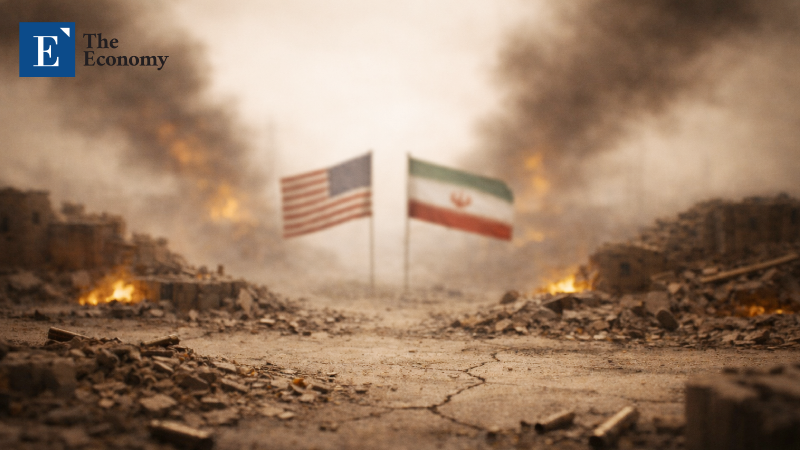
Missile and Drone Attacks on Neighboring States Ignite Regional Conflagration
The growing problem is that Iran’s retaliatory strikes targeting U.S. bases in the region are inflicting direct damage on neighboring Gulf states. Iran has broadened its attacks beyond Israeli territory to include Saudi Arabia, the United Arab Emirates (UAE), Kuwait, Qatar, Bahrain, Oman, Iraq, and Jordan, sharply escalating military tensions across the Middle East. The UAE has been a primary target of Iranian ballistic missile strikes. The UAE Ministry of Defense reported that its air defense systems intercepted 161 of 174 ballistic missiles launched by Iran, 654 of 689 drones, and seven cruise missiles. However, falling debris during interceptions killed three people and injured 68 others.
Qatar, which had served as a mediator between Iran and Israel, was also exposed to Iranian retaliation. Qatar’s Ministry of Defense announced that its air force shot down two Russian-made Sukhoi Su-24 fighter jets approaching from Iran. This marked the first confirmed instance of Iran attempting an attack using fighter aircraft rather than missiles or drones. Analysts view it as a new signal that Tehran is expanding military operations across the broader Middle East. The U.S. Embassy in Riyadh, Saudi Arabia, was also targeted by Iranian drones. Saudi Arabia’s defense ministry reported that two drones struck the embassy compound, causing a small fire and minor damage.
Although Iran insists it is targeting only military facilities such as U.S. bases, the damage has spread to civilian infrastructure. According to U.S. Central Command (CENTCOM) and The Wall Street Journal, international airports across the Middle East have suspended operations after suffering damage from Iranian missiles and drones. At Dubai International Airport—ranked first globally in international passenger traffic last year with about 92 million travelers—four employees were injured. Near Abu Dhabi airport, one person was killed by drone debris. Airports in Kuwait and Bahrain also suffered drone-related damage. Iran’s indiscriminate attacks forced the cancellation of more than 3,400 flights across seven airports in the Middle East on the 1st alone. The disruption effectively severed a vital economic lifeline for Gulf states, which rely heavily on air transport for food imports and the movement of foreign labor.
Tourism and commercial facilities have not been spared. The Burj Al Arab hotel in Dubai, the Fairmont The Palm on Palm Jumeirah, the Crowne Plaza in Bahrain, and residential complexes in Qatar also suffered damage. Videos circulating on social media show terrified tourists in high-rise hotels shouting that “missiles are flying across the sky.” Energy infrastructure has also been hit. At Saudi Aramco’s Ras Tanura refinery, falling drone debris ignited a fire that forced part of the facility to suspend operations. Ras Tanura, located on the Persian Gulf coast, is one of the world’s largest oil export hubs with a processing capacity of about 550,000 barrels per day.
Analysts say Iran’s concentrated attacks on Gulf states are intended to maximize the opponent’s costs while sowing divisions among U.S. allies. Rather than confronting the formidable air defense systems of the United States and Israel head-on, Tehran appears to be targeting neighboring states with more dispersed defensive capabilities, inflicting cumulative damage through persistent strikes. This dynamic is creating complex pressure on U.S. strategy. Hasan Alhasan, a senior fellow at the International Institute for Strategic Studies (IISS), told CNN that Iran’s calculation is to gradually increase the suffering of Gulf states and force the Trump administration to end the war sooner. Yasmin Farouk, Gulf project director at the International Crisis Group (ICG), said the strategy is intended to instill a sense of isolation among Gulf populations and provoke widespread panic. “Iran’s approach goes beyond regionalizing the conflict,” Farouk said. “By drawing Gulf states directly into the crisis, Tehran is effectively internationalizing the confrontation.”
Similar Post