[U.S.-Iran War] “Oil at $200 a Barrel” Iran Moves to Seal Off the Strait of Hormuz as Protracted-War Warning Blunts Impact of IEA Response

Authored On
Modified
Iran warns of a “closure of the Strait of Hormuz” and carries out actual attacks on transiting vessels
Global oil prices surge despite the IEA’s largest-ever emergency stockpile release
As Iran signals resolve for a prolonged conflict, Trump claims “the United States has won”
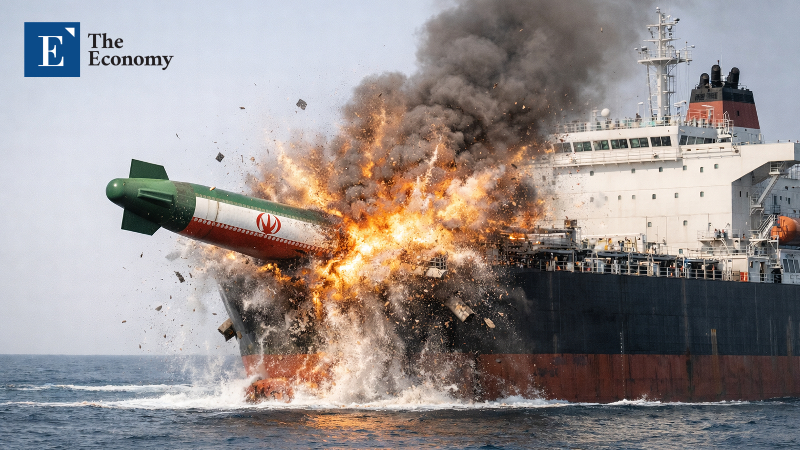
Iran has moved to impose a full-scale blockade of the Strait of Hormuz, a critical chokepoint in the global energy market. By launching indiscriminate attacks on commercial vessels in transit, Tehran is heightening tensions and exerting broad economic pressure on the international community. In response, the International Energy Agency (IEA) and major oil-producing nations have rolled out measures aimed at stabilizing prices, yet the upward trajectory in global crude markets has shown little sign of easing. Some observers have even begun to warn that, with Iran repeatedly signaling its willingness to fight to the end, the turmoil could become protracted.
Escalating Maritime Threats
On March 11, local time, a spokesperson for the Khatam al-Anbiya Headquarters of Iran’s Islamic Revolutionary Guard Corps (IRGC) said in a statement that “all vessels linked to the United States, Israel, or their allied countries will be regarded as legitimate targets.” He added that “oil prices depend on regional security” and said crude was expected to reach “$200 a barrel.” With the Strait of Hormuz, a key shipping route for Middle Eastern oil, effectively sealed off by the military confrontation between the United States and Iran, Tehran has once again issued a warning to the international community.
Iran also carried out actual attacks on vessels in nearby waters that same day. Iraqi port authorities said on March 11 that fires broke out on two tankers at Iraq’s Basra port, leaving at least one foreign crew member dead and 38 others rescued. Basra, adjacent to Kuwait, lies deep inside the Persian Gulf. The vessels struck were reported to be registered in Malta and the Marshall Islands, respectively, and were berthed side by side when the fires erupted. Iraqi authorities did not identify the party responsible, but CNN, citing sources, reported that “an Iranian vessel is believed to have attacked the tankers using explosives.”
Early the same day, the Mayuri Naree, a cargo ship operated by Thai transport company Precious Shipping, departed from a port in the United Arab Emirates and came under an unidentified attack at around 11 a.m. while passing through the Strait of Hormuz. A total of 23 crew members were on board the vessel at the time. Oman’s navy rescued 20 of them and transported them to Khasab, while rescue operations were continuing for the remaining three. The One Majesty, a cargo ship operated by Japanese shipping company Mitsui O.S.K. Lines and stationed in the nearby Persian Gulf, was also damaged after being struck by an unidentified projectile. Crew members reportedly heard a loud blast before discovering a hole in the stern, though the vessel did not take on water and no fire broke out.
Global Oil-Market Countermeasures
If Iran’s threats persist, international oil prices are all but certain to rise sharply. Most crude and gas exports from the Middle East’s major producers must pass through the Strait of Hormuz en route to the Indian Ocean. Roughly 20% of global seaborne crude shipments transit the waterway. In response, the IEA announced that its 32 member states had unanimously agreed to release 400 million barrels of strategic reserves into the market. That marks the largest such release in the agency’s history. During Russia’s invasion of Ukraine in 2022, the volume released stood at 182 million barrels.
Oil-producing nations are also moving to stabilize supply. Kuwait, for instance, is using South Korea and Japan as strategic distribution hubs for its crude. The plan is to pre-position oil volumes in key Asian locations to minimize delivery disruptions for customers. The move is widely seen as a strategy aimed at preserving trust with core Asian buyers even amid the threat of maritime disruption. Saudi Arabia and the UAE are likewise moving to export crude through routes that bypass the Strait of Hormuz.
Even so, the rally in oil prices has proved difficult to contain. On March 12, ICE Futures Europe said Brent crude for May delivery settled at $100.46 a barrel, up 9.2% from the previous session. It marked the first time Brent had closed above the $100 threshold on a settlement basis since August 2022, a span of three years and seven months. On the same day, West Texas Intermediate crude for April delivery on the New York Mercantile Exchange also climbed 9.7% from the prior close to settle at $95.73 a barrel.
Iran’s Blueprint for a Protracted War
A bigger concern is the possibility that the war could drag on, prolonging the turmoil. On March 11, Ali Fadavi, an adviser to the IRGC commander-in-chief, said in an interview with Iranian state television that “Israel and the United States will be drawn into a long war of attrition, and this war will destroy not only the U.S. economy but the global economy as well, pushing military capabilities to the brink of collapse.” The remark amounted to an explicit framing of economic pressure as a formal instrument of war.
Kamal Kharrazi, a foreign policy adviser to Iran’s supreme leader, also said in a recent CNN interview that “Iran is prepared for a long war with the United States” and that “attacks across the Gulf region could continue if necessary.” Effectively dismissing the prospect of a diplomatic resolution, he argued that “only economic pain can end the war.” Ebrahim Zolfaqari, spokesperson for Iran’s Khatam al-Anbiya Central Military Headquarters, also pressured President Trump through state television, saying, “Donald Trump, you may have started this war, but we will be the ones to end it.”
Trump, however, said in a speech in Hebron, Kentucky, on March 11 that “the United States has effectively destroyed Iran” and repeatedly stressed that “we won.” At the same time, he added that “we have to finish the mission” and that “this is not something I want to leave early.” In an interview the same day with the digital outlet Axios, he gave an ambiguous answer when asked about the timing of the war’s end, saying that “there are almost no targets left to strike and the war will end soon,” while also adding that “it will end whenever I want it to end.” That has fueled speculation both inside and outside the United States that the Trump administration may be exploring an exit strategy centered on a unilateral declaration of victory.
Similar Post