[U.S.–Iran War] Low-Cost Drones Strain U.S. Air Defenses, “Asymmetric War of Attrition” Emerges in the Middle East

Stefan Schneider brings a dynamic energy to The Economy’s tech desk. With a background in data science, he covers AI, blockchain, and emerging technologies with a skeptical yet open mind. His investigative pieces expose the reality behind tech hype, making him a must-read for business leaders navigating the digital landscape.
Authored On
Modified
Expensive U.S. air defense systems deployed to counter low-cost weapons
Drone attacks cause limited physical damage but ripple through financial markets
Importance of low-cost interception technologies rising as development race spreads
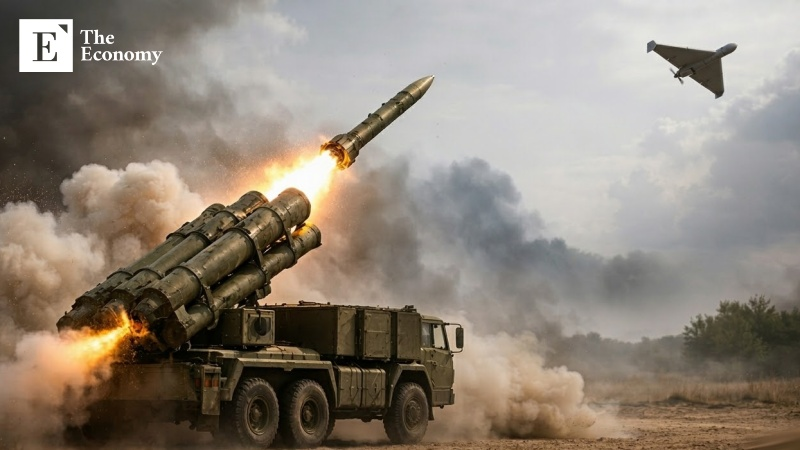
As the war in the Middle East passes the two-week mark, Iran’s large-scale deployment of inexpensive drones and missiles is rapidly draining the costly air defense systems of the United States and its allies faster than expected. Analysts say the conflict illustrates a new form of warfare in which low-cost weapons such as drones place sustained pressure on high-cost interception networks. In major Gulf cities, the aftermath of drone attacks has sharply reduced tourism and consumer activity, accelerating both population movement and capital outflows.
U.S. Air Defense Forces Redeployed to the Middle East
Bloomberg reported on March 11 (local time), citing Kelly Grieco, a senior fellow at the Stimson Center, that Iran—despite maintaining a defense budget smaller than the gross domestic product of Vermont—has rapidly depleted U.S. inventories of high-cost interceptor missiles using low-cost weapons accumulated over decades. While the United States previously led what was often described as a revolution in long-range precision strike warfare, analysts note that the current Middle East conflict represents the first time an adversary has demonstrated capabilities approaching that level. Bloomberg assessed the situation as one in which American weapons systems are facing a degree of pressure not previously experienced.
On the ground in the Middle East, the conflict has increasingly taken the form of a war of attrition driven by the mass deployment of low-cost drones and missiles against high-cost U.S. air defense systems. One prominent example is Iran’s use of Shahed-series loitering drones. Following preemptive strikes by the United States and Israel late last month, Iran launched more than 300 ballistic missiles along with large numbers of Shahed drones toward the Gulf region. Compared with precision strike missiles, drones require relatively simple launch infrastructure and place continuous operational pressure on defenders. Their short production-to-deployment cycle further amplifies their effectiveness.
The cost imbalance significantly increases the burden on defensive systems. The unit price of the Shahed-136 drone is estimated at around $30,000, while a PAC-3 interceptor missile used to destroy it costs roughly $4 million per unit. During the first six days of the war, more than 1,000 Shahed drones and about 200 ballistic missiles were reportedly launched toward the United Arab Emirates alone. In response, the United States and Gulf allies are estimated to have expended more than 1,000 PAC-3 interceptors. That figure is nearly double the annual production capacity of Lockheed Martin, the largest U.S. defense contractor, which manufactures roughly 650 PAC-3 missiles per year. It also exceeds the total number supplied to Ukraine by the United States and its allies over approximately four years since Russia’s invasion.
The situation has also led to losses involving strategic defense assets. In Jordan, a radar component of a Terminal High Altitude Area Defense (THAAD) battery valued at approximately $300 million was damaged, marking the first time the system has suffered combat damage in U.S. military history. With only eight THAAD batteries deployed worldwide, analysts say the incident represents a meaningful reduction in global missile defense capacity. The urgency of redeploying air defense resources has also triggered movements involving systems previously stationed elsewhere. Reports indicate that THAAD assets operated by U.S. Forces Korea may also be shifting toward the Middle East. One source said that Patriot batteries—including launchers and interceptor missiles—as well as some THAAD interceptors have been moved to Osan Air Base in Gyeonggi Province.
Dubai Bears the Economic Shock of Drone Barrages
The broader impact of Iran’s low-cost barrage strategy can be seen in the case of Dubai, which briefly appeared to resemble a ghost city. As the largest city in the United Arab Emirates—where more than 90 percent of the population consists of foreign residents—Dubai has long attracted global capital and wealthy visitors through tourism and consumer industries. That dynamic changed rapidly after Iran launched retaliatory attacks. According to The Guardian, more than two-thirds of the retaliatory weapons fired by Iran following U.S. and Israeli airstrikes were directed toward the UAE region, and Dubai did not escape the explosions and fires.
As a result, major tourist facilities including beachfront bars, shopping malls, and hotels closed simultaneously, leaving a sense of tension across the city. Although more than 90 percent of the roughly 1,700 weapons fired toward the UAE were intercepted by air defenses, some struck military bases and industrial areas. The shock intensified after strikes targeted areas surrounding Palm Jumeirah, one of Dubai’s most famous artificial island developments. Thick black smoke rising from drone strikes in the district—home to ultra-luxury villas and hotels—prompted tens of thousands of tourists and foreign residents to leave the city in haste. John Trudinger, a British national who works as a school principal in Dubai, told The Guardian that more than 100 British teachers employed at his school had returned home after reporting severe trauma from the attacks.
Economic repercussions have spread quickly. Unlike other Gulf states rich in oil resources, Dubai’s growth has largely been built on tourism and related service industries. That structure means any decline in tourist arrivals or foreign residents directly weakens the city’s economic base. Khalid Almezaini, a professor at Zayed University in the UAE, said Dubai has already suffered significant losses and warned that if the situation continues for more than twenty days, pressure on sectors such as the economy, aviation, and expatriate activity will intensify.

Cost Limits of Existing Interception Systems Exposed
Experts broadly agree that future warfare will increasingly revolve around low-cost interception technologies centered on drones. Iran’s large-scale use of inexpensive drones and missiles has forced Western governments and defense contractors to confront the reality that existing high-cost air defense systems alone may no longer be sufficient. The Financial Times noted that the situation has triggered a race to develop cheaper air defense weapons. After inexpensive drones demonstrated greater-than-expected destructive potential during the Ukraine war, the Middle East conflict has further accelerated scrutiny of the cost structure underlying existing air defense systems.
One technology gaining particular attention is interceptor drones. Ukraine’s interceptor drone Sting can fly at speeds exceeding 300 kilometers per hour and neutralizes Shahed drones—which typically travel around 180 kilometers per hour—by pursuing and colliding with them. The interception success rate can reach up to 90 percent. The drone’s cost is estimated to be roughly one-tenth that of a Shahed drone, making it extremely inexpensive. If a mission fails, the interceptor can be recovered and reused, which analysts say is its greatest advantage. Ukraine plans to send drone warfare specialists to the Middle East to assess battlefield conditions and assist U.S. forces.
Even radar technology, once the core of air defense systems, is undergoing change. In Ukraine, conventional radar systems struggled to detect low-flying Shahed drones, leading to the emergence of alternative detection methods. Systems that identify drones by analyzing acoustic signatures, as well as air defense networks built around low-cost detection equipment, have begun to appear. Dutch startup Robin Radar Systems has emerged as a leading player by adapting radar technology originally designed for bird detection into drone detection systems. Robin’s radar costs less than $1 million—roughly one-fiftieth the price of traditional air defense radar systems that can reach up to $50 million.
Laser and microwave technologies are also drawing attention as next-generation air defense weapons. Israeli defense firm Rafael has announced the delivery of its Iron Beam laser system to the Israeli military, while the United Kingdom plans to deploy the DragonFire laser weapon on naval vessels by 2027. The interception cost of DragonFire is estimated at around $0.06 per shot. Major defense companies including RTX in the United States, MBDA in Europe, and Britain’s Kinetic have also increased investment in laser weapon technologies. Defense industry observers say that if these investments lead to operational deployment, a new air defense architecture capable of countering the threat posed by low-cost drones could begin to take shape.
Stefan Schneider brings a dynamic energy to The Economy’s tech desk. With a background in data science, he covers AI, blockchain, and emerging technologies with a skeptical yet open mind. His investigative pieces expose the reality behind tech hype, making him a must-read for business leaders navigating the digital landscape.
- Previous [U.S.-Iran War] “Oil at $200 a Barrel” Iran Moves to Seal Off the Strait of Hormuz as Protracted-War Warning Blunts Impact of IEA Response
- Next [U.S.–Iran War] Oil Shock Pushes U.S. to Consider Easing Century-Old Shipping Rule, East Asian Production Faces Strain and Europe’s Energy Burden Grows
Similar Post