Dubai Shaken by Middle East War, Financial Hub Status Drifts to Singapore and Hong Kong Amid Capital Flight

As one of the youngest members of the team, Tyler Hansbrough is a rising star in financial journalism. His fresh perspective and analytical approach bring a modern edge to business reporting. Whether he’s covering stock market trends or dissecting corporate earnings, his sharp insights resonate with the new generation of investors.
Authored On
Modified
Middle East war shocks ripple through Dubai, with landmarks and other sites hit
Tourists and capital flee in droves, with some escaping on chartered jets
Distrust toward the UAE deepens, sending investor funds toward Singapore and Hong Kong
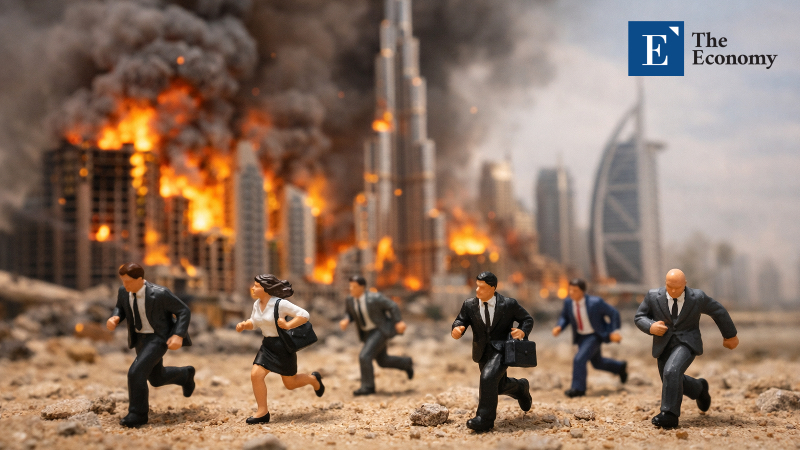
Dubai, the largest city in the United Arab Emirates and long regarded as a black hole for global capital, has been swept up in the fallout from the Middle East war. Iran’s attacks have struck key infrastructure, including Dubai landmark Palm Jumeirah, an artificial island, intensifying domestic turmoil. As tourists and investment capital steadily pull out of Dubai, markets are increasingly forecasting that Singapore and Hong Kong will emerge as alternative financial hubs for global investors and reap the spillover gains.
Dubai in ‘utter chaos’ amid Iranian attacks
On the 11th local time, Britain’s Guardian reported that a “mass exodus” of foreigners and tourists is continuing in Dubai as the Middle East war expands. According to the report, more than two-thirds of the weapons Iran launched over the past two weeks in retaliation against the United States and Israel were concentrated on the UAE. The number of projectiles headed toward the UAE reached 1,700. Most were intercepted by the UAE’s air defense network, but some fell on military bases and industrial complexes.
Amid such Iranian threats, Dubai International Airport, a global aviation hub, was at one point crippled, while Palm Jumeirah also sustained direct damage. On social media, footage circulated showing an area near the Fairmont Hotel on Palm Jumeirah engulfed in flames following a drone strike. Major tourist facilities in Dubai, including beachfront bars and shopping malls, are now virtually devoid of visitors. Zain Anwar, a Pakistani taxi driver who was at the scene when the Fairmont Hotel was bombed, told the Guardian, “I was lucky to survive, but my income has been completely cut off and there is no sign of a recovery in tourism,” adding, “Everyone now knows that ‘Dubai is finished.’”
The economic damage is also becoming visible. Dubai generates $30 billion in annual revenue from tourism. Unlike other Gulf states with vast oil resources, Dubai is far more dependent on tourism and finance, meaning the impact from a barrage of missiles is bound to be severe. Adding to the strain, global investors who had been based in Dubai to benefit from tax incentives and other advantages are increasingly returning home. Khalid Almezaini, a professor at Zayed University in the UAE, said, “We are already seeing substantial losses,” and warned, “If the situation continues for another 10 to 20 days, the foundations of the economy, including aviation, real estate and expatriate business, will be shaken.”
Confusion and chaos amid the exodus
The upheaval experienced by those who had been staying in Dubai is vividly illustrated by the chaos that unfolded during their attempts to leave. Following U.S. and Israeli airstrikes on Iran late last month, Middle Eastern air routes were temporarily paralyzed, leaving as many as 1 million tourists stranded. In the UAE in particular, the confusion caused by canceled flights was especially severe. Dubai authorities instructed local accommodation providers to extend stranded travelers’ stays under existing terms, but discontent erupted on the ground as some hotels demanded additional charges. Cruise ships carrying thousands of passengers also ground to a halt in the Persian Gulf. At least six cruise ships remained anchored near ports in the Gulf, and as the delays dragged on, passengers were effectively trapped on board.
Some wealthy individuals, meanwhile, arranged escapes using overland routes and private chartered jets. The method involves traveling by road to neighboring countries such as Oman and Saudi Arabia, where airports are operating normally, and departing overseas from there. Samuel Leeds, 34, a British real estate investor, drew heavy backlash online after posting a video on social media earlier this month showing himself heading to London Heathrow aboard a private charter jet he said cost about $200,000, remarking, “I don’t know why everyone isn’t doing this.”
In local expatriate and resident communities, so-called “escape brokers” also emerged, offering to arrange charter flights or overland departures. Informal evacuation brokering has spread broadly, exploiting flight disruptions and heightened anxiety. Through South Korean media, signs were confirmed of recruitment targeting Koreans through KakaoTalk open chat rooms, while numerous foreign media outlets also reported that foreigners residing in the UAE had received unverified evacuation brokerage offers through messaging apps. Prices proposed by brokers in chat rooms generally ran into the several-thousand-dollar range per person.
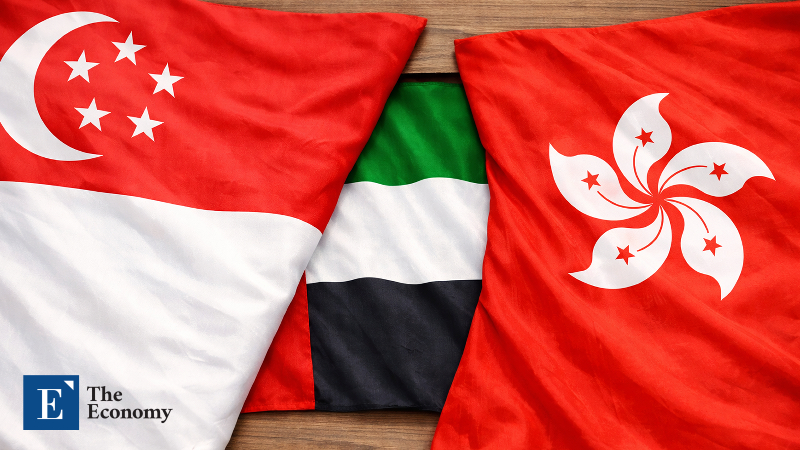
Will Singapore and Hong Kong fill Dubai’s vacuum?
As people and capital continue to stream out of Dubai, markets are raising the prospect that Singapore, long a tax shelter for wealthy individuals, will be among the chief beneficiaries. Over the past several years, Dubai had positioned itself as a financial hub rivaling Singapore. In particular, the UAE’s Golden Visa program, which has been in operation since 2019 to attract investors and talent from around the world, drew keen interest from the wealthy. The Golden Visa is a long-term residency visa, allowing holders to remain for up to 10 years, granted to those who meet thresholds for investment or tax payments, and it enables recipients to conduct business without a local sponsor.
But the war has rapidly altered the equation as the geopolitical climate across the Middle East has grown precarious. Investors who have begun to question the UAE’s stability have started redirecting funds back to Singapore, where many had previously based themselves. According to Reuters, immediately after Iranian missile and drone attacks first struck Dubai, two Indian businessmen living there each sought to move more than $100,000 from Dubai bank accounts to Singapore in order to diversify risk. One of them told Reuters, “The transfer was briefly delayed due to technical disruptions caused by the attacks,” adding, “I was later able to move the funds to a Singapore account through another UAE-based bank.”
Industry officials said that, beyond those cases, many wealthy Asians are inquiring about or actively considering moving assets they had stored in Dubai to regional financial centers such as Singapore. Ryan Lin, a Singapore-based lawyer specializing in private wealth, said, “Six or seven out of 20 Dubai-based clients contacted me this week regarding asset transfers, and three of them are planning to move assets to Singapore,” adding, “One client is trying to find out how quickly all assets can be transferred.”
Hong Kong is also being cited alongside Singapore as a beneficiary of the Middle East war. Kenny Tang Sing-hing, chairman of the Hong Kong Institute of Financial Analysts and Professional Commentators, told the South China Morning Post that “for international investors who had allocated funds to Dubai, Hong Kong is a natural option, given its free flow of capital and robust regulatory framework,” adding that “being outside the war’s sphere of influence is the biggest attraction for high-net-worth individuals.” The trend is especially pronounced in transactions involving physical assets such as gold. Brian Fung Wai-lung, chief executive of the Chinese Gold and Silver Exchange, noted, “Dubai was the gateway to Middle East investment, but fears are now spreading that gold and other assets could be trapped in the city because of logistical blockages.”
As one of the youngest members of the team, Tyler Hansbrough is a rising star in financial journalism. His fresh perspective and analytical approach bring a modern edge to business reporting. Whether he’s covering stock market trends or dissecting corporate earnings, his sharp insights resonate with the new generation of investors.
- Previous "Cutting Arms Imports, Expanding Military Spending" China’s Drive for Military Self-Reliance Heightens Tensions Across Asia and Oceania, While Doubts Over Chinese Weapons Performance Persist
- Next [U.S.-Iran War] “Oil at $200 a Barrel” Iran Moves to Seal Off the Strait of Hormuz as Protracted-War Warning Blunts Impact of IEA Response
Similar Post