[U.S.–Iran War] Oil Shock Pushes U.S. to Consider Easing Century-Old Shipping Rule, East Asian Production Faces Strain and Europe’s Energy Burden Grows

Stefan Schneider brings a dynamic energy to The Economy’s tech desk. With a background in data science, he covers AI, blockchain, and emerging technologies with a skeptical yet open mind. His investigative pieces expose the reality behind tech hype, making him a must-read for business leaders navigating the digital landscape.
Authored On
Modified
Plan to allow foreign vessels to transport crude oil and petroleum products
Manufacturing economies in East Asia confront rising energy supply tensions
Europe’s continued reliance on Russian energy highlights renewed supply risks
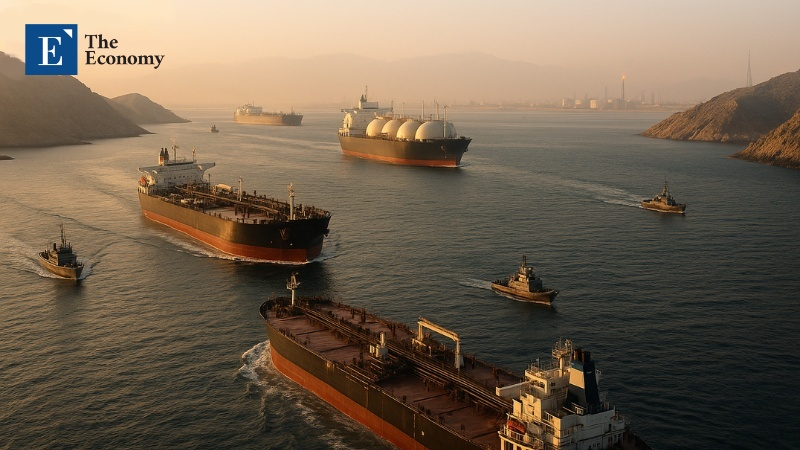
The military clash between the United States and Iran in the Middle East is rapidly destabilizing global energy markets. As international oil prices have surged for more than ten days, the United States has begun reviewing a temporary waiver of the Jones Act, a maritime shipping regulation that has been in place for more than a century, in an effort to stabilize supply flows. In East Asia, major manufacturing economies including South Korea, Japan, and China have simultaneously activated “energy defense lines” such as strategic reserve releases and price controls. In Europe, the shock has broadened further as surging energy costs and the issue of sanctions on Russia have resurfaced simultaneously.
Focus on Easing Supply Shortages and Logistics Disruptions
On March 12, White House Press Secretary Karoline Leavitt said in a statement that the administration is reviewing a plan to temporarily waive the Jones Act to ensure that key energy products and essential agricultural goods can move smoothly to U.S. ports for national defense purposes. She added that no final decision has yet been made. The Jones Act, enacted in 1920 to promote the U.S. shipbuilding industry and strengthen the country’s merchant marine capacity, requires that vessels traveling between U.S. ports be built in the United States, registered in the United States, and operated by American crews.
The review emerged as global oil prices surged following the U.S.–Iran conflict, placing pressure on energy transportation systems. One proposal under consideration would suspend the law’s application for up to thirty days. The exemption could apply to commodities including crude oil, gasoline, diesel, liquefied natural gas, and fertilizer. If implemented, foreign vessels could participate in transporting crude produced along the Gulf Coast to refineries on the U.S. East Coast or moving refined products to other regions. The involvement of foreign tankers with lower transportation costs could broaden logistics options and allow fuel supply flows within the United States to adjust more rapidly.
Global crude markets have remained volatile since the outbreak of the Iran war. Disruptions to oil shipments passing through the Strait of Hormuz have placed pressure on the entire global supply chain. In response, the International Energy Agency announced that member countries agreed to release 400 million barrels of strategic reserves to mitigate the market shock. The Trump administration also announced plans to release 172 million barrels of crude oil from the Strategic Petroleum Reserve. Policymakers warn that maintaining domestic shipping restrictions in the United States while global oil supply disruptions persist could intensify logistical bottlenecks.
A Jones Act waiver remains a rare step even in the United States. The most recent example occurred in October 2022 after Hurricane Fiona, when the government temporarily suspended the law to deliver supplies to Puerto Rico. At that time the policy focused on easing supply shortages and logistics disruptions. Analysts say the current discussion carries a similar purpose: adjusting supply flows rather than sharply reducing fuel prices. Alex Jacquez, policy director at the U.S. think tank Groundwork Collaborative, said the law’s impact on retail gasoline prices amounts to less than two cents per gallon and that consumers are therefore unlikely to notice meaningful price changes.
Strategic Reserve Use and Supply Chain Response
Major East Asian economies tied to the United States through trade have also come under the influence of rising oil prices and supply disruptions. International crude futures surged as much as 36 percent within a week of the conflict’s outbreak, marking the largest increase since the market opened in 1983. The surge reflects the paralysis of the Strait of Hormuz, a critical gateway for Middle Eastern oil shipments. Manufacturing-based economies in East Asia—including South Korea, Japan, and China—import most of the crude oil and natural gas used for electricity generation and industrial processes, meaning that disruption of this route threatens cascading shocks across their industries and economies.
In response, governments across the region have deployed supply management measures including strategic reserve releases and price controls to construct what policymakers describe as an energy defense line. South Korea introduced a fuel price cap for the first time since the Iranian Revolution in 1979. At the same time, it secured an emergency import of six million barrels of crude oil from the United Arab Emirates through routes that bypass the Strait of Hormuz. Japan has begun reviewing the possibility of releasing oil from its national storage facilities, backed by reserves equivalent to 254 days of consumption. China has raised retail gasoline and diesel prices by the largest margin since 2022 while ordering state-owned oil companies to maintain stable supply. China’s strategic petroleum reserves are estimated at roughly 900 million barrels, equivalent to about three months of imports.
Despite these active responses, tension across manufacturing supply chains has not subsided. Disruptions to liquefied natural gas supplies used for electricity generation have emerged as a key risk for technology industries. Louise Loo, an economist at Oxford Economics, noted that Northeast Asian economies including South Korea, Japan, and Taiwan rely heavily on imported gas for power generation. She warned that supply disruptions could simultaneously affect production in sectors such as semiconductors and artificial intelligence. If the crisis continues, analysts say the combination of rising corporate costs and weakening consumption could revive stagflation risks reminiscent of the 1970s.
The energy shock has already begun to appear across industrial sectors. In China, the National Development and Reform Commission convened major refiners and ordered a halt to exports of petroleum products. Companies were instructed to suspend new export contracts and negotiate cancellations of existing agreements. As a result, major energy firms including PetroChina, Sinopec, China National Offshore Oil Corporation, and Sinochem have begun adjusting export volumes. In addition, Shenghong Petrochemical—backed by Saudi Aramco—has suspended operations at facilities capable of processing 200,000 barrels per day, while Fujian Refining & Petrochemical has also announced a temporary halt to crude processing units handling 80,000 barrels per day.
Potential Cracks in EU Sanctions Policy Toward Russia
Europe faces a far more severe situation. On March 11 in a speech to the European Parliament in Strasbourg, France, European Commission President Ursula von der Leyen said gas prices have risen by 50 percent and crude oil prices by 27 percent since the start of the Middle East war. She added that European taxpayers have already paid an additional $3.27 billion for fossil fuel imports within ten days. The remarks underscored how supply shocks originating in the Middle East are translating directly into higher energy costs for European governments and industries.
Europe’s vulnerability stems largely from its supply structure. After the Ukraine war in 2022, the European Union pursued policies aimed at gradually reducing dependence on Russian energy. As a result, reliance on Russian crude oil fell from 45 percent in 2021 to about 13 percent recently, while dependence on Russian natural gas declined from 27 percent to roughly 3 percent over the same period. The bloc also adopted regulations late last year to fully prohibit purchases of Russian liquefied natural gas. However, the Middle East war erupted just as Europe was attempting to shift its import structure toward alternative suppliers, leaving replacement supply routes vulnerable to disruption at the same time.
Political tensions within Europe have begun to surface over the bloc’s sanctions policy toward Russia. Hungarian Prime Minister Viktor Orbán has called for a suspension of sanctions in light of surging global oil prices. Von der Leyen has maintained that sanctions must remain in place, arguing that revenue from Russian oil sales is used to purchase weapons for the war in Ukraine. Russia has attempted to exploit the divisions. Kirill Dmitriev, the Russian president’s special envoy for international investment and economic cooperation, said the European Union has harmed itself by rejecting Russian energy and claimed Europe is entering an era of collapsing and bankrupt energy systems.
Meanwhile, Europe’s policy options continue to narrow. Italy, Slovenia, Slovakia, and Austria have called for EU-wide measures to stabilize energy prices, while the European Commission has stated it is reviewing a range of policy tools including gas price caps and state subsidies. EU Energy Commissioner Dan Jørgensen said the war does not pose an immediate threat to Europe’s energy supply network but urged member states to reduce energy cost burdens through measures such as cutting fuel taxes. Analysts say the energy shock triggered by the Middle East war is now exerting simultaneous pressure on Europe’s fiscal policies and its sanctions strategy toward Russia.
Stefan Schneider brings a dynamic energy to The Economy’s tech desk. With a background in data science, he covers AI, blockchain, and emerging technologies with a skeptical yet open mind. His investigative pieces expose the reality behind tech hype, making him a must-read for business leaders navigating the digital landscape.
Similar Post