[U.S.-Iran War] Trump Floats ‘Delay of U.S.-China Summit’ Amid Pressure for Hormuz Deployment, Exposing Beijing’s Diplomatic Calculus Under the Iran Variable

Siobhán Delaney is a Dublin-based writer for The Economy, focusing on culture, education, and international affairs. With a background in media and communication from University College Dublin, she contributes to cross-regional coverage and translation-based commentary. Her work emphasizes clarity and balance, especially in contexts shaped by cultural difference and policy translation.
Authored On
Modified
Demand for postponement of summit ahead of China visit
China entangled in energy, Iran ties, and U.S. negotiations
Washington’s dual-track pressure strategy spanning energy and geopolitics
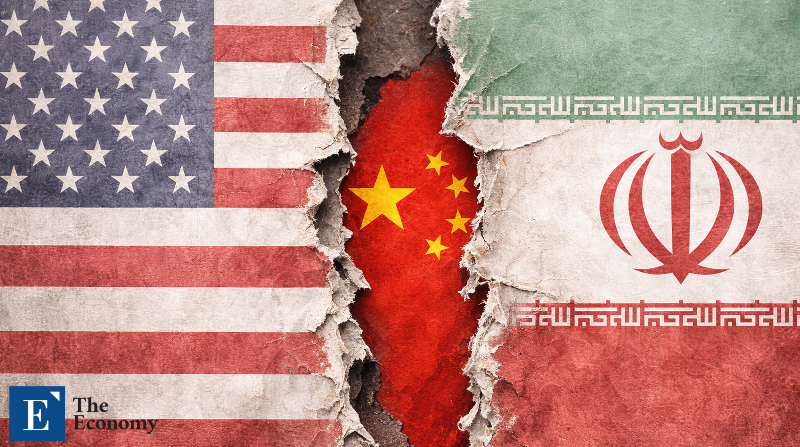
As U.S. President Donald Trump calls on major powers to dispatch warships under the pretext of protecting shipping routes through the Strait of Hormuz, the strategic calculus of China—the first country he singled out—is growing increasingly complicated. If Beijing rejects Washington’s demand ahead of a U.S.-China summit, the refusal could furnish the United States with added leverage in negotiations; if it complies, it could fracture relations with Iran, a key crude supplier and diplomatic partner. With Washington appearing willing to use even the Middle East crisis as a bargaining lever, the burden on China is mounting.
Trump demands Chinese warship deployment and raises possibility of summit delay
On June 15 local time, Trump said in a telephone interview with the Financial Times that day, “China gets 90% of its oil through that strait, so they should help,” arguing that China should participate in operations escorting vessels transiting the Strait of Hormuz. As Iran continued attacks on ships passing through the strait—widely described as a “global logistics artery”—and showed no sign of backing down despite Washington’s demands for capitulation, Trump’s remarks were widely interpreted as a forceful expression of intent to draw in China, which has maintained friendly ties with Tehran, in order to relieve pressure on maritime transport in the region.
Trump then turned to the U.S.-China summit, now about two weeks away, saying, “Two weeks is a long time,” and adding that “it could be postponed,” signaling that the schedule could slip if China does not provide an answer before the summit on whether it will join the Hormuz escort mission. The fact that Washington has asked China to take an active role in a Middle East security issue just before a major bilateral diplomatic event leaves ample room for the interpretation that the move is designed to go beyond stabilizing the strait and instead amplify a narrative of “responsibility” to strengthen U.S. negotiating leverage.
At present, Washington and Beijing are coordinating the agenda for the summit through high-level communications. On June 15, U.S. Treasury Secretary Scott Bessent met Chinese Vice Premier He Lifeng in Paris. While neither side disclosed details of the discussions, Reuters reported that the two sides addressed potential areas of agreement that could be examined at the summit, including agriculture, critical minerals, and trade management. With those consultations still unfinished, and with Trump simultaneously signaling his demand for Chinese cooperation on Hormuz security and the possibility of a summit delay, there is growing speculation that the U.S. side could raise the matter again in additional talks.
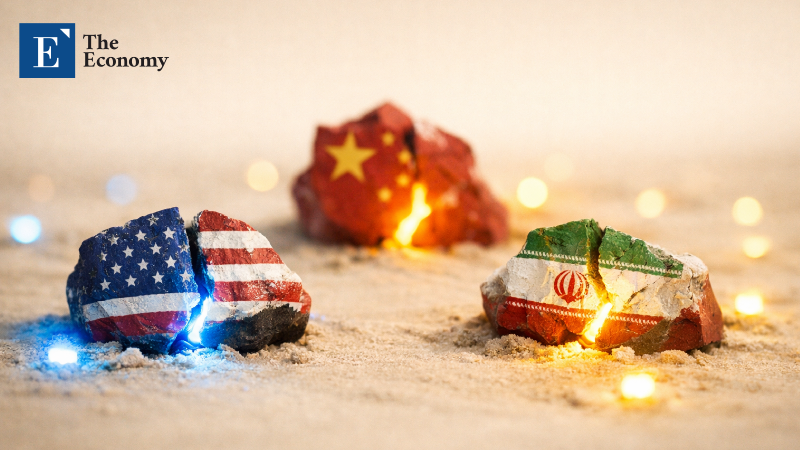
China’s predicament and diplomatic dilemma
The U.S.-China relationship is already defined by a complex matrix in which rivalry and cooperation intersect. Trade frictions, technological hegemony, and supply-chain realignment have over the past several years emerged as among the most consequential variables for the global economy. In such an environment, summit diplomacy has functioned as a buffer of sorts, tempering escalation and reducing the risk of strategic miscalculation. That safety valve is now beginning to wobble under the weight of the Middle East war as an external shock.
China is in an awkward position. The latitude it once had to present itself as an architect of Middle East peace has evaporated. According to energy analytics firm Kpler, China is the largest importer of Iranian crude, with roughly 80% of Iran’s total oil exports heading to the Chinese market. China maintains friendly ties with Iran while confronting the United States in a struggle for primacy. That leaves Beijing with little inherent reason to assist Washington. Yet the United States remains China’s largest export market. Tariffs and other trade barriers must be lowered. More importantly, if China refuses what amounts to a U.S. security subcontracting role, it risks being branded a complicit actor in a global energy crisis. It would not be easy for Beijing to flatly reject the request while also absorbing the disruption of a failed summit.
In practice, the Chinese government—apparently caught off guard by Trump’s request—has adopted a cautious line. On June 16, Chinese Foreign Ministry spokesperson Lin Jian said at a regular briefing only that “tensions in the Strait of Hormuz are threatening international energy transport corridors and adversely affecting regional stability,” adding that “all parties should immediately halt military action and prevent further deterioration of the situation.” Although he was repeatedly asked whether China would join efforts to escort shipping through the strait, he did not move beyond a generic answer that China was maintaining communication with relevant parties. For now, Beijing appears to be buying time behind the position that “military action must stop.” Asked about the possibility of a summit cancellation, he replied only that “the two countries are maintaining communication regarding President Trump’s visit to China.”
Trump-style military diplomacy and a strategic signal aimed at China
From Washington’s standpoint, the situation itself can be viewed as a strategic gain. Military pressure surrounding Iran shakes China’s energy dependency structure and shifts the negotiating environment in a direction more favorable to the United States. The mere fact that such a pressure environment has emerged ahead of the U.S.-China summit is, in the view of many observers, enough for Washington to have secured a diplomatic lever.
Indeed, diplomatic circles are increasingly convinced that Washington’s sudden strike on Iran was also intended to generate pressure on China, a friendly power to Tehran and a major buyer of Iranian crude. Just as the United States sought earlier this year to curb China’s influence in Latin America by striking at Venezuela, which has drawn closer to Beijing, the latest airstrikes on Iran are seen as containing a strategic dimension aimed at checking China. The calculation is to use force to dismantle the energy and economic benefits China has enjoyed through its relationship with Iran, along with Tehran’s challenge to the dollar-based order.
Ahead of the U.S.-China summit, Trump had a clear need to seize the initiative through an overwhelming display of power. Since returning to the White House in January last year, he has sought to pressure China with the tariff card, yet China’s commanding manufacturing capacity, supply-chain dominance, and leverage over rare earths gradually pushed Washington into a more defensive posture. In response, Trump has since January this year advanced a doctrine of “peace through absolute strength,” seeking to verify American superiority over China by applying military pressure to and dismantling what he has described as “China’s strategic footholds,” including Venezuela, Cuba, and Iran.
In particular, the United States is known to have long focused on the crude-oil connection between China and Iran. China has boosted the cost competitiveness of its manufacturing base by importing cheap oil from sanctioned states, including Iran. If Iranian crude supply is also cut off, that strategy would face a major setback. Should risks intensify through developments such as Iran’s closure of the strait, logistics disruptions, rising insurance premiums, and surging freight rates could push up the cost of energy imports. China is also the largest importer of Venezuelan oil, having sourced about 4.5% of its seaborne crude imports from Venezuela last year, but this flow has likewise effectively stopped after Washington’s removal of Venezuelan President Nicolas Maduro in January.
The Institute for Energy Research (IER), a U.S. think tank, said in a recent report, “As Venezuela’s Maduro regime is removed and Iran’s political future becomes uncertain, the structure from which China benefited could be destabilized,” adding, “If permanent political change occurs in Iran, China will lose yet another stable and inexpensive source of oil supply. It would be placed at a strategic disadvantage relative to the United States, the world’s largest oil producer.”
Siobhán Delaney is a Dublin-based writer for The Economy, focusing on culture, education, and international affairs. With a background in media and communication from University College Dublin, she contributes to cross-regional coverage and translation-based commentary. Her work emphasizes clarity and balance, especially in contexts shaped by cultural difference and policy translation.
Similar Post