“Targeting Three Times the Speed of Sound,” China Advances Ultra-High-Speed ‘T-Flight’ Train Technology

Authored On
Modified
China Moves From Research and Concept Phase Into Real-World Validation
Private-Led U.S. Model Exposes Limits in Sustained Investment
Government-Led Approach Highlights Differences in Infrastructure Investment Models
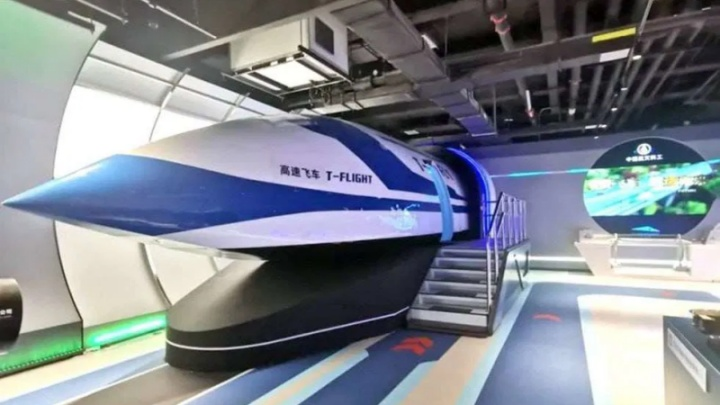
China’s ultra-high-speed train project has reached its initial milestone in unmanned testing, marking what analysts describe as a transition into a new phase of technological development. The system, which combines magnetic levitation with low-pressure vacuum tubes, is undergoing repeated validation with the ultimate goal of dramatically reducing long-distance travel times. While similar projects in most countries, including the United States, have faced repeated delays due to funding and technological challenges, China has continued accumulating test results through state-led investment and integrated technological development.
Reducing Air Resistance and Vehicle Weight
On the 16th, according to Polish media outlet Onet, China’s ultra-high-speed train project “T-Flight” recently reached a simulated operating speed of 623 kilometers per hour in an unmanned test designed to replicate travel between Beijing and Shanghai. The project, led by the China Aerospace Science and Industry Corporation (CASIC), ultimately aims to achieve speeds exceeding 4,000 kilometers per hour—more than three times the speed of sound. To reach this goal, CASIC has employed magnetic levitation technology to eliminate friction and low-pressure vacuum tubes to minimize air resistance. As a result, assessments have emerged that China is moving closer to realizing its ambition of compressing intercity travel times to minutes and reshaping the global economic landscape.
This ultra-high-speed train concept reflects years of accumulated technological development and testing. Transportation systems combining reduced-pressure tubes and magnetic levitation were first proposed in 2013 under the “Hyperloop” concept, and subsequent discussions have focused on both theoretical feasibility and technical limitations. Earlier Hyperloop projects set target speeds of around 1,220 kilometers per hour but largely stalled at the development stage due to technical barriers and safety concerns. Against this backdrop, China has expanded the technological scope by raising the target speed to 4,000 kilometers per hour through the T-Flight project, building on the same underlying concept.
Technological progress is also evident in China’s existing high-speed rail systems. The CR450AF high-speed train, unveiled in December 2024, successfully achieved operating speeds of up to 450 kilometers per hour, significantly exceeding the 350 kilometers per hour of the existing CR400 Fuxing trains. This advancement was enabled by a design that reduced air resistance by 22 percent and lowered vehicle weight by 10 percent, improving overall efficiency. As a result, travel time between Beijing and Shanghai has been reduced from approximately four hours to around 2.5 hours. Improvements in both speed and efficiency in conventional rail systems have thus provided a direct foundation for next-generation ultra-high-speed transportation.
T-Flight follows a phased testing structure built on this accumulated technological base. In initial trials, the system successfully reached speeds of 800 kilometers per hour over certain sections, confirming the stable operation of both the reduced-pressure system and magnetic levitation technology. In the second phase, the target is to exceed 1,000 kilometers per hour, with CASIC simultaneously constructing long-distance testing infrastructure extending beyond 60 kilometers. While a significant gap remains between the ultimate target speed and current test results, analysts note that the step-by-step approach of incrementally increasing speed through repeated testing has enhanced the feasibility of realizing the overall technological blueprint.
Limitations of Private-Sector Projects
In the United States and other Western countries, ultra-high-speed transportation development centered on Hyperloop concepts has largely been driven by private startups. However, projects have increasingly been suspended as they face the combined challenges of massive capital requirements and technical complexity. While systems combining reduced-pressure tubes and magnetic levitation have theoretically been presented as capable of achieving speeds exceeding 1,000 kilometers per hour, scaling them into real-world transportation networks has inevitably led to exponential cost increases. This dynamic highlights the limitations of a development model centered on private-sector funding.
For example, Virgin Hyperloop One, which had secured investment since 2014 and built a test track in Nevada while conducting manned trials, ceased operations in 2023 due to insufficient technological progress and difficulties in securing additional funding. Similarly, Dutch company Hardt conducted testing at the European Hyperloop Center (EHC) in the second half of 2024 but was only able to achieve speeds of 30 kilometers per hour over a 90-meter section within a 420-meter, 2.5-meter-diameter test tube, encountering difficulties in attracting further investment. The Boring Company, founded by Elon Musk, who originally proposed the Hyperloop concept, has also yet to deliver tangible results.
Technical challenges remain a critical barrier to commercialization. Hyperloop systems require maintaining an ultra-low-pressure environment inside the tube at roughly one-thousandth of atmospheric pressure, making it difficult to secure materials capable of withstanding both the pressure differential and the mechanical stresses of high-speed travel. While Hyperloop has been evaluated as a transportation mode combining aircraft-level speeds with high urban accessibility, it faces a dual barrier of simultaneously overcoming cost and technological constraints. South Korea also pursued a “Hyper Tube Technology Development Project,” including a 2-kilometer pilot operation in late 2023, but the initiative was rejected during the preliminary feasibility review due to insufficient economic viability and technological limitations.
Cases of Overcoming Physical Constraints Emerge
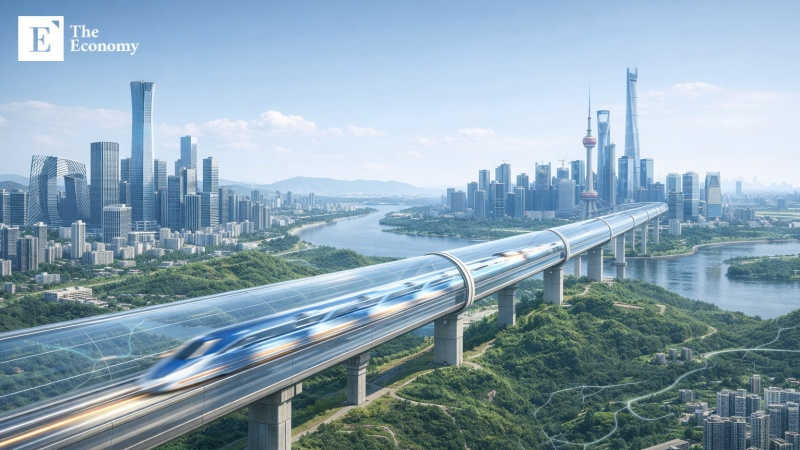
In contrast, China has demonstrated a pattern of gradually overcoming key technical challenges through large-scale, state-led investment and coordinated research efforts. Rather than relying on individual private-sector innovation, China has adopted an integrated approach encompassing infrastructure construction, materials innovation, and control systems, enabling progress beyond the point where many Hyperloop projects stalled. The structure, in which state-run research institutions and industrial enterprises participate simultaneously, provides a foundation for sustained funding and large-scale validation testing. This marks a fundamental difference from other countries that have largely delegated the entire development process—from investment to research, development, and testing—to the private sector.
The outcomes of this state-led model are reflected in testing results. According to China’s state broadcaster CCTV, a research team at the National University of Defense Technology successfully accelerated a one-ton vehicle to 700 kilometers per hour within two seconds on a 400-meter magnetic levitation test track in December last year. CCTV described the achievement as “entering a higher speed domain even compared to the Shanghai Maglev, which operates at a maximum speed of 430 kilometers per hour,” adding that “China has set a world record for this type of platform.” The previous record of 603 kilometers per hour was set by Japan’s JR Tokai in 2015.
Technological advancements aimed at overcoming the constraints of existing Hyperloop systems are also progressing. Chinese researchers have proposed a solution combining low-vacuum steel-concrete tubes, artificial intelligence-based magnetic dampers, and military-grade precision structures to simultaneously address issues related to pressure differentials, magnetic resistance, and precision control. Verification tests led by the China Railway Engineering Consulting Group (CREC) demonstrated that reorganizing the internal magnetic flux design using this approach reduced energy loss by more than one-third. These efforts to resolve key engineering bottlenecks faced by earlier Hyperloop projects are expected to lead to the next stage of ensuring stability in high-speed operation.
To mitigate cost burdens, design changes are being implemented in parallel. Specifically, construction costs have been reduced by 60 percent through the mass production of modular tube components, while energy efficiency has been improved through the adoption of distributed vacuum pump systems. These design choices reflect an approach aimed at enabling scalable network expansion in the future. However, building a transport system capable of speeds around 1,000 kilometers per hour still requires investment on the order of hundreds of billions of dollars for a Beijing–Shanghai route. Even so, the integration of technology, capital, and infrastructure into a unified development model is widely viewed by both industry and academia as sufficient to shift the center of competition in ultra-high-speed transportation toward China.
- Previous [U.S.-Iran War] Trump Floats ‘Delay of U.S.-China Summit’ Amid Pressure for Hormuz Deployment, Exposing Beijing’s Diplomatic Calculus Under the Iran Variable
- Next “Overcome the Power Constraints of HBM”: Next-Generation AI Memory Race Enters Full Swing as the Market Moves Into a Transitional Phase
Similar Post