Russia-Origin “Gas Time Bomb” Adrift in Mediterranean Puts Europe’s Response to the Test Between Sanctions and Safety

Stefan Schneider brings a dynamic energy to The Economy’s tech desk. With a background in data science, he covers AI, blockchain, and emerging technologies with a skeptical yet open mind. His investigative pieces expose the reality behind tech hype, making him a must-read for business leaders navigating the digital landscape.
Authored On
Modified
Cargo Left Unattended Raises Risk of Environmental Disaster
Russia Claims “Piracy Using Maritime Drones”
Accumulating Attack Cases Point to Long-Range Maritime Drone Reality
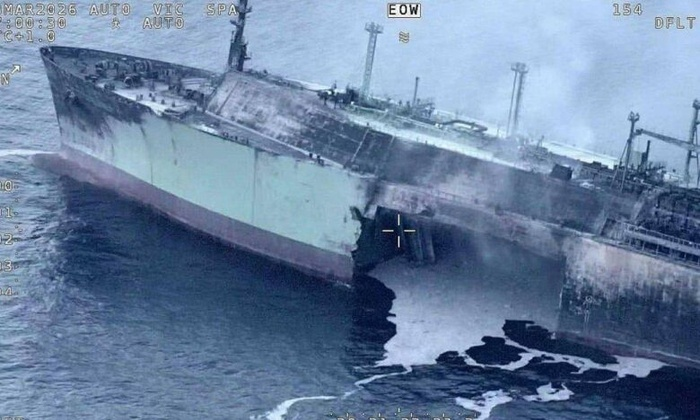
As a Russian liquefied natural gas (LNG) carrier continues to drift unmanned in the middle of the Mediterranean, concerns have surged across Europe. A vessel loaded with massive volumes of fuel has been left uncontrollable at sea, prompting official warnings of a potential “environmental disaster.” While many European countries have called for an emergency response, a dilemma has simultaneously emerged as such action risks clashing with the principle of maintaining sanctions. Russia has framed the incident as the result of an external attack, drawing renewed attention to past maritime drone strikes attributed to Ukraine.
Warning of an “Ecological Catastrophe”
On the 18th (local time), Reuters reported that nine European Union (EU) member states, including Italy and France, recently sent a joint letter to the European Commission (EC) urging an emergency response to the situation involving the Russian LNG carrier Arctic Metagaz. In the letter, the countries stated, “Considering the condition of a vessel drifting unmanned while carrying large quantities of LNG, the central waters of the EU are facing an ‘imminent and severe ecological catastrophe,’” while also warning that “any response, including monitoring or technical assistance, could undermine the integrity, effectiveness, and deterrence of the EU’s sanctions regime against Russia.”
The incident dates back to the 3rd. At the time, a series of explosions occurred aboard the Arctic Metagaz as it was sailing approximately 170 nautical miles southeast of Malta. According to CNN, the blasts left the vessel tilted at around 30 degrees, with parts of the deck collapsed, pipelines twisted, and sections of the bridge burned. All 30 crew members evacuated via lifeboats, leaving the vessel unmanned at sea. Italian authorities conducting the investigation stated that approximately 900 metric tons of diesel and more than 60,000 metric tons of LNG remained on board. Alfredo Mantovano, Secretary to the Italian Council of Ministers, described the vessel as “a ticking time bomb filled with gas,” warning that “it could explode at any moment.”
Since then, the vessel has continued to drift without any additional stabilization measures. Concerns have intensified that the structurally weakened hull may not withstand wave impacts. The World Wide Fund for Nature (WWF) noted that the area is “a major migration route for bluefin tuna and swordfish and one of the Mediterranean’s most biodiverse regions,” warning that “LNG, stored at minus 162 degrees Celsius, can create extreme cryogenic conditions upon leakage when it comes into contact with seawater, potentially causing fatal harm to marine life.” It further added that “gas clouds formed during vaporization could pose additional risks if they spread over land.”
The Arctic Metagaz is understood to be linked to Novatek’s Arctic LNG 2 project, with records confirming that it had received icebreaker assistance during Arctic navigation. The EU has classified the vessel as part of Russia’s so-called “shadow fleet” used to circumvent sanctions and has placed it on its sanctions list. In response to growing international concerns over environmental risks, Russian Foreign Ministry spokesperson Maria Zakharova stated, “Under international law, responsibility for resolving issues involving drifting vessels lies with coastal states,” while refraining from committing to direct intervention.
Russia Emphasizes Legitimate Operation and External Attack
Russia has consistently claimed since the incident that the explosions were caused by a drone attack attributed to Ukraine. On the 4th, Russia’s Ministry of Transport described the incident in a Telegram post as “an act of international terrorism and piracy, as well as a grave violation of fundamental norms of international maritime law.” It added, “The vessel was operating in full compliance with all international regulations and was carrying cargo with proper documentation,” emphasizing that the damage resulted from an external attack. Russian President Vladimir Putin also referred to the incident as a “terrorist attack,” clarifying the government’s position.
The Russian side also provided details regarding the method and route of the alleged attack. The Ministry of Transport stated that the strike was “carried out using an unmanned boat launched from the Libyan coast,” outlining a scenario that assumes operational reach into the central Mediterranean. Regarding the vessel’s route, Russia said it had departed from Murmansk and was en route to Port Said in Egypt when the attack occurred. However, Egypt’s Ministry of Petroleum denied any connection, stating that “the vessel was not part of any LNG supply or receipt contract involving Egypt.”
Changes in maritime transport routes have been observed following the incident. According to ship-tracking data from the London Stock Exchange Group (LSEG), the LNG carrier Buran, loaded with cargo from Russia’s Arctic LNG 2 plant, diverted from its usual Mediterranean route and instead took a detour along the northwest African coast. This marks a departure from the typical route in which LNG carriers from the plant travel through the Mediterranean and the Suez Canal toward Asian markets. The shift is interpreted as reflecting Russia’s assessment that route stability in the Mediterranean has deteriorated.
Maritime Energy Transport Network Exposed to Risk
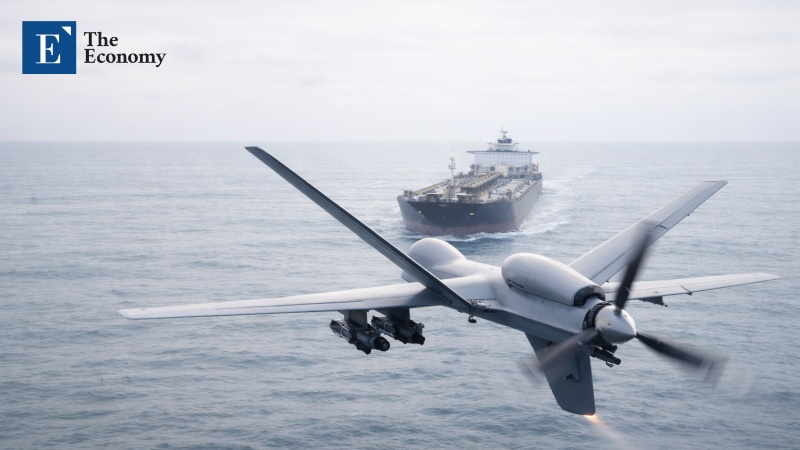
Ukraine has neither confirmed nor denied Russia’s claims. However, past instances of drone attacks targeting maritime and energy infrastructure have drawn renewed attention. In the early stages of the war, such operations were largely confined to areas near Odesa in southern Ukraine and waters around Crimea. Over time, as drone range and operational scope expanded, activity spread across the Black Sea. Notably, oil tankers and energy logistics infrastructure along maritime routes became frequent targets, exposing the broader shipping network directly to wartime risks.
On November 28 last year, two large tankers linked to Russia, the Kairose and the Birat, were attacked by drones in Turkey’s exclusive economic zone (EEZ). Although both vessels were registered in Gambia, they had been designated as part of Russia’s sanctioned shadow fleet and were sailing 51 to 65 kilometers off Turkey’s coast with their automatic identification systems (AIS) turned off. The “Sea Baby” unmanned surface drone used in the attack is known to carry up to 850 kilograms of explosives with a range of up to 1,000 kilometers. However, at the time, the payload had been reduced to extend range, and the vessels were not fully loaded, preventing a large-scale explosion.
Just two days later, on the 30th of the same month, the Panama-flagged tanker Mersin was struck by a drone near the port of Dakar in Senegal, causing the engine room to collapse and the stern to flood. While officially registered under a Turkish company, the vessel had been suspected of involvement in illicit oil transshipment between Russia and Senegal. The attack marked an expansion beyond the Black Sea—previously considered the primary operational zone—into West African waters, and was seen as a case demonstrating that vessels in transit over long distances are directly exposed to such risks.
Russia responded forcefully. In a speech at the Moscow Investment Forum in December last year, President Putin stated, “The most fundamental solution to (prevent maritime drone attacks) is to completely cut Ukraine off from the sea,” adding, “Only then can acts of piracy be stopped.” He further warned, “We are aware that tankers from certain countries supporting Ukraine are involved in attacks on Russian vessels, and we will take corresponding measures.” Despite these remarks, Ukraine carried out another attack on the same day using a suicide drone against the Russian tanker Midvolga 2 near Turkish waters.
Stefan Schneider brings a dynamic energy to The Economy’s tech desk. With a background in data science, he covers AI, blockchain, and emerging technologies with a skeptical yet open mind. His investigative pieces expose the reality behind tech hype, making him a must-read for business leaders navigating the digital landscape.
Similar Post