Bezos’ “Space Data Center Vision” Gains Momentum as Blue Origin Outlines Orbital Infrastructure Strategy

Authored On
Modified
Infrastructure race to address power shortages intensifies
Significant technical hurdles remain in launch and operations
If successful, operating costs could be drastically lower than on Earth
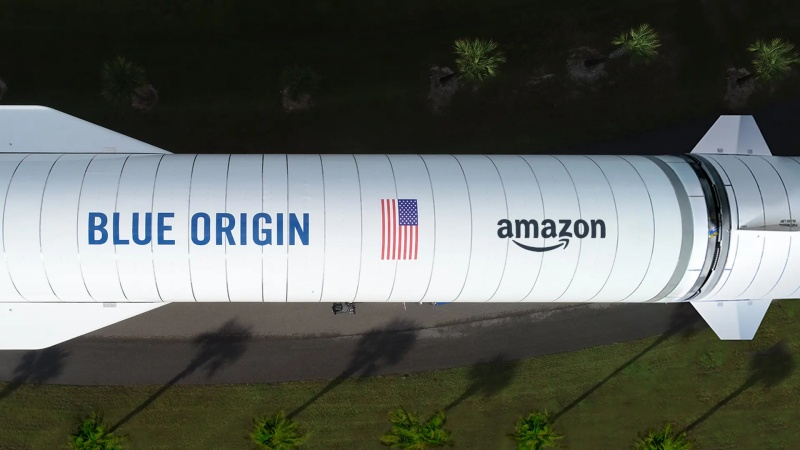
Jeff Bezos’ space exploration and development company has formalized a plan to utilize satellites themselves as data centers, extending the competition for core infrastructure in the artificial intelligence era into space. By presenting a model in which up to 52,000 satellites simultaneously handle computation and communication, the competitive landscape between existing satellite internet businesses and Blue Origin has become more clearly defined. However, technical challenges and cost burdens remain key variables for actual implementation, with launch costs and operational efficiency expected to determine the project’s ultimate success.
Redefining the physical location of computing infrastructure
Blue Origin submitted an application to the U.S. Federal Communications Commission (FCC) on the 19th to build a satellite network under the name “Project Sunrise.” The proposal outlines an unconventional approach to perform high-performance computing (HPC) directly in space, thereby fundamentally eliminating environmental burdens on Earth. Blue Origin stated that “by adding computing resources in space, we will expand the overall processing capacity of the industry and provide a new computing environment powered by clean energy.”
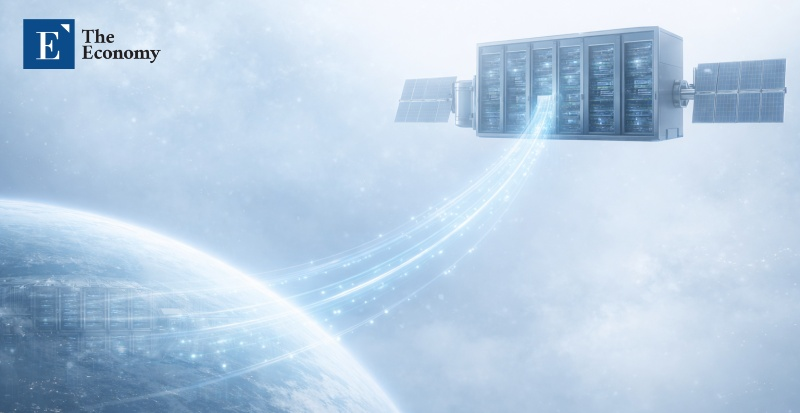
Blue Origin’s space data center concept is notable in that the satellites themselves function as data centers. Based on its separately planned communications satellite network, “TeraWave,” the company aims to establish an ultra-high-speed data transmission system between satellites and between satellites and the ground, enabling large-scale AI computation to be processed directly in orbit. This represents an attempt to redefine the physical location of computing infrastructure by shifting workloads traditionally handled by ground-based data centers into orbital systems.
Earlier in January, Blue Origin outlined a plan to launch 5,408 satellites by 2027 to provide communications services. The network is designed to deliver data transmission speeds of up to 6 terabits per second globally, targeting high-speed connectivity for approximately 100,000 users. The plan has since expanded toward a network of up to 52,000 satellites, evolving into a space-based computing infrastructure. Bezos stated that “Earth’s resources are limited, but space is effectively infinite,” emphasizing that “in the near future, we will operate gigawatt-scale data centers in space.”
This expansion directly intensifies competition with existing satellite internet services. For example, SpaceX’s Starlink operates a network of approximately 10,000 satellites and has secured more than 6 million users across at least 140 countries. It is widely regarded as the most advanced satellite network service, having achieved both global coverage and a large subscriber base. While Blue Origin’s TeraWave is designed primarily for enterprise and institutional users rather than individuals, both ultimately target the same market in terms of orbital infrastructure competition.
Skepticism within Amazon
However, the realization of space-based data centers is expected to take considerable time. Technical challenges remain substantial, including launch capacity limitations, a lack of experience in building orbital infrastructure, and the difficulty of adapting high-performance server equipment to the space environment. As a result, skepticism toward the concept of space data centers remains prevalent across the industry. Even Amazon Web Services (AWS) CEO Matt Garman dismissed the idea as “still far from reality,” noting the difficulty of achieving both economic viability and technical feasibility at the current stage.
Garman elaborated on these limitations during the Cisco AI Summit held in San Francisco on the 3rd of last month. In an interview, he remarked, “If you’ve seen server racks recently, they are extremely heavy,” adding, “to my knowledge, humanity has never built permanent structures in space.” He explained that the physical weight of equipment required for AI data centers makes repeated transport into space a significant burden under current technological conditions. He also added that “there are not enough rockets today to launch the required number of satellites.”
These remarks highlight the gap between Bezos’ personal vision for space and the practical assessment within Amazon. While Blue Origin has presented a direction to expand computing infrastructure into orbit through satellite-based data centers, AWS, which operates actual cloud services, does not view it as a viable near-term option given launch costs, equipment transport, and maintenance burdens. This indicates that while space data centers may be considered a long-term possibility, existing infrastructure systems will remain the priority for current operations and investment decisions.
Launch and orbital deployment costs as key variables
Cost issues also pose a major barrier to building space data centers. The central challenge lies in the cost of launching satellites into orbit and ensuring their stable deployment. Constructing large-scale computing infrastructure requires launching thousands to tens of thousands of satellites, and as the number of launches increases, total investment costs rise sharply. When additional costs for maintaining communication stability and computational continuity in orbit are considered, the cost structure in the early stages effectively becomes the determining factor for the project’s overall success.
A notable point is that launch cost structures are evolving with technological progress. Previously exceeding $20,000 per kilogram, space launch costs are showing signs of decline due to the development of reusable launch systems such as SpaceX’s Starship. Elon Musk stated that “with Starship, costs decrease by about 20% each time cumulative launch mass doubles,” adding that launch costs could fall below $200 per kilogram by 2035. If launch costs fall below a certain threshold, space-based computing infrastructure could become a viable option from an economic perspective.
At the operational stage, the cost structure shifts in the opposite direction. In space, cooling systems are largely unnecessary, and power can be continuously generated through solar energy. As a result, operating costs for space data centers could be reduced to as little as one-seventieth of those on Earth. According to space data center company Starcloud, operating a 40-megawatt data center on Earth would require up to $140 million in electricity costs over ten years, whereas in space, operations could be maintained with approximately $2 million for solar array installation.
Changes in cost structures are also influencing corporate investment strategies. Nvidia partnered with Starcloud late last year to launch a satellite equipped with H100 GPUs and has outlined plans to build a 5-gigawatt data center using its Blackwell GPUs. Google has also announced plans to launch two TPU-based test satellites within the year and to establish a space-based computing cluster by 2035. China, for its part, has launched 12 AI computing satellites and plans to ultimately build a network of 2,800 satellites.
Similar Post