"Surging Oil Prices Drive Demand Spike" Europe’s Auto Market Reorients Around EVs, Chinese Influence Becomes Increasingly Pronounced

Oliver Griffin is a policy and tech reporter at The Economy, focusing on the intersection of artificial intelligence, government regulation, and macroeconomic strategy. Based in Dublin, Oliver has reported extensively on European Union policy shifts and their ripple effects across global markets. Prior to joining The Economy, he covered technology policy for an international think tank, producing research cited by major institutions, including the OECD and IMF. Oliver studied political economy at Trinity College Dublin and later completed a master’s in data journalism at Columbia University. His reporting blends field interviews with rigorous statistical analysis, offering readers a nuanced understanding of how policy decisions shape industries and everyday lives. Beyond his newsroom work, Oliver contributes op-eds on ethics in AI and has been a guest commentator on BBC World and CNBC Europe.
Authored On
Modified
EV sales across Europe soar, demand concentrates on Chinese brands
Falling prices and surging global oil prices amplify EV advantages
China leverages price competitiveness, EU regulatory trajectory remains a variable
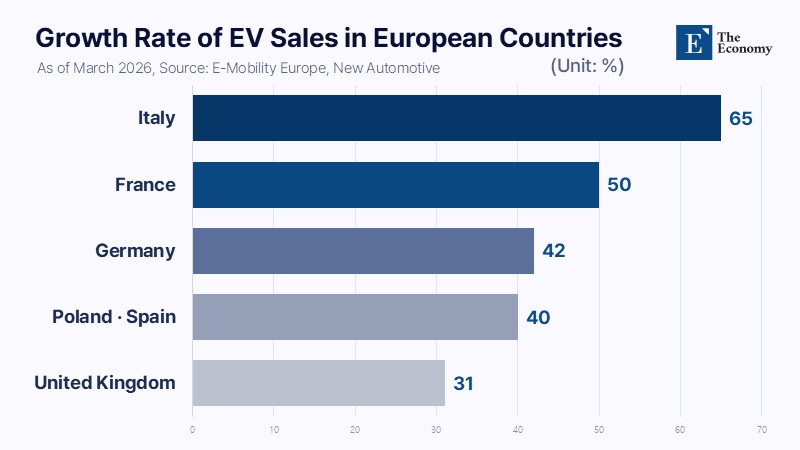
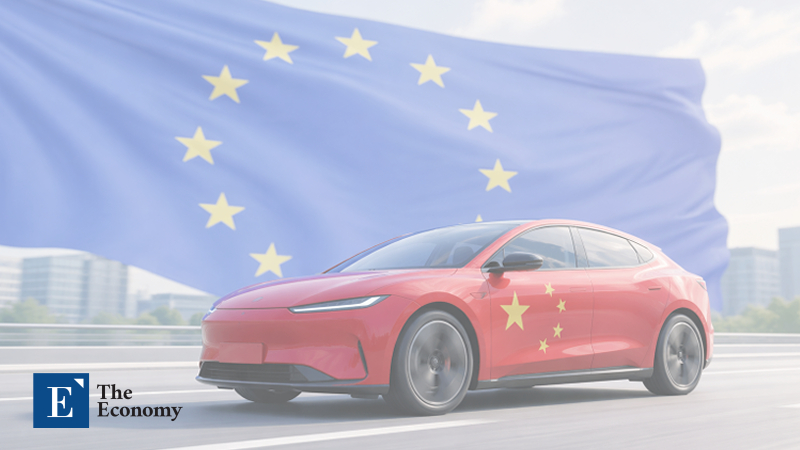
A structural shift is underway in Europe’s automotive market. As regulatory measures by the European Union (EU) have broadly driven down EV prices across the region, a concurrent surge in global oil prices has sharply accelerated EV adoption. With swelling demand gravitating toward price-competitive Chinese-made EVs, industry participants are closely monitoring whether regulatory uncertainties surrounding China within the European market will ultimately be resolved.
Transformation of Europe’s Automotive Market
According to a report by The Guardian on the 21st (local time), citing data from E-Mobility Europe and research firm New Automotive, 224,000 electric vehicles were newly registered last month across 15 major European markets including Germany, France, the United Kingdom, and Italy. This represents a 51.3% year-over-year increase. On a first-quarter basis, total new EV registrations reached 560,000 units, marking a 29.4% increase from the same period a year earlier.
Norway recorded the highest EV penetration, with electric vehicles accounting for 98% of all new car sales last month, followed by Denmark at 76% and Finland at 50%. The Guardian noted that “Nordic countries led by Norway are achieving the fastest progress in EV adoption, supported by high wages, generous subsidies, and extensive government-led charging infrastructure deployment.” EV adoption also rose sharply across Central and Southern Europe, including Germany, France, Spain, Italy, and Poland—markets where sales had previously lagged due to subsidy reductions and tax credit cuts.
A significant portion of this incremental demand has been captured by Chinese brands. According to the South China Morning Post (SCMP), EU imports of Chinese-made vehicles rose 30% year-over-year to 1.006 million units last year, surpassing the one-million mark for the first time. The China Passenger Car Association (CPCA) also reported that Chinese EVs accounted for 16% of the EU market at the start of this year, a notable increase from 12.2% recorded in 2025.
Acceleration of Demand Shift Driven by External Factors
Europe had already been undergoing a gradual transition toward electrification. According to the European Automobile Manufacturers’ Association (ACEA), total car sales across Europe increased by 1.8% last year. Within this, battery electric vehicle (BEV) sales surged 51%, while plug-in hybrid electric vehicle (PHEV) sales rose 36.7%, and internal combustion engine (ICE) vehicle sales declined. Notably, in December last year, EV sales surpassed ICE vehicles for the first time. During that period, EVs accounted for 26.3% of total sales across Europe—including the UK and non-EU European Free Trade Association (EFTA) countries such as Norway, Switzerland, Iceland, and Liechtenstein—significantly exceeding ICE vehicles at 21.7%.
The recent acceleration in electrification has been driven by shifting external conditions. First, EV prices across the region have declined, lowering the barrier to entry for consumers. According to an EV progress report by Transport & Environment (T&E), the average price of EVs in the EU last year stood at $46,000, down by approximately $1,940 from the previous year. T&E attributed this price decline to stricter EU carbon emissions regulations for automobiles. As the EU imposed limits on average fleet emissions, automakers responded by expanding EV sales and strengthening price competitiveness to meet compliance requirements.
Prolonged geopolitical tensions in the Middle East have also contributed to rising EV demand. Following airstrikes on Iran by the United States and Israel in late February, global oil prices have maintained an upward trajectory and remain elevated. On the 21st, Brent crude futures for June delivery settled at $98.48 per barrel on the ICE Futures Europe exchange, up 3.14% from the previous session, while West Texas Intermediate (WTI) crude futures for June delivery closed at $89.67 per barrel on the New York Mercantile Exchange, gaining 2.57%. This surge has dealt a severe blow to Europe, where countries rely heavily on energy imports and maintain a relatively fragile energy structure centered on natural gas. As a result, internal combustion vehicles have effectively lost their appeal as a viable option.
Sustainability of Chinese EV Competitiveness
Chinese EVs are drawing particular attention due to their overwhelming price competitiveness. In the European market, Chinese-made EVs demonstrate a clear pricing advantage over comparable local and U.S. models. According to market research firm JATO Dynamics, Chinese EVs were sold at prices approximately 20–30% lower than competing European models in 2024. When comparing vehicles within the same segment with similar options and battery specifications, price gaps of several thousand dollars are consistently observed.
However, regulatory risks at the EU level remain a key variable. The EU and China have been engaged in prolonged trade tensions surrounding electric vehicles. In September 2023, the EU formally launched a subsidy investigation into Chinese EVs, and based on the findings, announced plans in 2024 to impose provisional countervailing duties of up to 38%. Temporary tariffs were subsequently implemented in July of that year, prompting China to retaliate with investigations into EU exports such as automobiles and brandy. The EU maintained its stance, and within three months finalized countervailing duties of up to 45%, including existing tariffs.
Negotiations between the two sides gained momentum last year, culminating in a guideline-level agreement in January. The core of the agreement allows Chinese manufacturers to avoid additional tariffs if they commit to maintaining prices above a certain threshold. This framework is regarded as a compromise consistent with World Trade Organization (WTO) rules. However, detailed negotiations regarding implementation scope, pricing levels, and company-specific conditions remain ongoing, while the existing tariff regime continues to be enforced.
Further complicating the landscape, reports in February indicated that the EU is considering preferential measures for EVs produced within the region. According to the Financial Times (FT), the European Commission has drafted legislation encouraging EV manufacturers to source a majority of vehicle components from within the EU. The draft stipulates that, to qualify for government subsidies, EVs and hybrid vehicles must be assembled within the EU, and at least 70% of components—excluding batteries—must be sourced from within the region based on value.
Oliver Griffin is a policy and tech reporter at The Economy, focusing on the intersection of artificial intelligence, government regulation, and macroeconomic strategy. Based in Dublin, Oliver has reported extensively on European Union policy shifts and their ripple effects across global markets. Prior to joining The Economy, he covered technology policy for an international think tank, producing research cited by major institutions, including the OECD and IMF. Oliver studied political economy at Trinity College Dublin and later completed a master’s in data journalism at Columbia University. His reporting blends field interviews with rigorous statistical analysis, offering readers a nuanced understanding of how policy decisions shape industries and everyday lives. Beyond his newsroom work, Oliver contributes op-eds on ethics in AI and has been a guest commentator on BBC World and CNBC Europe.
Similar Post