Middle East Jet Fuel Shock Deepens LCC Crisis as Supply Chain Normalization Stalls and U.S., China and India Ramp Up Production

Oliver Griffin is a policy and tech reporter at The Economy, focusing on the intersection of artificial intelligence, government regulation, and macroeconomic strategy. Based in Dublin, Oliver has reported extensively on European Union policy shifts and their ripple effects across global markets. Prior to joining The Economy, he covered technology policy for an international think tank, producing research cited by major institutions, including the OECD and IMF. Oliver studied political economy at Trinity College Dublin and later completed a master’s in data journalism at Columbia University. His reporting blends field interviews with rigorous statistical analysis, offering readers a nuanced understanding of how policy decisions shape industries and everyday lives. Beyond his newsroom work, Oliver contributes op-eds on ethics in AI and has been a guest commentator on BBC World and CNBC Europe.
Authored On
Modified
Soaring Jet Fuel Prices Amid Iran War Put LCCs Worldwide on Emergency Footing
Middle East Crude Production Facilities and Logistics Networks Unlikely to Normalize Quickly
Higher Refining Margins Drive Jet Fuel Supply Growth Outside the Middle East
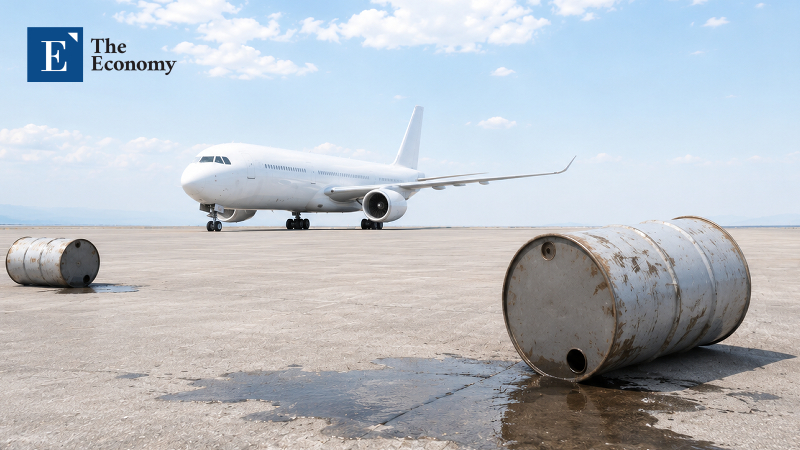
The global aviation industry is reeling from an energy shock originating in the Middle East. Jet fuel prices have surged in the wake of the Iran war, pushing low-cost carriers (LCCs) around the world into a fight for survival. With normalization of crude production and logistics networks in the Middle East expected to take considerable time, the market is pointing to export volumes from countries outside the region as the most critical variable in the supply chain.
Deteriorating Profitability Across the LCC Industry
According to a report by Polish economic outlet money.pl on the 20th, local time, Michael O’Leary, chief executive officer of Ryanair, Europe’s largest low-cost carrier, recently said in an interview with CNBC that “if oil prices remain high for a long period this summer, several European airlines will face severe financial difficulties.” Civil aviation jet fuel prices stood in the $80-per-barrel range as recently as March, but rose to around $150 per barrel after the outbreak of the war. In an interview with Bloomberg, O’Leary also warned that “a domino wave of airline bankruptcies could occur across Europe,” identifying Hungary’s Wizz Air and Latvia’s airBaltic as among the carriers at risk.
The crisis facing LCCs is also becoming increasingly visible outside Europe. Flights operated by Southeast Asian LCCs have recently fallen by about 20% compared with levels before the Iran war. Specifically, Malaysia’s AirAsia and Vietnam’s VietJet have cut seats by around 30%, while Indonesia’s Lion Air and Citilink have each reduced capacity by about 20%. These companies have raised fares across the board since March, but the increases have been insufficient to offset the cost burden from higher jet fuel prices. On some routes, fare hikes have instead led to lower load factors, creating a vicious cycle in which further schedule reductions have accelerated. Industry officials say that because LCCs serve as core infrastructure supporting domestic and intra-regional aviation connectivity in Southeast Asia, the current situation could have a direct adverse impact on the region’s economy.
In South Korea as well, flight reductions are spreading, particularly on medium-haul routes where fuel surcharge burdens are relatively high. Jeju Air cut about 4% of its international flights in May and June, equivalent to 187 round trips, and implemented unpaid leave for cabin crew, while Jin Air reduced 176 round trips across 14 routes including Guam and Phu Quoc. Eastar Jet cut 150 flights, Air Premia reduced 73 flights, and Air Seoul plans to cut 51 round trips on routes to Vietnam and Guam this month and next. Air Busan reduced 212 round trips, and next month it will additionally adjust flights on eight routes, including Busan-Da Nang, Busan-Bangkok, Busan-Vientiane, Busan-Guam, Busan-Cebu, Incheon-Chiang Mai and Incheon-Hong Kong.
Prolonged Disruption Expected in Crude Supply Chains
The dominant view in the market is that the aviation industry’s crisis will persist for some time. Even if the war ends immediately, it will take a considerable period for crude production to normalize. The Middle East’s crude production system has been hit hard by the fallout from the war. According to Middle Eastern outlet Al Jazeera, Saudi Arabia’s Ras Tanura refinery complex halted operations after a fire broke out in March due to debris from an intercepted Iranian drone, while similar incidents occurred at oil terminals in Fujairah and Musaffah in the United Arab Emirates. At Oman’s Port of Duqm, fuel storage tanks and oil tankers were struck, while Qatar’s Ras Laffan LNG facility also suspended production following an Iranian attack.
The problem is that repairing damaged crude production facilities in a short period will be difficult. Some surface facilities or modular equipment can be repaired within weeks, but if core process units or long-lead equipment such as compressors and turbines are damaged, new manufacturing, transportation, installation and safety inspections require substantial time. Refining and petrochemical facilities are particularly complex, and the difficulty of securing core parts as well as engineering and construction personnel could further extend repair timelines. Large gas turbines used in LNG facilities also have a limited supplier base, with existing order backlogs already reaching two to four years, raising the likelihood that full normalization will be delayed. The cost burden is also enormous. Norwegian energy consultancy Rystad Energy has estimated that restoration and reconstruction costs for Middle East energy infrastructure could reach as much as $58 billion.
Logistics risks are also expected to persist. Maritime insurers have sharply reduced or suspended war-risk insurance coverage for vessels in the Gulf region since the Middle East conflict intensified, leaving many ships unable to satisfy contractually required insurance conditions and stranded near the Strait of Hormuz. Cases have also surged in which vessels abandon passage through the Strait of Hormuz and divert to alternative routes, causing cascading delays in tanker allocation and loading schedules. Even if a ceasefire or formal end to the war is announced, it will take considerable time for insurers to downgrade risk ratings and for waiting tankers to proceed with loading and transit in sequence. This means transport capacity is unlikely to return to normal as quickly as the market expects.

U.S., China and India Expand Jet Fuel Exports
A key variable that could determine future supply chain conditions is the volume coming from regions outside the Middle East. According to Reuters, the Chinese government this month approved exports of refined fuels including gasoline, diesel and jet fuel totaling 500,000 tons. That is about 56% higher than the estimated April export volume of 320,000 tons compiled by ship-tracking firm Vortexa. After state-owned refiners requested expanded overseas sales in light of soaring refining margins, Beijing partially eased restrictions on refined fuel exports that had been imposed to protect energy security and stabilize domestic supply.
The United States is also increasing jet fuel production. Bloomberg reported on the 20th, citing data from the U.S. Energy Information Administration, that U.S. jet fuel output had exceeded 2 million barrels per day for four consecutive weeks. This is the first time the United States has maintained jet fuel production at that level for more than four weeks. Jet fuel exports also reached a record high of 455,000 barrels per day in the second week of this month. These refiners are believed to be benefiting from the Middle East crisis by using relatively cheap North American crude. According to the Financial Times, refining margins at U.S. Gulf Coast refiners recently rose to around $20 to $25 per barrel.
India has joined the trend as well. On the 14th, Reuters reported that Indian refiners were expanding exports in response to Middle East supply disruptions and surging jet fuel prices. Market research firm FGE projected that India’s jet fuel exports could rise to as much as 1.2 million barrels per day in the second quarter of this year. In practice, major Indian refiners such as Reliance Industries and Nayara Energy are said to be generating profits by importing large volumes of discounted Russian crude, refining it into jet fuel and diesel, and re-exporting those products to European and Asian markets.
Oliver Griffin is a policy and tech reporter at The Economy, focusing on the intersection of artificial intelligence, government regulation, and macroeconomic strategy. Based in Dublin, Oliver has reported extensively on European Union policy shifts and their ripple effects across global markets. Prior to joining The Economy, he covered technology policy for an international think tank, producing research cited by major institutions, including the OECD and IMF. Oliver studied political economy at Trinity College Dublin and later completed a master’s in data journalism at Columbia University. His reporting blends field interviews with rigorous statistical analysis, offering readers a nuanced understanding of how policy decisions shape industries and everyday lives. Beyond his newsroom work, Oliver contributes op-eds on ethics in AI and has been a guest commentator on BBC World and CNBC Europe.
Similar Post