“U.S.-China Rivalry Expands Into Minerals” As Chinese Miners Absorb Overseas Assets, Washington Responds With Industrial Policy Counteroffensive

Matthew Reuter is a senior economic correspondent at The Economy, where he covers global financial markets, emerging technologies, and cross-border trade dynamics. With over a decade of experience reporting from major financial hubs—including London, New York, and Hong Kong—Matthew has developed a reputation for breaking complex economic stories into sharp, accessible narratives. Before joining The Economy, he worked at a leading European financial daily, where his investigative reporting on post-crisis banking reforms earned him recognition from the European Press Association. A graduate of the London School of Economics, Matthew holds dual degrees in economics and international relations. He is particularly interested in how data science and AI are reshaping market analysis and policymaking, often blending quantitative insights into his articles. Outside journalism, Matthew frequently moderates panels at global finance summits and guest lectures on financial journalism at top universities.
Authored On
Modified
Zijin Mining Targets Gold and Copper Supercycle
Chinese Mining Groups Accelerate Global Asset Acquisitions
U.S. Deploys Policy Capital to Reshape Rare Earth Supply Chains
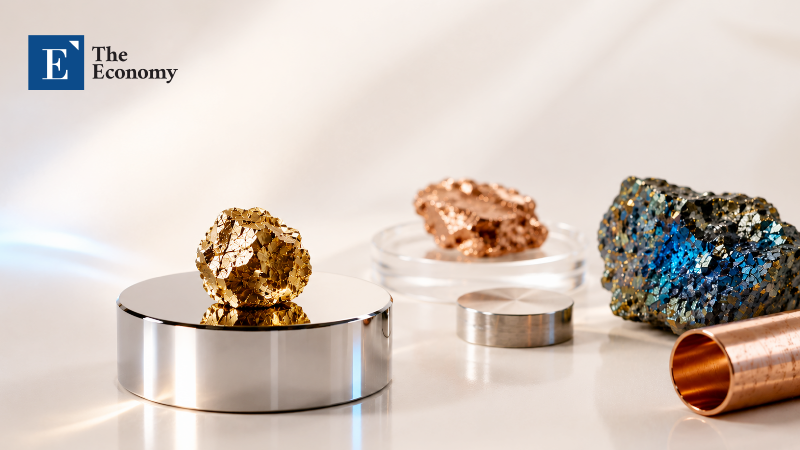
Chinese mining companies are aggressively pursuing overseas mine acquisitions, rapidly expanding their global influence. Major Chinese miners including Zijin Mining have accelerated efforts to enlarge production capacity by absorbing mining assets across Africa, Latin America, and Central Asia. In response, the United States has also begun mobilizing large-scale policy funding and allied cooperation after defining China-centric critical mineral supply chains as a national security risk. The U.S.-China rivalry is increasingly spilling beyond semiconductors and artificial intelligence (AI) into a full-scale confrontation over global mineral supply chains.
Zijin Mining’s Emergence as a Global Mining Powerhouse
According to investment banking industry sources on the 28th, Zijin Mining, China’s largest mining company, is rapidly emerging as one of the biggest beneficiaries of the gold and copper supercycle. Over the past decade, Zijin Mining has consistently pursued aggressive overseas resource acquisitions. The company expanded its production portfolio by securing major gold and copper mines in the Democratic Republic of Congo (DRC), Serbia, Kazakhstan, Ghana, and Tibet. In particular, the Kamoa-Kakula project in the DRC, the Bor copper mine in Serbia, and the Julong mine in Tibet are now regarded as the company’s core cash-generating assets.
As of last year, Zijin Mining held gold reserves of 64 million ounces and copper reserves of 56.6 million metric tons. Total resource holdings reached 148 million ounces of gold and 109.7 million metric tons of copper. Those figures place the company among the world’s top-tier global mining majors. In copper alone, the company is already viewed as having entered the ranks of the world’s largest producers. Zijin Mining produced 1.09 million metric tons of copper last year and is targeting 1.2 million metric tons this year. The company plans to expand annual production capacity to 1.5 million-1.6 million metric tons by 2028. Gold output growth has also accelerated sharply. Gold production reached 90 metric tons last year, with this year’s target set at 105 metric tons. That marks an increase of roughly 17% year-over-year, driven by acquisitions of gold mines in Ghana and Kazakhstan as well as expansion projects at existing mines.
Surging gold and copper prices combined with rising production volumes have also fueled explosive earnings growth. Zijin Mining posted revenue of approximately $48.5 billion last year, up roughly 15% from a year earlier, while net profit climbed 62% to approximately $7.2 billion. Earnings momentum accelerated particularly sharply in the first half of last year. First-half net profit rose 54% year-over-year to approximately $3.2 billion, while recurring earnings increased more than 40%. Analysts said profitability improvements were driven not only by rising commodity prices but also by substantial increases in actual production volumes.
Chinese Firms Accelerate Overseas Mine Buying Spree
Zijin Mining’s rapid rise is closely tied to Beijing’s strategic mineral acquisition policy. As the United States and Europe push to restructure supply chains and reduce dependence on China, Beijing has expanded global mining asset acquisitions through its domestic mining champions. China already commands overwhelming dominance in rare earth mining, refining, and magnet manufacturing. The International Energy Agency (IEA) estimated that the combined market share of the top three countries in critical energy mineral refining climbed to 86% last year, while roughly 90% of supply growth between 2020 and 2024 originated from a single dominant supplier. In cobalt, graphite, and rare earths, that supplier was China.
The scale of overseas acquisitions by Chinese mining firms has also risen rapidly. According to data from S&P and Mergermarket, Chinese mining companies completed 10 overseas mining acquisitions valued at more than $100 million last year, marking the most active acquisition pace since 2013. Australia’s Griffith Asia Institute estimated that Chinese overseas mining investment reached $22.1 billion last year, surpassing the previous record set in 2018.
Among the most aggressive players was CMOC, formerly focused on cobalt and copper, which has now expanded aggressively into gold assets. In April last year, CMOC announced the acquisition of Canadian mining company Lumina Gold and completed the transaction in June. The deal was valued at approximately $420 million. The acquisition centered on Ecuador’s Cangrejos gold-copper project, regarded as one of the country’s largest gold and copper development projects.
Ganfeng Lithium has gradually expanded its stake in the Goulamina lithium project in Mali, effectively securing management-level influence over the asset. Goulamina is widely regarded as one of Africa’s key lithium supply hubs. Ganfeng has also linked the project with Argentina’s Mariana brine project and Mexico’s Sonora project, establishing simultaneous control over lithium belts in both South America and Africa. The strategy reflects Beijing’s effort to lock in long-term lithium supply chains required by China’s battery industry.
Huayou Cobalt has focused heavily on acquiring nickel mines in Indonesia. In particular, the company has rapidly expanded mining assets tied to HPAL (high-pressure acid leach) projects, which are critical for producing nickel intermediates. Indonesia possesses the world’s largest nickel reserves, and much of its nickel industry has already been reorganized around Chinese capital and refining technology. Huayou Cobalt has strengthened supply chain integration by linking acquired mines directly with smelters and battery material factories.
Beyond those deals, Baiyin Nonferrous entered the South American copper asset race last year by acquiring Brazil’s Mineração Vale Verde copper-gold mine for approximately $420 million, while MMG, a subsidiary of China Minmetals, has expanded its influence over South American copper supply chains through Peru’s Las Bambas mine. China Nonferrous Metal Mining Group (CNMC) has also strengthened its presence in Africa through the Deziwa project in the DRC and copper belt assets in Zambia.

Washington Moves to Challenge China’s Mineral Dominance
The United States, locked in strategic rivalry with China, is also accelerating efforts to secure critical minerals. Washington has simultaneously pursued aggressive industrial policy and international cooperation aimed at achieving critical mineral self-sufficiency. The Department of Defense, Department of Commerce, Department of Energy, U.S. International Development Finance Corporation (DFC), and Export-Import Bank (EXIM) have all deployed funding across supply chains, while the State Department has signed a series of critical mineral agreements with resource-rich countries and nations possessing refining and processing capacity. In rare earths specifically, Washington’s core objective is the creation of an integrated “mine-to-magnet” supply chain.
The Department of Defense has provided equity investments and long-term purchase agreements to U.S.-based rare earth producers while also establishing price floors to guarantee profitability. MP Materials has emerged as one of the most prominent beneficiaries. The Pentagon invested approximately $400 million in MP Materials and guaranteed purchases for 10 years at a minimum price of $110 per kilogram, ensuring that domestic production can survive despite low-cost Chinese competition. Washington has also signed an agreement to build the 10X Facility, a magnet manufacturing plant with annual capacity of roughly 10,000 metric tons, targeting operations by 2028.
The core structure of the deal centers on selecting specific companies and vertically integrating mining, refining, and magnet production — effectively mirroring the “state-led industrial policy” model that Washington has long criticized in China. The Joe Biden administration had also supported MP Materials, but domestic refining and magnet production failed to achieve major breakthroughs due to aggressive Chinese pricing pressure and technological gaps. Under the second Donald Trump administration, support measures have become even more aggressive.
Washington’s response has also expanded into allied supply chain construction. On the 26th, the Quad security framework comprising the United States, Japan, Australia, and India announced plans to mobilize approximately $20 billion in public and private investment to strengthen critical mineral supply chains. The initiative focuses on simultaneously expanding mining, processing, and recycling capabilities to reduce dependence on China. Australia’s Nolans rare earth project, operated by Arafura, has also emerged as a key example of U.S.-led efforts to establish non-China supply chains. According to The Wall Street Journal (WSJ), the project aims to become Australia’s first fully integrated rare earth operation and is expected to supply roughly 4% of global demand for neodymium and praseodymium used in electric vehicles, wind turbines, and defense systems.
Matthew Reuter is a senior economic correspondent at The Economy, where he covers global financial markets, emerging technologies, and cross-border trade dynamics. With over a decade of experience reporting from major financial hubs—including London, New York, and Hong Kong—Matthew has developed a reputation for breaking complex economic stories into sharp, accessible narratives. Before joining The Economy, he worked at a leading European financial daily, where his investigative reporting on post-crisis banking reforms earned him recognition from the European Press Association. A graduate of the London School of Economics, Matthew holds dual degrees in economics and international relations. He is particularly interested in how data science and AI are reshaping market analysis and policymaking, often blending quantitative insights into his articles. Outside journalism, Matthew frequently moderates panels at global finance summits and guest lectures on financial journalism at top universities.
Similar Post