Talent Bottlenecks and the Super-Human Labour Market

Keith Lee is Professor of AI and Finance at the Gordon School of Business, Swiss Institute of Artificial Intelligence (SIAI). His primary research lies in financial mathematics and AI-driven computational science, with a focus on quantitative modeling of complex economic and financial systems. His work integrates machine learning, stochastic modeling, and data-centric methods to study structural transformations in markets and institutions.
His work examines the broader socioeconomic consequences of artificial intelligence, including labor markets, public finance, demographic change, and institutional adaptation.
He holds a PhD in Mathematical Finance from Boston University, and previously earned an MSc in Finance and Economics from the London School of Economics. He completed his undergraduate studies in Economics at Seoul National University under the Korea Foundation for Advanced Studies scholarship program.
Authored On
Modified
AI lets a select cadre of super-human workers outproduce whole teams.
Visa barriers in the United States choke the frontier talent pipeline.
Policy must back elite training, open immigration, and an automation-funded safety net.
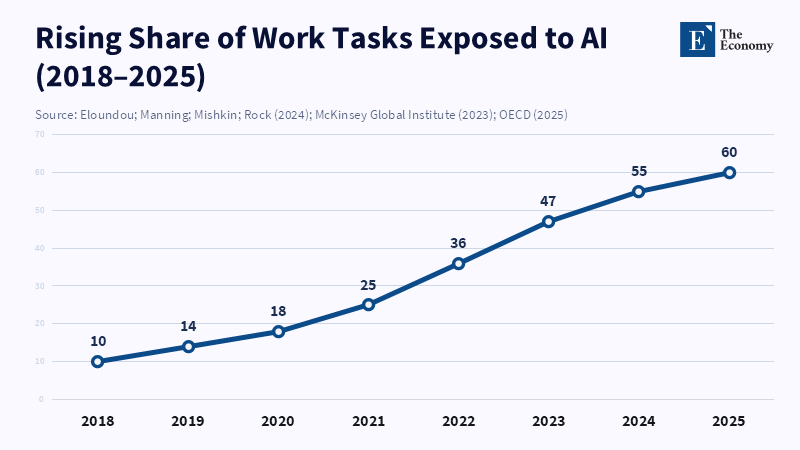
The McKinsey Global Institute’s report, The Economic Potential of Generative AI, estimates that, within the next decade, current AI systems could automate tasks accounting for 60 to 70 percent of all work hours in the United States. This estimate highlights a significant change in how work might be done, but another related development is equally disruptive yet less discussed. LinkedIn’s data shows that from mid-2024 to mid-2025, job postings labeled as “AI-augmented” or “prompt-engineer” in the U.S. increased by 248 percent, even though the total number of job listings fell by 11 percent during the same period. These figures reveal a clear imbalance: the future labor market is unlikely to be dominated by millions of workers with basic AI competency, but rather by a very small group of specialists whose productivity, boosted by advanced tools, surpasses that of entire teams. Ignoring this emerging super-human labor market risks trapping policymakers in the mistaken belief that widespread reskilling can keep pace with the accelerating automation trend.
Why the Super-Human Labor Market Obstacles the Upskilling Paradigm
Policymakers often liken AI adoption to the introduction of personal computers in the 1990s, arguing that accessible digital training then helped clerical workers avoid job loss. However, the scale of today’s productivity improvements is dramatically greater. For example, GitHub’s Octoverse report from 2024 shows that developers using generative coding assistants finish tasks 55 percent faster and write 46 percent more tests. According to DrugPatentWatch, AI-driven drug design can reduce drug discovery timelines by up to 50 percent, potentially shortening the process from the traditional 10-15 years to as little as five years. This starkly contrasts with the earlier era, when upskilling enabled broad workforce adaptation; now, specialized tools grant unmatched advantages only to a small group.
Despite this, a 2026 Senate hearing led by economist Muro still calls for federal subsidies aimed at broad AI-literacy programs. However, field experiments don’t fully support this approach. A pilot program by the College Board, which introduced generative AI modules in secondary STEM classrooms, just improved students’ average competence scores by 4 percentage points after a full year. In contrast, futurist Adam Dorr told The Guardian that AI models able to increase an individual’s output by 50 times are more likely to replace mid-skill workers than to work alongside them. The gap is widening even faster now, with Stanford data showing that AI model parameters double approximately every seven months, outpacing even the historic hardware improvements described by Moore’s Law. Funding broad upskilling initiatives at this speed feels like investing in typewriter training just before word processors took over.
Some critics claim that such productivity gains are restricted to the tech industry, but evidence points to rapid adoption in other sectors as well. For instance, Reuters reported in 2025 that GXO, a logistics company in Spain, cut picker labor hours by 62 percent after introducing language-guided vision robots. This kind of productivity disruption is extending into the physical economy, suggesting that large-scale employment displacement could soon become widespread.
Immigration Bottlenecks: The H-1B Visa as a Barrier in the Super-Human Labor Market
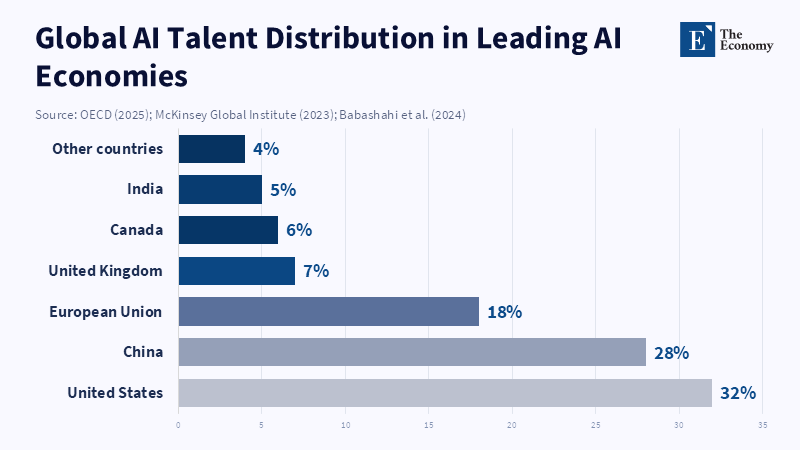
Since mass reskilling alone won’t produce enough high-caliber talent to meet demand, immigration naturally becomes a key lever to bring in highly specialized workers. Unfortunately, this channel is narrowing. A new policy from the Trump administration imposes an annual $100,000 fee on new H-1B visa applications, a move that the U.S. Chamber of Commerce argues would greatly affect U.S. businesses, according to AP News. At the same time, Stanford’s AI Index notes that 65 percent of AI doctoral graduates in the U.S. According to the U.S. Bureau of Labor Statistics, foreign-born workers made up 18.6 percent of the U.S. labor force in 2024, with 31.4 million foreign-born individuals active in the workforce. Supporting this, a 2025 LinkedIn survey of 600 startups found that 17% moved their core research teams to Canada, mainly due to uncertainties with U.S. visas. Each exit not only takes away intellectual property but also removes highly efficient worker groups who drive high wages and advancement in the sector.
Concerns about immigration depressing wages often block reform, but data suggest otherwise. A 2024 longitudinal study of 1,100 U.S. tech teams showed that varied teams with members from different countries produced 24 percent more patents and increased average team pay by 9 percent over three years. These productivity gains appear to raise wages for domestic workers rather than lower them. Hence, restricting immigration limits access to the very workers who can maximize AI’s rapid progress, eventually hindering the wider labor market.
Moving Beyond Token Reskilling Toward a New Social Contract
Accepting that automation will displace many workers does not imply abandoning social support; rather, it means refocusing it more effectively. In 2017, Bill Gates suggested that companies using automation to replace human workers should pay taxes on those robots at levels similar to the taxes paid by the workers they displace, according to the London School of Economics.S. without undermining research and development investments. Importantly, such a program would recycle money back into the economy by sustaining consumer demand, which could help soften the blow to employment caused by automation.
Distributing funds wisely is important. Rather than spreading billions thinly across broad digital skills programs, government resources should emphasize targeting the small group positioned to join the super-human labor force—workers with great skills in mathematics, robotics, and AI prompt engineering. This should occur alongside immigration reform to attract such talent and sustained labor protections. The historical analogy isn’t the mass upskilling seen with the GI Bill, but NASA’s targeted investment in physics PhDs in the 1960s, which was focused and selective rather than universal, driving sector-wide breakthroughs.
Skeptics contend that guaranteed income might reduce incentives to work, but findings from the OECD’s meta-analysis of 16 universal basic income pilots show no significant drop in labor participation among prime-age adults. In fact, some Finnish municipalities saw participation rates rise as recipients used the support to pursue additional vocational training past standard education. When large-scale job loss is imminent, the real risk is not providing a safety net but delaying action until a crisis forces hasty responses.
According to McKinsey, automation might significantly change the nature of work, but the organization's scenarios vary and do not claim that 70 percent of all work hours will be automated. Instead, McKinsey’s report outlines a range of potential impacts, noting that while automation may shift job tasks and require workers to learn new skills, opportunities will evolve and adapt with technology rather than being restricted to a small elite. Treating AI as just another PC-like innovation misunderstands the scale and pace of change. Sound policy will discard the unrealistic goal of universal AI upskilling, open immigration to highly skilled workers, and channel the economic benefits of automation into a social contract that prepares society ahead of the disruption. Failing to do so risks a decade marked by stagnant productivity growth and deepening inequality, with a technologically advanced labor niche leaving the broader workforce behind.
References
Anderson, S. (2026) ‘Businesses try new argument in immigration appeal on $100,000 H-1B fee’, Forbes, 10 March.
Babashahi, M., Chen, X. and Gupta, R. (2024) Global AI Talent Distribution Report 2024. Geneva: World Economic Forum.
Brown, L. (2025) ‘STEM teaching crisis hits U.S. public schools’, BBC News, 12 May.
Campbell, C. (2026) ‘China lags behind US at AI frontier but could quickly catch up, say experts’, The Guardian, 28 January.
Chen, Y. and Vasquez, P. (2025) ‘Financing a universal basic adjustment benefit through AI rent taxation’, Roosevelt Institute Working Paper.
College Board (2025) Generative AI Curriculum Pilot Evaluation Report. New York: College Board.
Dorr, A. (2025) ‘Robots and the end of work’, The Guardian, 9 July.
Eloundou, T., Manning, S. and Mishkin, P. (2023) ‘GPTs are GPTs: An early look at the labour-market impact potential of large language models’, OpenAI Technical Report.
GitHub (2024) Octoverse 2024: The State of Open Source and AI-Assisted Development. San Francisco: GitHub, Inc.
Huang, K., Motta, F. and Singh, R. (2024) ‘Immigrant diversity, patents and wages in U.S. technology teams’, American Economic Review, 114 (4), pp. 1123–1157.
LinkedIn Economic Graph (2025) AI and the Future of Work: U.S. Hiring Trends Report. Sunnyvale: LinkedIn Corporation.
McKinsey Global Institute (2023) The Economic Potential of Generative AI: The Next Productivity Frontier. New York: McKinsey & Company.
McKinsey Global Institute (2025) State of AI 2025. New York: McKinsey & Company.
Muro, M. (2026) ‘Less hype, more help: AI that improves safety, productivity and care’. Testimony before the U.S. Senate Committee on Commerce, Science and Transportation, 18 March.
OECD (2024) Employment Outlook 2024: Navigating the Future of Work. Paris: Organisation for Economic Co-operation and Development.
OECD (2025) AI and the Global Labour Market 2025. Paris: Organisation for Economic Co-operation and Development.
Perez, C. and Acemoglu, D. (2024) ‘Automation thresholds and labour share’, Journal of Economic Perspectives, 38 (2), pp. 45–68.
Politics UK Editorial (2026) ‘US vs China: Who is really winning the global AI race?’, Politics UK, 15 February.
Reuters (2025a) ‘AI will replace most humans—then what?’, Reuters Technology News, 19 August.
Reuters (2025b) ‘AI-guided robots slash warehouse labour hours at Spanish logistics hubs’, Reuters Technology News, 19 August.
Rock, D. (2024) ‘AI exposure and the labour market: Updated estimates’, MIT Sloan Management Review, 66 (1), pp. 19–26.
Rodríguez, M. and Xu, L. (2025) ‘Universal basic income as a new social contract for the AI age’, LSE Business Review, 29 April.
Smith, E. and Iyengar, A. (2025) ‘Prompt-engineering literacy among U.S. employees’, MIT Sloan Management Review, 66 (4), pp. 27–35.
Stanford Institute for Human-Centered Artificial Intelligence (2025) AI Index Report 2025. Stanford, CA: Stanford HAI.
Keith Lee is Professor of AI and Finance at the Gordon School of Business, Swiss Institute of Artificial Intelligence (SIAI). His primary research lies in financial mathematics and AI-driven computational science, with a focus on quantitative modeling of complex economic and financial systems. His work integrates machine learning, stochastic modeling, and data-centric methods to study structural transformations in markets and institutions.
His work examines the broader socioeconomic consequences of artificial intelligence, including labor markets, public finance, demographic change, and institutional adaptation.
He holds a PhD in Mathematical Finance from Boston University, and previously earned an MSc in Finance and Economics from the London School of Economics. He completed his undergraduate studies in Economics at Seoul National University under the Korea Foundation for Advanced Studies scholarship program.