The AI Job Market Needs a Demand Policy, Not a Rescue Myth

Working across research, policy, and data-driven analysis, the Editorial Board ensures that published pieces reflect a consistent institutional perspective grounded in quantitative reasoning and long-term structural assessment.
Authored On
Modified
AI boosts output, but may weaken jobs
Less work means weaker demand
Training must come before displacement

Over two-thirds of Americans say AI is developing at too rapid a pace. This is more than simply a general sentiment: it is an early signal of what is likely to occur in the AI job market. A public that views automation as a threat will react very differently from a public that is eagerly anticipating a surge in productivity. People will save more and spend less; delay risk and institutional trust; and resist adopting new technologies at work. All of this is significant. The key peril in AI is not just that machines will substitute for workers at particular tasks: it is that millions of private choices will result in a stagnant economy. Even when a firm's individual decision to replace workers with AI is logical in terms of reducing costs, widespread adoption of such decisions by many firms simultaneously can lead to falling demand, an economy that is more efficient on paper but less potent in practice, and is thus the real policy conundrum.
The AI Job Market Is Already a Demand Problem
The debate over AI and jobs has thus far revolved around two diametrically opposing ideas: AI will boost productivity, generate economic growth, and create new kinds of jobs; and AI will eliminate work far faster than new work is created. In fact, both claims can coexist at different moments of the same transition process. Automation can allow an individual worker to do more with her hands and her head, but can also lead firms to need fewer workers at all. A particular task can thus become more productive but require less labor input. AI can simultaneously allow an office's accounts to appear healthier and local cafes, shopkeepers, tenants, and the public sector revenues they depend upon to falter when workers' paychecks decline. For these reasons, the primary lens through which to examine AI and jobs cannot simply be how well it can assist or harm work as a task; it must also consider whether this automation could provoke a general failure of aggregate demand.
The initial evidence indeed confirms a reality that is mixed. Trials with automated writing, coding, and customer service jobs demonstrate clear improvements in productivity, and a tendency to deliver the strongest gains for less-experienced workers. This is one side of the coin: AI can close skills gaps and permit beginners to produce good work more quickly, at the cost of fewer routine tasks. But when looking at labor survey data, a more cautionary story emerges. Automation is rapidly expanding in the business world, but it is only beginning to cause widespread job losses. Survey data from the Federal Reserve Bank of New York found that by 2025, only a tiny percentage of businesses reported having laid off employees directly due to AI implementation, whereas a much larger number reported that they intended to retrain workers or halt future hiring. This distinction between past and anticipated job losses is important. The first signal may not be mass layoffs, but rather silently denied future entry opportunities. Job vacancies should drop, new-entrant routes into the labor force may become restricted, and wage growth might slow. These negative effects may not be dramatic or instant, but can still be substantial.
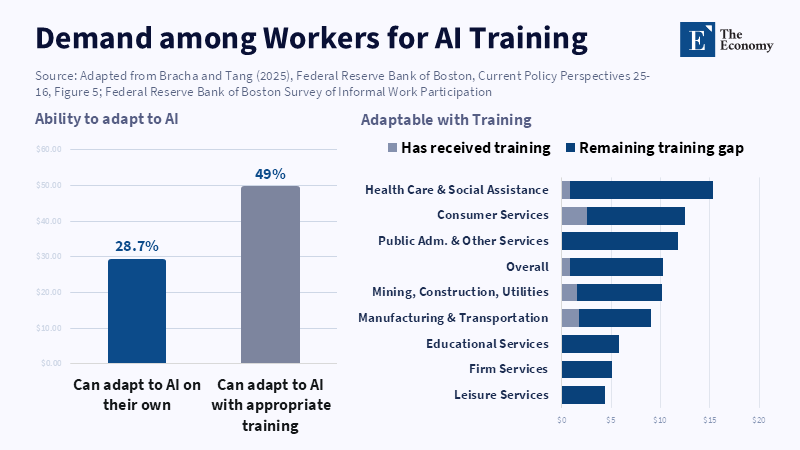
This means that the fears about AI cannot be dismissed as mere hyperbole. According to YouGov surveys conducted in 2026, Americans' pessimism about AI significantly outnumbered their optimism, with young people and lower-income workers being particularly anxious about displacement. Similar sentiments appear in the Boston Federal Reserve surveys, where, though some workers view the development of AI as neither good nor bad, the majority perceive it to pose significant risks over the next five to ten years. Almost half of the respondents indicated a readiness to adapt if there are proper support mechanisms available. This statistic alone signals the key demand challenge of AI: rather than fearing technological advancement directly, the public is anxious about the economic landscape's capacity to accommodate it. If policy fails to supply that path, a public that is afraid will not invest, not consume, not take on risk, and thus the problem becomes an economic confidence shock, not merely a labor market shock.
Productivity Gains Without Wage Increases are an AI Job Market Weakness
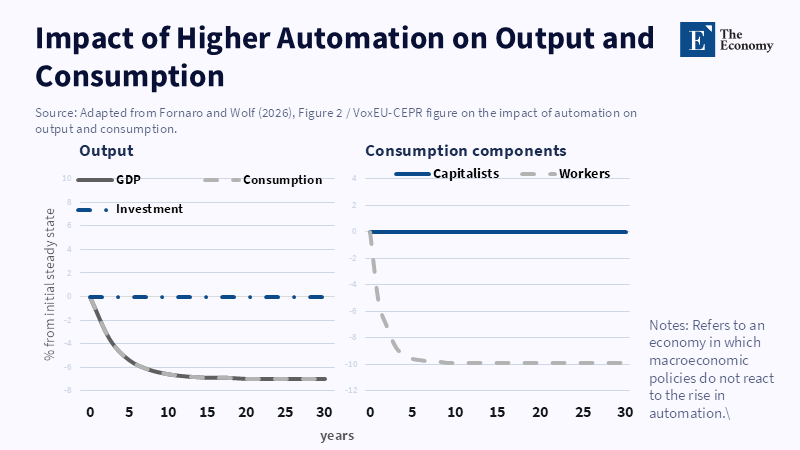
The classic theory of productivity assumes that an increase in production leads to benefits for all in the long term. And it can lead to such a benefit, but only if income gains are sufficiently distributed among individuals and their wage accounts. Workers tend to spend most of their income, whereas the owners of capital tend to save much more. A wave of automation and a simultaneous shift in national income away from labor income to capital income will thus tend to result in decreased consumption levels in the first instance, which can also reduce aggregate demand. Since consumption makes up the largest fraction of GDP in advanced countries, too much immediate displacement of labor income could lead to lower demand and a weaker economy despite any gains in measured productivity within individual companies.
This is precisely the externality associated with the AI job market. Individual companies, by replacing labor with machines, recognize that they have cut costs. But they fail to count the lost consumption power when those laid-off workers reduce their spending in local economies. On a small scale, this is perhaps not catastrophic, but on a large scale, it can mean aggregate demand will suffer in the economy. The answer is not a simple "robots taking all jobs", but instead an AI market of falling demand. Labor income is being funneled into cash held in corporate accounts, dividends, stock buybacks, or targeted investments, but is no longer circulating within the economy. This will cause a contraction in the economy if that spending is not fully reinvested by companies, causing demand to shrink even as productivity inside individual businesses rises.
The optimism argument, in particular, requires critical scrutiny. Investment in AI has grown significantly. 2025 figures from Stanford's AI Index suggest a massive adoption of AI in organizational settings, alongside heavy private investment. Investment is not, however, an automatic indicator of social gain; in many cases, its purpose is directly tied to saving labor time, not to opening up new markets. If a tool allows for fifteen workers to be replaced by ten, for example, there is a strong business incentive to adopt it; however, the social benefit will depend on the fates of the displaced workers, wages for the remaining workers, and consumer demand within the economy. Without any feedback mechanisms to support labor, gains to productivity are merely internal accounting entries for firms, with few implications for society.
The pessimistic argument needs refinement, too. Exposure to AI does not automatically mean job displacement. The IMF has calculated that almost 40% of global jobs are exposed to automation, with advanced countries topping the list. The ILO suggests most jobs will undergo significant modification rather than complete elimination, and clerical and office roles are particularly exposed. For these reasons, the relevant policy response is not to halt technological adoption, but to manage the rate at which exposed workers become excluded. Job design, training, minimum wages, public purchasing policies, and new workplace cultures should be part of the transition process. The key risk is not merely that work will be lost, but that viable career paths will disappear altogether.
Training infrastructure needs to keep up with AI labor markets
Training is usually viewed as an optional accompaniment; instead, it should be treated as a core component of the economic infrastructure. Just as roads permit goods to move between locations and power grids enable businesses to function, so too do training systems help workers shift from tasks that machines have begun to replace. The 'learn once, work forever' mindset is no longer valid; however, there is no ready replacement. 'Lifelong learning' must be tangible: it requires funding, a supportive infrastructure and worker trust, which can be gained from clearer signals from the labor market.
Training providers, employers and the workforce agencies have a direct role to play; it's not about forcing every course to become a coding workshop, but about integrating the use of AI as a basic skill throughout curricula. Whether it is in business, healthcare, law, journalism, graphic design, logistics, public administration, or skilled trades, students should gain the skills necessary to utilize AI tools, evaluate the veracity of its outputs, safeguard private information, and assess error rates. Crucially, students will need to focus on human skills which will acquire more value as routine tasks are automated: judgment, communication, industry expertise, ethics, and an understanding of problems in context. The goal should be worker augmentation, not a race against machines over speed, in order to preserve skills for tasks requiring discernment and responsibility.
Training shouldn't be treated as a marketing buzzword. A far more difficult challenge is tracking which jobs are susceptible, which employers are shifting their hiring practices, and which skills would give workers a chance to climb up to more secure positions. Real-time tracking of how AI is shifting hiring practices must be undertaken by community colleges, employers, and workforce agencies. The shrinking field of clerical work, for instance, requires training adjustments before we are confronted by a generation of trained and untrained workers competing for fewer jobs.
Government and policymakers cannot ignore this challenge and treat training as entirely the responsibility of private individuals. Productivity gains generated by AI could be used to subsidize workforce adaptation; this is not a crude technology tax. Rather, it involves developing solid financial support systems like wage insurance, paid leave for training purposes, individual accounts dedicated to skill development, and matching contributions from employers. Instead of waiting until workers lose their jobs to provide them with support, proactive interventions should focus on exposed jobs to prevent displacement as early as possible. A clerk or a call center agent facing replacement needs to be informed and supported prior to losing their employment. The cost of retraining while still employed will be considerably less than after a worker has already faced displacement.
Some will critique these measures as disguised industrial planning. But the opposite is also a policy choice: inaction will result in employers alone, who will continue to redesign their workforces and economies in their own interest. A second criticism is that training will do little for weak demand. While it is true that a training system alone cannot replace income and spending power, it can however prevent people from leaving the labor force due to unemployment. In addition, it can enable individuals to find new, skilled roles in sectors still dominated by human beings, such as in healthcare, teaching, repairs and maintenance, infrastructure development, the green economy, and client-facing service roles.
A new labor-market bargain is needed for AI
Monetary policy alone is insufficient to address these issues. While lower interest rates may blunt a downturn, they will not determine whether a displaced secretary transitions to becoming a health support assistant, a data quality associate, or is long-term unemployed. Fiscal stimulus can boost demand temporarily, but it will not succeed in helping people transition from obsolete roles to new ones without efficient training systems, strong local employers and sufficient labor protections. The future of the AI jobb market requires a different compact. Employers will continue to be allowed to take advantage of the tools that boost efficiency; however, they should no longer be permitted to unilaterally offload the costs of worker transition to employees and the government.
This compact begins with disclosure. Employers of large size will need to report on the number of their employees, changes in hiring rates, training programs offered, and overall work quality with regard to AI adoption. This is not intended to reprimand companies, but to shed light on labor market effects which remain hidden; this also goes some distance towards providing policymakers with adequate data to intervene promptly. Information is crucial. A successful AI job market policy demands real-time data about where tasks are disappearing, new roles are emerging and how specific demographics are most affected.
This new bargain requires a demand-side perspective. Where automation reduces wages relative to profit, the government should not rely solely on optimistic assumptions of future private investment to boost aggregate demand. Public sector contracts can also favor businesses that use AI to increase quality and workforce effectiveness rather than reducing staff. Tax policy may also support training and redeployment instead of pure labor replacement, and social insurance should evolve to protect the income streams of individuals undertaking retraining. Basic worker protections should also be mandated with regard to the pace of algorithmic management, preventing workers from becoming exhausted by rapid increases in productivity expectations without their consent. None of these are anti-technology proposals; on the contrary, they promote demand by keeping workers connected to income, skills and the economy.
Another lesson to be drawn is sector-specific. Index of AI risk reports from Tufts University suggests the negative impacts might extend beyond traditional manufacturing areas, extending to higher-skilled sectors. The memory of policy-making is thus accustomed to the old paradigm of manufacturing shocks. This time, the first losses may appear in roles for junior analysts in cities, clerical workers in corporate functions in financial services and insurance sectors, as well as support positions in professional services industries, and in the media. Such developments will make the politics surrounding AI different. Those individuals displaced, despite possessing formal training and urban residence, are still vulnerable if the initial step in the career ladder is removed.
Finally, a straightforward implication for the AI job market is that it should be managed not as an economic battle between growth and protectionism, but rather as an interactive system that aims to maintain steady demand. Only then can productivity gains actually become social gains, supporting personal income, useful reinvestment in new ventures and pathways for workers to find new employment. The alternative scenario where automation causes companies to become more efficient but employees less secure is likely to be characterized by worker backlash, lower consumption and political instability. With appropriate job creation, fair compensation, skills updates and public support, however, economic progress can be more inclusive.
Seventy-one percent of people who see AI as moving too quickly are expressing judgment not only about a new technology but also about the supporting institutions that are shaping it. They want to know that the gains will be widely distributed and that future careers will still hold the promise of progression. Market responses alone will not bring about the ideal outcomes, nor will fiscal stimuli smooth over structural change. A policy response built before the problems solidify is required for the AI jobs market: proactive training, transparent reporting by employers, maintenance of economic demand, and a transition for workers towards tasks that value human capability and input.
The views expressed in this article are those of the author(s) and do not necessarily reflect the official position of The Economy or its affiliates.
References
Abel, J.R., Deitz, R., Emanuel, N., Hyman, B. and Montalbano, N. (2025) ‘Are Businesses Scaling Back Hiring Due to AI?’, Liberty Street Economics, Federal Reserve Bank of New York, 4 September.
Allen, J.S. (2026) ‘Monitoring AI Adoption in the US Economy’, FEDS Notes, Board of Governors of the Federal Reserve System, 3 April.
Angelo, J. (2026) ‘The China shock hollowed out factory towns. This professor thinks the AI shock is coming for your urban coffee shop’, Fortune, 12 May.
Bracha, A. and Tang, J. (2025) ‘Shaping the Future of Work: Workers’ Optimism and Pessimism about AI’, Current Policy Perspectives, 25-16, Federal Reserve Bank of Boston.
Brynjolfsson, E., Li, D. and Raymond, L.R. (2025) ‘Generative AI at Work’, Quarterly Journal of Economics, 140(2), pp. 889–942.
Cazzaniga, M., Jaumotte, F., Li, L., Melina, G., Panton, A.J., Pizzinelli, C., Rockall, E. and Tavares, M.M. (2024) ‘Gen-AI: Artificial Intelligence and the Future of Work’, IMF Staff Discussion Note, SDN/2024/001.
Chakravorti, B., Filipovic, C. and Adisa, A. (2026) ‘Will Wired Belts Become the New Rust Belts? The American AI Jobs Risk Index’, Digital Planet, The Fletcher School at Tufts University.
Fornaro, L. and Wolf, M. (2026) ‘Macroeconomic Policies for AI’, CEPR Discussion Paper DP21412 / VoxEU, 15 May.
Gmyrek, P., Berg, J., Kamiński, K., Konopczyński, F., Ładna, A., Nafradi, B., Rosłaniec, K. and Troszyński, M. (2025) ‘Generative AI and Jobs: A Refined Global Index of Occupational Exposure’, ILO Working Paper 140, International Labour Organization.
Hayes, A.R. (2026) ‘Most Americans say AI development is moving too fast and twice as many are AI pessimists as AI optimists’, YouGov, 12 May.
Krankenitrate (2026) ‘Most Americans say AI development is moving too fast and twice as many are AI pessimists as AI optimists’, Reddit, r/technology.
Maslej, N., Fattorini, L., Perrault, R., Gil, Y., Parli, V., Kariuki, N., Capstick, E., Reuel, A., Brynjolfsson, E., Etchemendy, J., Ligett, K., Lyons, T., Manyika, J., Niebles, J.C., Shoham, Y., Wald, R., Walsh, T., Hamrah, A., Santarlasci, L., Betts Lotufo, J., Rome, A., Shi, A. and Oak, S. (2025) The AI Index 2025 Annual Report, AI Index Steering Committee, Institute for Human-Centered AI, Stanford University.
Mian, A., Straub, L. and Sufi, A. (2021) ‘Indebted Demand’, Quarterly Journal of Economics, 136(4), pp. 2243–2307.
Noy, S. and Zhang, W. (2023) ‘Experimental evidence on the productivity effects of generative artificial intelligence’, Science, 381(6654), pp. 187–192.
Peng, S., Kalliamvakou, E., Cihon, P. and Demirer, M. (2023) ‘The Impact of AI on Developer Productivity: Evidence from GitHub Copilot’, arXiv preprint arXiv:2302.06590.
Working across research, policy, and data-driven analysis, the Editorial Board ensures that published pieces reflect a consistent institutional perspective grounded in quantitative reasoning and long-term structural assessment.