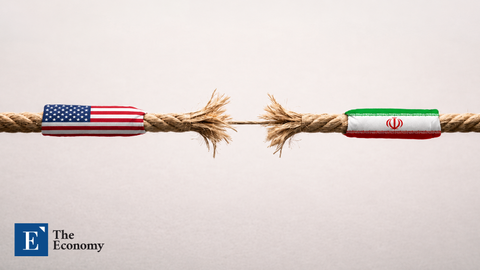
Trump Presses Allies to Cooperate in ‘Military Operations in the Strait of Hormuz,’ but Partners Maintain Caution Rather Than Immediate Intervention

As one of the youngest members of the team, Tyler Hansbrough is a rising star in financial journalism. His fresh perspective and analytical approach bring a modern edge to business reporting. Whether he’s covering stock market trends or dissecting corporate earnings, his sharp insights resonate with the new generation of investors.
Authored On
Modified
Trump pressures allies to join military operations in the Strait of Hormuz
The EU and Germany effectively refuse, while Britain reverses course and maintains an ambiguous posture
Japan, constrained by its pacifist constitution, faces speculation over possible participation should a Hormuz blockade become prolonged

As the U.S. government steps up calls for allied participation in military operations in the Strait of Hormuz, a number of countries are maintaining a cautious stance. The European Union (EU) and Germany have effectively signaled refusal, while Britain has withdrawn its initial expression of support after reversing its position. Japan, too, has remained observant due to constraints including its pacifist constitution, though some observers suggest that if the closure of the Strait of Hormuz were to drag on, a Sanae Takaichi administration could ultimately tilt toward participation in the operation.
EU Rebuts Trump’s Request for Support
According to foreign media reports compiled on the 17th, U.S. President Donald Trump warned NATO in a telephone interview with the Financial Times (FT) on the 15th (local time) that “if member states do not cooperate here (in military operations in the Strait of Hormuz), they will face a very bad future.” The remark came after he had already called on South Korea, China, Japan, Britain, and France on the 14th to take part in operations to defend the Strait of Hormuz, marking a renewed appeal for international cooperation. He added, “We had no obligation to help them (the EU) on the Ukraine issue, which is thousands of miles away, but we acted very generously,” adding, “Now we will see whether they help us.”
The EU, however, effectively dismissed Trump’s demand. EU High Representative for Foreign Affairs and Security Policy Kaja Kallas told reporters after the EU foreign ministers’ meeting on the 16th that there was no intention to expand the operational area of the EU naval mission, currently confined to the Red Sea, to the Strait of Hormuz. She stressed that, even in discussions with foreign ministers that day, while “a clear wish” had emerged to reinforce the naval mission in the Red Sea, “for now, there is no will to change the mandate of Operation Aspides.”
Negative responses have also emerged at the level of individual states. German Foreign Minister Johann Wadephul said in an interview with ARD on the 15th, in reference to the U.S. proposal, that “there is no immediate necessity, and above all, there is even less need for Germany to participate.” German Chancellor Friedrich Merz likewise stated the same day that “as long as the war continues, we will not be involved in guaranteeing free passage through the Strait of Hormuz by military means.” He underscored that “it is clear this war is not NATO’s issue,” while pointing out that the United States and Israel had not consulted other countries before launching strikes on Iran. According to AFP, a number of other European countries, including Poland, Spain, Greece, and Sweden, are also maintaining a cautious posture toward military involvement in the Strait of Hormuz.
Britain, Which Had Said It Was Reviewing Support, Also Shifts Stance
Britain, which had earlier signaled a willingness to provide support, also abruptly changed course. According to a report by The Guardian on the 15th, British Energy Secretary Ed Miliband said that Britain was discussing with allies an international response to reopen the effectively blocked Strait of Hormuz, and was reviewing a range of options, including sending Royal Navy vessels or mine-clearing drones. No actual deployment had been decided, and consultations were said to be under way in light of surging oil prices and the shock to energy markets.
The following day, on the 16th, British Prime Minister Keir Starmer promptly adjusted his position. In a speech delivered at 10 Downing Street in London, Starmer said that while the Strait of Hormuz needed to be reopened to ensure stability in oil markets, “it is not a simple matter,” adding that “we are working with all allies, including our European partners, to establish a viable collective plan to restore freedom of navigation in the region as quickly as possible and mitigate the economic shock.” Even so, he stressed that “this will not become a NATO mission, nor has it ever been regarded as one.”
When repeatedly asked by reporters afterward whether he opposed deploying the Royal Navy to the Strait of Hormuz, Starmer said only that he had discussed the matter with President Trump in a phone call the previous day (the 15th), and that discussions were continuing over a viable plan. He also said in the speech that “first, we will protect our people in the region; second, we will take the steps necessary to protect ourselves and our allies while avoiding being drawn into a broader war; and third, we will continue to work toward a swift resolution that restores regional security and stability and blocks Iran’s threats to neighboring states.”
Will Japan Move Despite the Risks?
Europe is hardly alone in grappling with whether to respond to Washington’s request for support. Japan, in particular, has adopted a cautious attitude toward military involvement, given its traditionally cordial ties with Iran and the extensive legal constraints imposed on the Self-Defense Forces. Prime Minister Takaichi formally stated in parliament on the 16th that “no decision whatsoever has been made regarding the dispatch of destroyers (to the Strait of Hormuz).”
Most Japanese media outlets assess that, given the pacifist constitution and related constraints, it would in practice be difficult for Japan to accept the U.S. request. Liberal Democratic Party Policy Research Council Chair Takayuki Kobayashi also said in an interview with NHK that “at this point, the Japanese government does not view the situation as either a ‘survival-threatening situation’ or an ‘important influence situation,’” mentioning only the possibility of invoking “maritime security operations” under Article 82 of the Self-Defense Forces Law. If maritime security operations were to be invoked, Japan’s forces would be able to conduct maritime policing activities to protect lives and property, but their scope would be limited to escorting Japanese vessels.
If Japan were to recognize the current situation as an “important influence situation” with a major impact on its national security, participation by the Self-Defense Forces in military operations would become possible. That, however, would require the premise that the U.S. strikes on Iran do not constitute a violation of international law. In that regard, one foreign-affairs specialist said, “Given that there are assessments viewing the U.S. attack on Iran as unlawful, and that public opinion within Japan is not favorable, it would be difficult for the Japanese government to readily decide on participation in the operation,” while adding, “If, however, the closure of the Strait of Hormuz becomes prolonged and the economic damage deepens, the Takaichi government, which is oriented toward a war-capable state, could begin seriously considering intervention.”
As one of the youngest members of the team, Tyler Hansbrough is a rising star in financial journalism. His fresh perspective and analytical approach bring a modern edge to business reporting. Whether he’s covering stock market trends or dissecting corporate earnings, his sharp insights resonate with the new generation of investors.
Similar Post