[Hormuz Deployment] Trump Says “We Protected Them—Why Won’t They Help?”, Allies Put to the Test Amid Rising Tensions in the Strait of Hormuz

Authored On
Modified
“Show Commitment as Allies” Remark Signals Demand for Troop Support
Qatari LNG Supply Disruption → Direct Impact on Korea and Japan
Major Powers Remain Reluctant Despite Justifications for Military Involvement
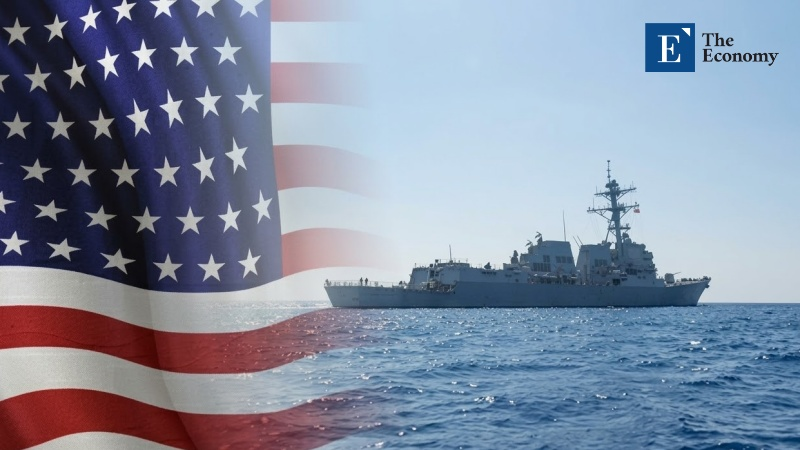
U.S. President Donald Trump is escalating pressure on allies including Korea and Japan over potential military involvement in the Strait of Hormuz, explicitly naming them while raising the intensity of his rhetoric. By citing the scale of U.S. troop deployments and their reliance on imported oil, he has emphasized the need for allied participation while signaling that he will assess each country’s response—effectively framing the issue as a test of loyalty. Even as disruptions to the global energy supply chain become a reality following Qatar’s suspension of liquefied natural gas production and force majeure declarations, major countries continue to maintain a cautious stance toward direct military involvement.
Blunt Expressions of Discontent and Repeated Pressure Messaging
On the 17th, President Trump, speaking to reporters in the Oval Office the previous day, expressed frustration with allies that have shown reluctance to dispatch naval forces to the Strait of Hormuz. “We have 45,000 troops stationed in both Japan and Korea, and 40,000 to 50,000 in Germany,” he said. “We defend all of these countries, yet when we ask, ‘Do you have minesweepers?’ they respond, ‘Well, we don’t want to get involved.’” He added, “We’re going to start thinking a little differently,” signaling a willingness to reconsider security commitments to allied nations.
However, the troop figures cited by Trump differ from actual numbers. U.S. forces in Korea total approximately 28,500, while those in Germany stand at around 35,000. U.S. forces in Japan are estimated at up to 50,000. Presenting inflated figures, Trump argued, “We’ve protected them from terrible external threats, but they showed no enthusiasm,” directly criticizing the posture of allied countries. He further emphasized that “that level of enthusiasm is important to me,” making clear that beyond military cooperation, he is evaluating political loyalty and willingness to contribute.
Earlier, on the 14th, Trump named Korea, Japan, China, the United Kingdom, and France in a post on his social media platform Truth Social, calling for naval deployments. He later expanded the list of countries to roughly seven. He also warned NATO that failure to cooperate would lead to a “very bad future,” effectively demanding a collective response. His argument rests on the heavy dependence of these countries on oil transported through the Strait of Hormuz. This approach goes beyond traditional alliance logic, foregrounding economic interests and resembling a form of transactional negotiation.
At the same time, Trump delivered conflicting messages that undermined the consistency of his stance. At a press event held at the White House on the 16th with the board of the Trump–Kennedy Center, he stated that “we don’t need anyone’s help in the Strait of Hormuz,” asserting that the United States could act independently. He added, “We don’t necessarily need help from allies, but we’re asking anyway because we want to see how they respond,” suggesting that the request functions as a form of “loyalty test.” This approach—evaluating participation irrespective of necessity—signals a shift in alliances from practical military cooperation toward political bargaining instruments.
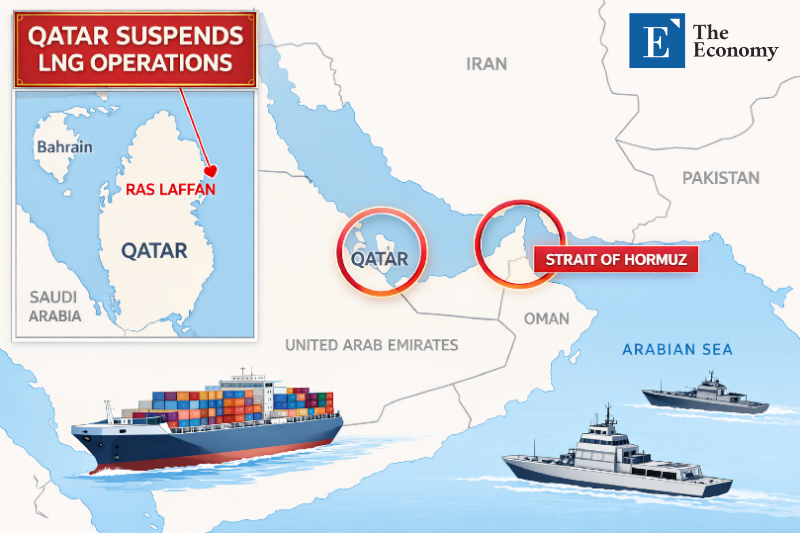
Energy Supply Chain Disruptions Begin to Materialize
As Trump has argued, rising tensions in the Strait of Hormuz are already causing tangible fractures across the global energy supply chain. On the 4th, Shell, the world’s largest LNG trader, declared force majeure on LNG cargoes sourced from QatarEnergy and supplied to global customers. TotalEnergies and several Asian firms soon followed with similar measures, signaling a broader disruption in global LNG distribution networks. Shell and TotalEnergies are key market participants, purchasing and reselling approximately 6.8 million tons and 5.2 million tons of Qatari LNG annually, respectively.
The immediate cause of the supply disruption lies in attacks on Qatar’s core production facilities. Iranian drone strikes hit industrial complexes in Ras Laffan and Mesaieed, prompting QatarEnergy to halt LNG production entirely and suspend shipment contracts. Ras Laffan, with an annual production capacity of 77 million tons, is the largest single LNG production hub in the world. If operations there stop, roughly one in five LNG vessels globally would be unable to depart port. The longest prior disruption at the facility occurred during the 2008 global financial crisis, lasting only five days.
The impact intensifies further downstream in the supply chain. Force majeure notices issued by QatarEnergy specified that March deliveries would proceed as scheduled, but disruptions would begin with April shipments. This indicates that supply gaps will emerge once cargoes currently in transit are exhausted. Asia, which absorbs approximately 90% of Qatar’s LNG output, faces heightened exposure to supply instability. Saad al-Kaabi, Qatar’s energy minister, also noted that even if the war ends immediately, it could take weeks to months to restore normal operations, underscoring the difficulty of near-term supply normalization.
Reluctance Toward Military Response
Despite the anticipated economic impact, major countries continue to maintain a cautious stance toward deploying naval forces. According to France’s Le Monde, foreign ministers of European Union (EU) member states recently agreed not to expand the operational scope of the Middle East naval mission “Aspides” to include the Strait of Hormuz. The mission, currently operating in the Red Sea near Yemen, involves three vessels from France, Italy, and Greece. Expanding its scope would require consensus among member states. EU High Representative for Foreign Affairs and Security Policy Kaja Kallas stated, “No one wants to actively participate in this war,” reaffirming that there are no plans to modify the mission’s scope at this time.
At the same time, Kallas emphasized that “this is not Europe’s war, but Europe’s interests are directly at stake,” clearly separating economic interests from military involvement. During the meeting, opposition from member states was pronounced. Spanish Foreign Minister José Manuel Albares argued that “the current mission scope is appropriate,” while Germany’s Foreign Minister Johann Wadephul stated that “it is difficult to alter security arrangements when the end point and objectives of the war remain uncertain.” These positions reflect a judgment that premature military involvement could escalate into uncontrollable risks.
A similar stance is evident at the national level. German Chancellor Friedrich Merz stated during a meeting with the Dutch prime minister that “as long as the war in the Middle East continues, we will not participate in guaranteeing freedom of navigation in the Strait of Hormuz through military means.” German Defense Minister Boris Pistorius likewise emphasized that “this is not our war, nor did we start it.” U.K. Prime Minister Keir Starmer also drew a clear line, stating that “this will not become a NATO mission.” European countries are thus maintaining a policy direction that prioritizes diplomatic solutions over military intervention, seeking to avoid direct entanglement in an escalating conflict.
Korea is following a similar approach. Hong Ik-pyo, senior presidential secretary for political affairs, stated in an appearance on SBS on the 17th that “the issue of deploying combat troops involves not only the Korea–U.S. relationship but also a highly important domestic political consultation process,” adding that “even the U.K., France, and Japan appear to hold largely negative positions.” The foreign and defense authorities have also refrained from taking a definitive stance. Foreign Minister Cho Hyun commented that whether a deployment request has been made is “a situation that could be interpreted either way,” while Defense Minister Ahn Gyu-back stated that “no formal request has been received from the United States” and that “no review has been conducted regarding the possible deployment of the Cheonghae Unit.”
Similar Post