U.S. Counterterror Chief Resigns, Israel Lobbying and Disinformation Allegations Put War Justification Under Scrutiny

Authored On
Modified
Internal Fractures Deepen as Israel Lobbying Allegations Spread
Recurring Legitimacy Disputes Divide International Opinion
U.S. Exit Strategy Trends Toward “Limited Engagement”
Signs of internal division have emerged in and around the United States over President Donald Trump’s push toward war with Iran. A senior military official personally appointed by Trump publicly resigned, stating that “Iran was not a grave and imminent threat to the United States,” while additional claims have surfaced alleging that public support for the war was shaped by Israeli lobbying and disinformation campaigns.
As a result, the controversy is expanding into a broader debate over the legitimacy of the war itself. Questions over potential violations of international law, rising anti-war sentiment within the United States, and discussions surrounding a limited engagement exit strategy are converging, turning the conflict into both an external confrontation and an internal political burden for the Trump administration.
“I Cannot Support This in Good Conscience” as Loyalist Breaks Ranks
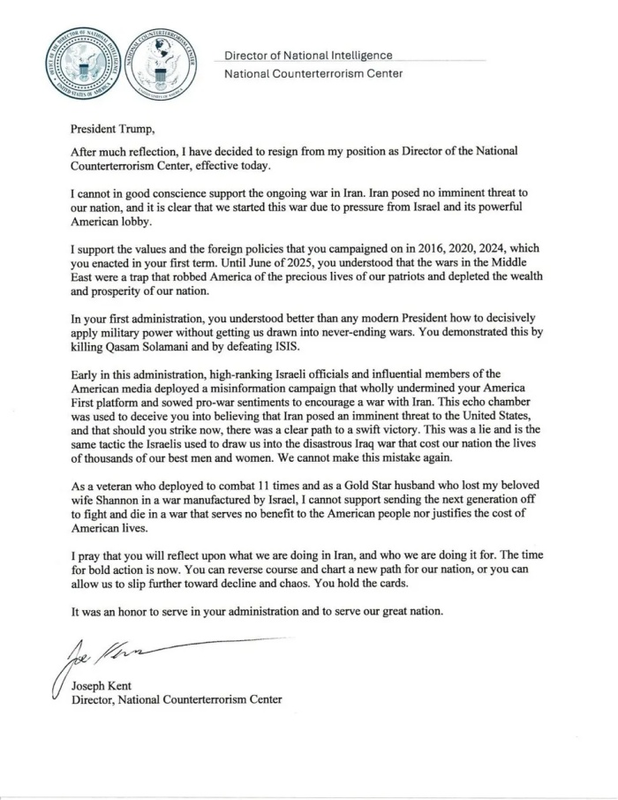
On the 17th (local time), Joe Kent, director of the U.S. National Counterterrorism Center (NCTC), released a resignation letter addressed to President Donald Trump via his social media account on X. In the letter, he stated, “Iran was not a grave and imminent threat to the United States,” adding, “I cannot, in good conscience, support the ongoing war with Iran.” Kent, who was confirmed by the Senate in July last year and had overseen counterterrorism and counternarcotics policy, previously ran twice as a Republican candidate for the House of Representatives and was widely regarded as a staunch Trump loyalist within the party.
Kent argued that the war stemmed from Israeli lobbying efforts. He claimed that “senior Israeli officials and certain U.S. media outlets not only shaped public opinion for war through disinformation campaigns, but also undermined an America-first policy and misled the president into believing Iran posed an ‘imminent threat.’” He further criticized the rationale behind the war, stating that “the promise of a quick victory was false and mirrors the same tactics used to draw the United States into the Iraq War.” Kent made clear his position, saying, “I cannot support sending young Americans into a war that offers no benefit to the United States and cannot justify the sacrifice.”
Kent also contrasted the current approach with the military strategy of Trump’s first administration. “During your first term, you understood precisely how to apply military force decisively without dragging us into endless wars,” he wrote, referencing the killing of Qasem Soleimani and the campaign against ISIS. This reflects a view that, unlike past limited and goal-oriented use of force, the current conflict carries the risk of prolonged involvement. His criticism thus extended beyond questioning the necessity of the war to challenging both its execution and strategic direction.
Kent’s resignation marks the first instance of a senior official appointed by Trump stepping down in opposition to the war with Iran. In response, Trump told reporters that he “thought he was a good person, but very weak on security.” He defended his decision, stating, “Iran was absolutely a threat, and if we had not acted, they would have obtained nuclear weapons.” White House Press Secretary Karoline Leavitt also dismissed Kent’s remarks as “the same false claims repeatedly made by Democrats and some progressive media,” adding that evidence of an imminent threat had been compiled from “multiple sources and factors.”
Legal Justification for Military Action Comes Under Pressure
Kent’s resignation has brought renewed scrutiny to the legal justification for the war. Following the launch of U.S. and Israeli strikes on Iran on the 28th of last month, Trump described Iran as a “grave and imminent threat,” arguing for the necessity of a preemptive attack. However, the War Powers Resolution of 1973 limits presidential use of military force to three conditions: a formal declaration of war, specific congressional authorization, or a national emergency caused by an external attack. With the NCTC director publicly stating that Iran did not pose such a threat, criticism has intensified that the administration’s justification may not meet even domestic legal standards.
Debate at the level of international law is centered on the same issue. The United Nations Charter, under Article 2(4), prohibits the use or threat of force against other states, while Article 51 permits self-defense only in the event of an armed attack. Susan Breau, an international law expert at the British Institute of International and Comparative Law, noted that “legitimate self-defense requires irrefutable evidence of an external attack.” Rafael Grossi, director general of the International Atomic Energy Agency (IAEA), stated at a recent press conference that while Iran possesses “a very large and ambitious nuclear program,” there is no evidence confirming the existence of a system to produce nuclear weapons.
As a result, international debate has intensified. On the 28th of last month, when military operations against Iran began, U.S. Ambassador to the United Nations Mike Waltz stated that “this is a historic moment that demands moral clarity,” emphasizing that “the goal of this operation is to ensure that the Iranian regime cannot threaten the world with nuclear weapons.” Iran, however, condemned the attacks as “war crimes and crimes against humanity,” while China and Russia, both maintaining friendly ties with Iran, called for adherence to the UN Charter and condemned the use of force. Within the Western bloc, countries such as France and Spain also voiced concerns, warning that the situation could “have serious consequences for international peace and security.”
A similar controversy arose during the 12-day conflict between Iran and Israel in June last year (reference timing based on the original article). At that time, the United States struck three Iranian nuclear facilities—Fordow, Natanz, and Isfahan. Critics argued that a permanent member of the UN Security Council had directly participated in military action without securing international consensus, raising concerns that “a second Iraq War” could emerge. Some went further, asserting that “the United States has abandoned even its moral authority.” At the same time, Iran’s response, which included attacks targeting Gulf states and civilian areas, complicated the narrative of unilateral victimhood. This underscores that neither side is free from scrutiny regarding both legitimate self-defense claims and potential violations of international law.
Potential Use of Internal Iranian Variables
As anti-war sentiment begins to gain traction within the United States, the Trump administration’s strategic calculus is becoming increasingly complex. Statements hinting at regime change in Iran and efforts to elevate symbolic figures appear to be part of this dynamic. Reza Pahlavi, the son of Iran’s last monarch, stated in a Fox News appearance in January—during peak anti-government protests—that he is “ready to return to Iran as soon as possible,” describing his role as one of “leading a transition.” He added that “the Iranian people should be free to choose their leaders and determine their own future,” framing change as a matter of internal political transformation rather than direct U.S. control.
His daughter, Noor Pahlavi, has also consistently voiced support prior to the U.S. military operation. She actively supported protests following the death of Mahsa Amini in 2022 and spoke at an anti-regime rally in Los Angeles in February, stating that “the Iranian regime is oppressing ordinary citizens” and that “we cannot ignore this harsh reality.” She further declared that “the protests in Iran today are not merely a social movement, but a national determination to reclaim identity,” emphasizing the need for regime change.
However, the likelihood that these developments will translate into tangible regime change remains limited. Vali Nasr, a professor at Johns Hopkins University’s School of Advanced International Studies, noted in a Time magazine interview that while Reza and Noor Pahlavi have emerged as symbolic figures amid instability in Iran, “it cannot be said with confidence that they enjoy broad support within the country.” The Islamic Revolutionary Guard Corps (IRGC) continues to wield significant influence domestically, and public support for a return to monarchy remains constrained.
This helps explain why the United States is focusing on calibrated deterrence and message management rather than expanding the scope of direct intervention indefinitely. The expected outcome of the conflict appears less about immediate regime change and more about amplifying anti-government sentiment within Iran while increasing pressure on the regime’s legitimacy. This approach aims to create conditions for internal resolution while identifying an exit before deeper entanglement. Trump’s statement immediately after launching military operations—“we will make Iran great again”—also reflects an emphasis on political messaging rather than military occupation.
Similar Post