Middle East-Driven LNG Shock Delivers Windfall, Canada Surges as Qatar’s Void Widens

Oliver Griffin is a policy and tech reporter at The Economy, focusing on the intersection of artificial intelligence, government regulation, and macroeconomic strategy. Based in Dublin, Oliver has reported extensively on European Union policy shifts and their ripple effects across global markets. Prior to joining The Economy, he covered technology policy for an international think tank, producing research cited by major institutions, including the OECD and IMF. Oliver studied political economy at Trinity College Dublin and later completed a master’s in data journalism at Columbia University. His reporting blends field interviews with rigorous statistical analysis, offering readers a nuanced understanding of how policy decisions shape industries and everyday lives. Beyond his newsroom work, Oliver contributes op-eds on ethics in AI and has been a guest commentator on BBC World and CNBC Europe.
Authored On
Modified
North America’s First Pacific Direct-Shipping Terminal
Shorter Transit Times Than U.S. Supplies
Sharp Rise in Exports to Asia in March

As the war with Iran rattles the global liquefied natural gas (LNG) supply chain, Canada’s first large-scale LNG project is rapidly ramping up production and exports, moving to expand supply. With concerns mounting over potential disruptions to supplies from Qatar, the world’s second-largest LNG exporter, Canada is emerging swiftly as a new supplier to the Asian market. Against this backdrop, Canada is accelerating its bid to secure leadership in the global LNG market by pairing additional infrastructure investment with an aggressive output expansion strategy.
Canada’s Kitimat Terminal Sees Export Surge
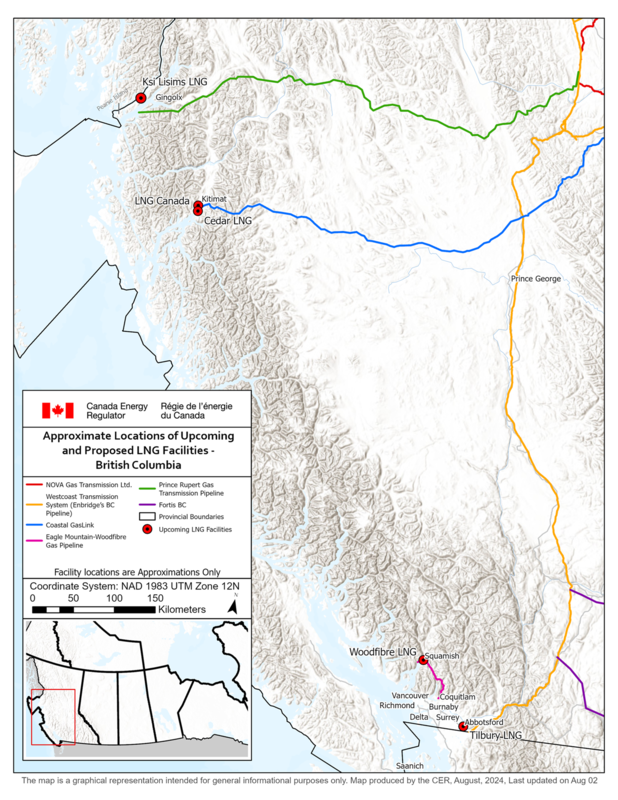
According to Reuters on the 18th (local time), LNG Canada, a global joint venture, dispatched five LNG cargoes to Asia from its Kitimat terminal in British Columbia through the 10th of this month—two to Japan, two to South Korea, and one to the Philippines. That amounts to more than half of the previous month’s total throughput being processed in just 10 days.
The Kitimat terminal is Canada’s first and only LNG export terminal and holds the advantage of significantly shorter shipping times to Asia compared with the U.S. Gulf Coast. Although operational issues in the early phase of the project slowed the pace of production ramp-up more than expected, it is now viewed as having entered a phase of stabilization, with output increasing gradually since January this year.
LNG Canada is a mega-project involving Korea Gas Corp. (5%), Shell (40%), Petronas (25%), PetroChina (15%), and Mitsubishi (15%). Supplies are delivered through the Coastal GasLink pipeline linking northern gas fields. Completion of Phase 1 has given the project LNG production capacity of 14 million tonnes per annum (mtpa), with expansion to 28 million tonnes expected after Phase 2. Martin King, an analyst at energy consultancy RBN Energy, said, “Canada is trying to increase production in the short term to capture the high price premium in Asia.”
Canadian Gas Exports Continue to Decline as U.S. Domestic Output Rises
The increase in LNG Canada’s output is drawing market attention as it coincides with Qatar’s production halt. Qatar, which accounts for roughly 20% of global LNG trade, recently suspended production and declared force majeure after tanker traffic through the Strait of Hormuz was blocked by the Iran war. Canadian LNG is now moving to fill part of the supply gap created by that disruption.
LNG Canada carries major strategic significance as the first large-scale facility in North America to export LNG directly across the Pacific. Compared with existing export terminals on the U.S. Gulf Coast, it offers a substantial reduction in voyage times to Asian buyers. That logistical efficiency translates into lower shipping costs and stronger supply security, bolstering its competitiveness in the Asian market.
Canada’s aggressive push is closely tied to a strategy aimed at diversifying a natural gas export structure that had been heavily dependent on the United States. While Canada holds vast oil and natural gas reserves, particularly in Alberta, its energy exports have long relied on overland pipeline shipments to the U.S. According to Bloomberg, the global LNG export market is dominated by the United States (26.3%), Qatar (18.6%), and Australia (17.8%). As of 2024, Canada was the world’s fifth-largest producer of natural gas and the fourth-largest exporter. Canada’s exports to the U.S. peaked at USD 18.9 billion in 2022 before falling to USD 6 billion in 2024. Since 2010, Canadian gas exports have remained on a persistent downtrend as U.S. domestic production has increased.
Target of 100 Million Tonnes in Annual Exports
Canada has accordingly shifted course toward liquefying natural gas and exporting it as LNG. The model involves transporting gas produced in the inland areas of British Columbia, which holds substantial shale gas reserves, through a 670-kilometer pipeline crossing the Rocky Mountains for liquefaction. Two liquefaction units have already been built, and the project also holds a 40-year LNG export license. This carries significance not only in terms of lower transportation costs but also in mitigating geopolitical risk. The route bypasses both the Strait of Hormuz, which is exposed to Middle East conflict, and the Panama Canal, where drought-related transit restrictions recur periodically.
The Canadian government is also pursuing large-scale infrastructure investment plans to expand LNG supplies not only to Asia but also to European Union member states. In September last year, Prime Minister Mark Carney told a press conference in Berlin that Canada was pursuing USD 500 billion in port and energy infrastructure investment. “Canada has abundant natural gas reserves, world-class LNG projects, renewable energy resources, a nuclear industry, and carbon capture technology,” he said. “If demand and infrastructure are in place, LNG supply will not be a problem.” Tim Keller, head of the German Gas and Hydrogen Industry Association, responded at the time by saying that German industry needed stable and affordable gas supplies and welcomed the prospect of long-term contracts.
The Canadian government is not stopping there and has set a target of 100 million tonnes in annual LNG exports as it seeks to join the ranks of the world’s largest suppliers. Earlier this month, Tim Hodgson, Canada’s minister of energy and natural resources, said, “Countries in Asia want Canadian gas,” adding, “If we can supply up to 100 million tonnes of LNG annually, as we expect, we will become one of the world’s major LNG suppliers.” Annual exports of 100 million tonnes would be an aggressive figure, more than double the scale expected when all currently planned projects come online. To meet that target, the Canadian government is pushing legislation to expedite permitting procedures for major infrastructure projects while also accelerating the creation of investment funds for new export ventures.
Oliver Griffin is a policy and tech reporter at The Economy, focusing on the intersection of artificial intelligence, government regulation, and macroeconomic strategy. Based in Dublin, Oliver has reported extensively on European Union policy shifts and their ripple effects across global markets. Prior to joining The Economy, he covered technology policy for an international think tank, producing research cited by major institutions, including the OECD and IMF. Oliver studied political economy at Trinity College Dublin and later completed a master’s in data journalism at Columbia University. His reporting blends field interviews with rigorous statistical analysis, offering readers a nuanced understanding of how policy decisions shape industries and everyday lives. Beyond his newsroom work, Oliver contributes op-eds on ethics in AI and has been a guest commentator on BBC World and CNBC Europe.
Similar Post