[U.S.-Iran War] Iran Strikes Qatar’s Largest LNG Facility, Raising Prospect of Prolonged Energy Price Surge as ‘Economic Warfare’ Escalates

As one of the youngest members of the team, Tyler Hansbrough is a rising star in financial journalism. His fresh perspective and analytical approach bring a modern edge to business reporting. Whether he’s covering stock market trends or dissecting corporate earnings, his sharp insights resonate with the new generation of investors.
Authored On
Modified
Iran, Hit at South Pars, Targets Qatar’s Core LNG Hub
Damage Seen Spreading to Saudi Arabia and the UAE, Deepening Market Anxiety
Whether the Energy Price Spike Endures Hinges on Iran’s Remaining Military Capacity
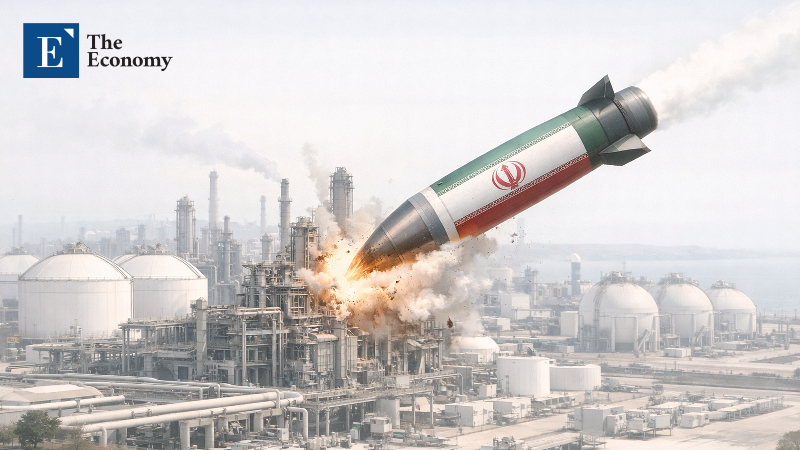
Iran has struck Qatar’s largest liquefied natural gas (LNG) production hub with ballistic missiles. The attack dealt a devastating blow to Qatar, which had already suffered an earlier strike on its energy production facilities and declared force majeure. As the Middle East conflict begins to take on the contours of “economic warfare,” with national energy infrastructure emerging as a primary target, markets are increasingly concerned that, should this pattern persist, the current surge in global energy prices could prove prolonged.
Ras Laffan Industrial City Engulfed in Flames
According to a report by the Financial Times (FT) on the 18th, Iran fired five ballistic missiles that day at Ras Laffan Industrial City, the world’s largest LNG export hub, located near Doha, Qatar. Four of them were intercepted, but one landed in an area densely packed with LNG production and refining facilities. In response, QatarEnergy, Qatar’s state-owned energy company, said that “Ras Laffan Industrial City was hit by a missile attack, causing a fire and extensive damage.”
QatarEnergy had already suspended all LNG production and declared force majeure after Ras Laffan and Mesaieed Industrial City were hit by drone attacks on the 2nd. Qatar’s energy minister, Saad al-Kaabi, had also indicated the possibility of a protracted disruption, saying that it could take several weeks to several months to resume operations. Iran’s latest strike amounts to a decisive escalation capable of completely crippling Qatar’s already fragile LNG supply capacity.
Markets are raising concerns that the global energy supply chain could now face prolonged turmoil. Ras Laffan Industrial City is a critical facility responsible for roughly 20% of global LNG supply. In the near term, countries with heavy dependence on Qatari energy are likely to suffer the most severe shock, while a broader tightening in global supply and demand would make it difficult for other countries to avoid indirect price pressure.
In that regard, Saul Kavonic, an energy analyst at MST Financial, said, “Depending on the scale of the damage, the global gas shortage could be prolonged,” adding, “Even after the war ends, restoration could take months to years.” Tom Marzec-Manser, head of gas and LNG at Wood Mackenzie, also said, “If Ras Laffan’s production capacity has been impaired, gas balances will become even tighter.”
Escalating Energy Warfare, Further Attacks Also Possible
The attack is widely seen as retaliation for the strikes by the United States and Israel on Iran’s South Pars gas field. Iran’s semi-official Fars News Agency reported on the 18th that “South Pars, one of the world’s largest gas fields, and the Asaluyeh natural gas refining complex, Iran’s largest energy hub, were struck by missiles.” According to Iranian state television, fires broke out in zones 3, 4, 5, and 6 of the South Pars gas field as a result of the attack, and operations in those areas were suspended to prevent the damage from spreading. Multiple explosions were reportedly heard at the scene, and impacts were also detected across parts of the Asaluyeh refining complex.
In response, Iran’s Islamic Revolutionary Guard Corps (IRGC) signaled its intent to retaliate against energy facilities in the Gulf region and urged nearby countries to evacuate. The nature of the conflict in the Middle East has begun to evolve beyond military confrontation into economic warfare targeting energy infrastructure. Potential targets cited included Saudi Arabia’s Samref refining facilities and Jubail petrochemical complex, the United Arab Emirates’ Al Hasa gas field, and Qatar’s petrochemical facilities. This suggests that, following Qatar, additional attacks on the energy infrastructure of other Gulf states may yet be carried out.
Amid mounting uncertainty stemming from the Middle East, energy prices are rising sharply. On the 18th, Brent crude futures for May settlement, the global oil benchmark, closed at USD 107.38 a barrel, up 3.8% from the previous session, while U.S. West Texas Intermediate (WTI) crude futures for April settlement also rose 0.1% to close at USD 96.32 a barrel. Dutch TTF futures, Europe’s benchmark for gas prices, also jumped more than 7.5% in a single day, surpassing USD 63.83 per megawatt-hour (MWh).

What Remains of Iran’s Military Capacity?
Major financial institutions are forecasting that the current rise in energy prices will continue. According to a report by The Washington Post (WP) on the 18th, Citibank expects Brent crude to climb to around USD 120 a barrel in the near term. It also presented a scenario in which average Brent prices in the second and third quarters of this year could surge to USD 130 a barrel if widespread attacks on energy facilities continue and the Strait of Hormuz remains closed for an extended period. The scale of crude supply disruptions through April was estimated at 11 million to 16 million barrels per day.
Some analysts also say the trajectory of future energy prices could shift sharply depending on Iran’s remaining military capabilities. Based on assessments by the U.S. Department of Defense and the Israeli side, Iran’s missile and drone capabilities have declined steeply in recent days. U.S. Secretary of War Pete Hegseth has claimed that Iran’s ballistic missile operations have fallen by about 90% and its drone attacks by 95%. The Jewish Institute for National Security of America (JINSA), a U.S. national security think tank, also assessed that simultaneous strikes on Iran’s missile stockpiles and launch infrastructure had created conditions in which “it would be difficult to sustain continuous high-intensity attacks.”
However, there is also a view that it would be premature to conclude that Iran’s military capabilities have been exhausted. The Wall Street Journal (WSJ) pointed out that Iran still retains missile forces numbering in the thousands and remains capable of launching several hundred missiles over a short period. Another U.S. military and security think tank, the Institute for the Study of War (ISW), also suggested that the decline in Iranian missile launches reflected a strategy of calibrating launch tempo with a protracted conflict in mind.
As one of the youngest members of the team, Tyler Hansbrough is a rising star in financial journalism. His fresh perspective and analytical approach bring a modern edge to business reporting. Whether he’s covering stock market trends or dissecting corporate earnings, his sharp insights resonate with the new generation of investors.
Similar Post