[U.S.-Iran War] “Boasting a 90% Interception Rate” Israel’s Air Defense Shield Has Been Breached Near Nuclear Facilities

Niamh O’Sullivan is an Irish editor at The Economy, covering global policy and institutional reform. She studied sociology and European studies at Trinity College Dublin, and brings experience in translating academic and policy content for wider audiences. Her editorial work supports multilingual accessibility and contextual reporting.
Authored On
Modified
Vulnerabilities in responding to individual warheads repeatedly exposed
Growing anti-war sentiment undermines the rationale for war
Military victory remains uncertain, strategic failure does not
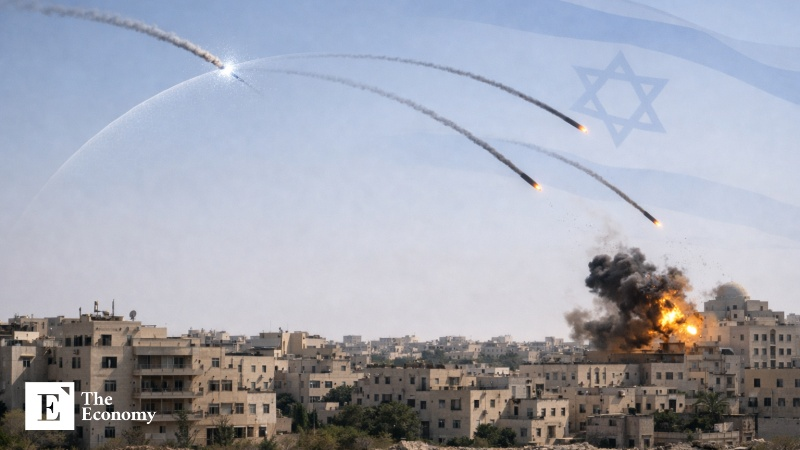
As Iranian ballistic missiles landed in cities near the Negev desert, where Israel’s nuclear facilities are located, confidence in the air defense network long touted as the world’s strongest is also beginning to waver. Confirmation that repeated interception attempts failed even in the area protected by Israel’s most formidable defenses has prompted assessments that the limitations of the existing defense architecture have been laid bare. With no sign that the Middle East war is nearing an end, anti-war sentiment has expanded in the United States, while the international community continues to take a cautious stance on military intervention, making the broader atmosphere surrounding the conflict increasingly complex.
Repeated attack pattern still met with no answer
On the 22nd, The New York Times (NYT) reported that two ballistic missiles launched by Iran the previous day fell in residential areas of Dimona and Arad, near the Negev desert, where Israel’s nuclear research facilities and reactor are located, and assessed that “domestic anxiety is spreading in Israel over its air defense system, long regarded as among the best in the world.” The area hit in the latest strike is one of the most heavily defended in all of Israel, and confirmation that two interception attempts still failed has only deepened public unease, according to the report.
The extent of the damage was captured in footage obtained by the Associated Press. In Dimona, a missile was seen falling directly to the ground, sending flames into the air, while residential buildings suffered severe exterior damage that exposed their interiors. In Arad, a ballistic missile struck a densely populated area, seriously damaging at least three buildings. The AP raised the possibility that some fatalities had occurred, while Israeli local media reported that the number of injured had exceeded 150. On social media platforms including X, numerous videos circulated showing interceptor missiles being launched, explosions lighting up the sky, and CCTV footage of windows shattering from the impact.
Israel’s vaunted air defense system is built on a multilayered structure. Arrow-3, capable of exo-atmospheric interception, has a range of up to 2,400 kilometers, while David’s Sling, responsible for medium-range interception, defends an area of roughly 300 kilometers. Iron Dome, tasked with short-range defense, can intercept threats at altitudes of 4 to 70 kilometers. This architecture has been regarded as the global benchmark in countering short-range rockets. Even immediately after the outbreak of the current war, the Israeli military claimed that the interception rate for Iranian ballistic missiles exceeded 90%, but this latest case has once again confirmed that complete defense is impossible.
The issue is that this interception failure was not an isolated incident. Israel experienced a similar breach of its air defenses in June of last year. At the time, Iranian ballistic missiles drew attention for employing a tactic in which they split into multiple small warheads midair, disrupting the interception system. Given that the existing defense network was designed on the premise of responding to individual warheads, an attack pattern in which targets disperse simultaneously places a heavier burden on the entire detection and response process. Yet despite a nine-month gap, the renewed exposure of the air defense system’s vulnerabilities leaves the Israeli military unable to avoid criticism that it failed to sufficiently understand the enemy’s attack pattern.
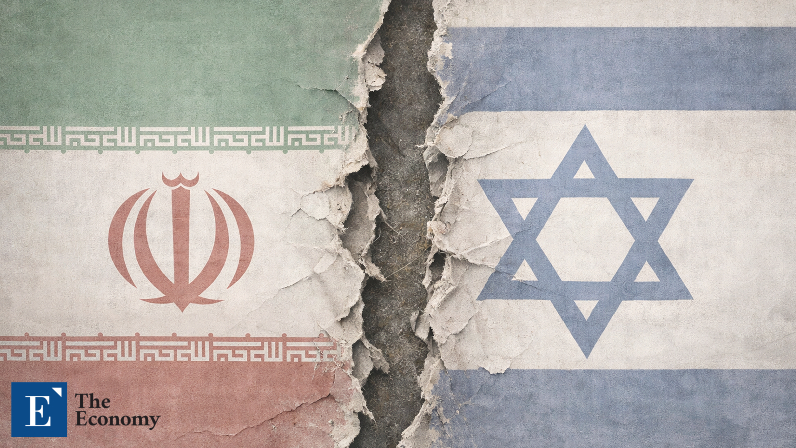
Fatigue builds as the war drags on
Anti-war sentiment is also gaining momentum. In a recent survey conducted by CBS News and pollster YouGov of 3,335 U.S. adults, 60% said they opposed U.S. military action against Iran. That marked a 4 percentage point increase from 56% earlier this month. In the same survey, 68% of respondents said the Donald Trump administration had not clearly explained its goals in the conflict, up 6 percentage points from 62% earlier this month. Doubts about both the legitimacy of the war effort and the clarity of its objectives are expanding at the same time.
In addition, 57% of respondents said the war was unfolding in a way unfavorable to the United States, while only 43% viewed it positively. When asked about the nature of the conflict, 66% described it as a “War of Choice,” while 34% called it a “War of Necessity.” The divide was especially pronounced by political affiliation: 92% of Democratic supporters and 73% of independents viewed the war as a matter of choice, while 67% of Republican supporters saw it as an unavoidable response for national security. This points to a stark divergence in perception along political lines.
On the question of war aims, many respondents pointed in the same direction. A full 92% agreed that ending the conflict as quickly as possible was important, while top priorities included the permanent dismantling of Iran’s nuclear program (73%) and the prevention of regional threats (68%). On the need for regime change in Iran, however, opinion was split, with 49% saying it was important and 51% saying it was not. Views were similarly divided on ending the war while leaving the current regime in place, at 47% versus 53%. While there is relatively little disagreement over the desirability of ending the war, the survey confirmed that no social consensus has been formed on the direction or method for doing so.
Within Israel itself, fatigue from the prolongation of war is also accumulating. This can be seen in the conflict with Hamas, which has been underway in Gaza for more than two years. In a survey conducted by the Israel Democracy Institute (IDI) at the end of 2023, when the two sides first clashed, 67% of Israelis said the suffering in that region should either be ignored or given only minimal consideration in government decision-making. In subsequent surveys, however, support for a negotiated ceasefire steadily increased. The IDI noted that “in a period of just over two years, more than 1,200 people have been killed and 251 hostages abducted, with public fear and concern also growing.”
Anti-war protests spread, criticism ripples outward
The view from the international community is not markedly different. As the conflict enters its fourth week with no sign of ending, protests condemning U.S. and Israeli military action are spreading in multiple countries. In Madrid, Spain, demonstrators carried signs labeling President Donald Trump and Israeli Prime Minister Benjamin Netanyahu as “war criminals,” while chanting slogans calling for the war to end immediately. Protesters voiced concern that the conflict could escalate into nuclear war, revealing growing anxiety over the possibility of wider escalation.
Diplomatic cracks are also becoming visible. The Group of Seven (G7) and the European Union (EU) issued a joint statement urging Iran to halt its attacks immediately, while drawing a clear line against the prospect of military intervention. British Foreign Secretary Yvette Cooper said, “We were not involved in offensive actions, and we will not be,” making clear that the United Kingdom’s position is limited to defensive support. Even as the United States seeks military participation from allies, major countries appear to be choosing distance rather than coordination. At the same time, Iran has continued its legal and moral argument over responsibility for the war, saying that “the war will end only if the United States and Israel stop attacking first.”
This dynamic is expanding the nature of the war into a battle over public opinion. Netanyahu had previously defined international opinion and social media as a new battlefield during clashes with the Palestinians, officially describing it as the “eighth front.” At the time, messages bypassing official narratives spread rapidly across social platforms such as X and YouTube, while reports of civilian casualties in conflict areas were shared in real time. As the traditional media-centered structure of opinion formation has weakened, the ability of states to control messaging has also become more limited. That is the backdrop to growing assessments that, regardless of Israel’s battlefield performance, this war will accelerate its international isolation.
Niamh O’Sullivan is an Irish editor at The Economy, covering global policy and institutional reform. She studied sociology and European studies at Trinity College Dublin, and brings experience in translating academic and policy content for wider audiences. Her editorial work supports multilingual accessibility and contextual reporting.
Similar Post