Will Ukraine Join the EU in the Next Decade? Rethinking "Fast-Track" Membership and Its Costs

Working across research, policy, and data-driven analysis, the Editorial Board ensures that published pieces reflect a consistent institutional perspective grounded in quantitative reasoning and long-term structural assessment.
Authored On
Modified
Ukraine EU membership hinges less on speed and more on credible sequencing
Reconstruction costs, public opinion, and veto politics demand phased and enforceable integration
A structured, conditional pathway can secure Ukraine’s future while protecting EU cohesion
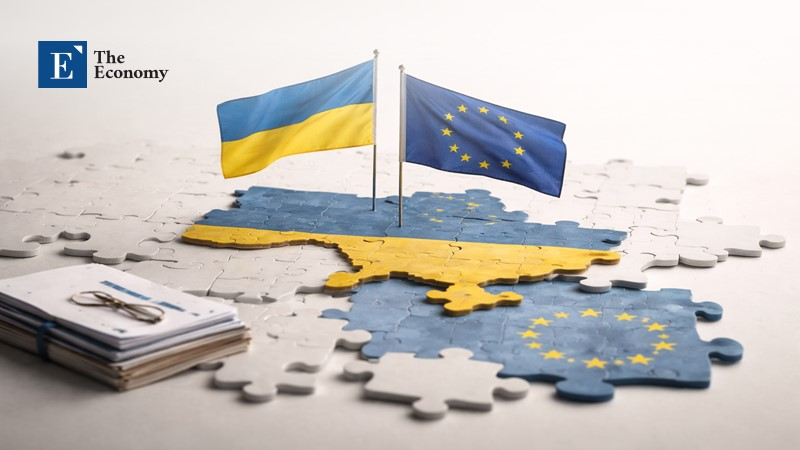
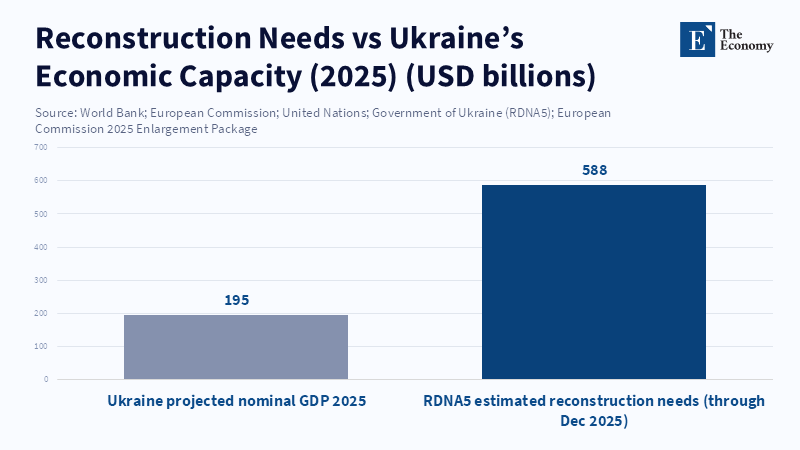
Ukraine's potential membership in the EU has moved past a mere idea. By September 2025, Kyiv had finished the EU's legislative review and quickly moved through the required steps, a feat that appeared impossible just three years before (European Commission, 2025a; European Commission, 2025b). However, this technical success hides a more complex reality: joining the EU is as much about political agreement as it is about following laws. The European Commission can confirm that regulations are met, but member countries must be willing to relinquish some control over their veto powers, budget decisions, and political discourses (European Union, 2024). According to a United Nations report on Ukraine, the total cost of reconstruction and recovery is projected to be almost $588 billion by the end of 2025 (World Bank, European Commission and United Nations, 2025). According to Statista, 85 percent of Ukrainians were in favor of their country joining the European Union as of July 2023, showing strong public support for EU membership. These factors lead to a key decision: Should Ukraine's membership be treated as an emergency measure due to the war (a fast-track approach), or should it be considered a standard enlargement process that follows the EU's established rules? The answer to this question will not only affect Ukraine's future but also the EU's unity, its trustworthiness, and its ability to manage future expansions (Emmanouilidis, 2026).
Ukraine EU membership: shifting the discussion from speed to a step-by-step approach
The usual discussion presents two options: speed up membership to quickly integrate Ukraine into Europe, or stick to the full Copenhagen criteria, which could mean a long wait (Morina, 2025). This way of thinking overlooks a more important aspect: the order in which things are done. Ukraine's completion of the screening process by September 2025 indicates it is making progress on reforms (European Commission, 2025a). However, screening is simply a preliminary assessment. The Copenhagen criteria still matter because they ensure that when a country joins, the EU's fundamental principles are upheld (European Union, 2024). These include the rule of law, working markets, protection of minorities, and a government that can manage funds properly. If membership is rushed without addressing how Ukraine will fit into the EU's financial systems, its border control policies (Schengen), its currency (the euro), and its labor market, the EU risks creating a two-tiered system where Ukraine is included on paper but excluded in practice. This would satisfy immediate political goals but damage the EU's long-term legitimacy (Aydıntaşbaş et al., 2026).
By focusing on a step-by-step approach, we can also change how we think about policy for educators, government workers, and decision-makers. For education, the timing of membership is not just symbolic. It affects curriculum alignment, recognition of qualifications, student mobility, and funding opportunities. For government administrations, this approach changes priorities. Should limited resources be focused on strengthening the rule of law, or on reforming education and training to support the job market? For decision-makers, the question is whether to impose strict conditions up front to reassure member states that Ukraine's membership will not disrupt EU budgets, or to create temporary arrangements that are well-defined and time-limited (Emmanouilidis, 2026). In short, the choice is not between fast and slow, but between organized and enforceable, or rushed and unclear.
Ukraine EU membership: economics, reconstruction needs, and reliable conditions
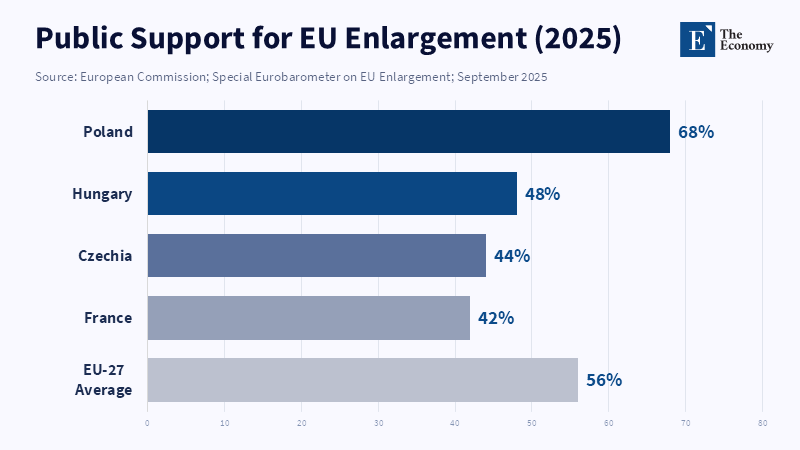
Numbers are important because they force us to be realistic in policy planning. The joint RDNA5 assessment estimates that around $588 billion will be needed for reconstruction and recovery over the next ten years (World Bank, European Commission and United Nations, 2025). This is not simply an abstract figure. It is almost three times Ukraine's projected 2025 GDP, with the greatest needs in transportation, energy, and housing. At the same time, the EU has shown its readiness to begin negotiations and to employ tools such as the Ukraine Facility to provide aid (European Commission, 2025b). Public opinion polls in the EU show that around 56% of people support further enlargement, but this varies widely among countries (European Commission, Directorate-General for Communication, 2025; Lory, 2025). In key countries like France and Czechia, support is closer to the low 40s. These numbers indicate that political space is limited, and technical progress alone will not guarantee political approval in national capitals.
Given these facts, any conditions for membership must specify financing, measurable goals, and temporary safeguards. A practical approach would be to build on existing EU practices, such as gradually integrating Ukraine into the internal market based on verifiable progress in fighting corruption, upgrading public procurement, and screening foreign investments (Transparency International Ukraine, 2025). This would involve using Commission monitoring reports and independent audits (from organizations such as the World Bank and the IMF) to determine when Ukraine can access funds. Access to these funds would be conditional on Ukraine implementing matching reforms. If data is lacking, transparent estimates should be calculated by combining damage assessments with proxies for administrative capacity (such as the number of certified public procurement officials and the rate at which past EU funds have been used). According to AP News, any estimates should be evaluated under various scenarios, such as a ceasefire or continuing conflict, to ensure that decisions about funding Ukraine, including proposals like using frozen Russian assets, are based on thorough technical verification and allow member states to render informed, confident votes (World Bank, European Commission and United Nations, 2025).
This careful sequencing also addresses the concern that a fast-track approach means lower standards. Instead, it distinguishes between temporary measures (such as market access, student and researcher mobility, and participation in EU programs) and permanent changes (such as full budget transfers, euro adoption, and free movement). Members can agree to temporary, conditional, and time-bound benefits without changing treaty obligations. This approach protects the EU's credibility while providing Ukraine with much-needed political support, without forcing member states to make open-ended financial commitments (Morina, 2025).
Ukraine EU membership: politics, vetoes, and credible solutions
Politics has a crucial role. The objections from Hungary and Turkey's sensitivity demonstrate that membership is not only a technical process (European Parliament, 2016). Hungary's tactics (referendums, parliamentary blocks) and its willingness to link unrelated issues to enlargement decisions underscore the vulnerability of the unanimity rule (Zsiros, 2025). Turkey's frozen accession talks show how enlargement can be used for political purposes within countries (European Parliament, 2016). The EU needs to develop institutional responses that protect the spirit of the unanimity principle (safeguarding sovereign consent) while preventing individual members from demanding unrelated concessions or permanently delaying a candidate's progress.
One solution is to create temporary mechanisms, approved by qualified majorities, for provisional measures. The EU already uses enhanced cooperation and can use it as a model (SIEPS, 2026). A group of willing member states could move forward on financing, market integration, or common procurement for Ukraine while preserving the unanimity requirement for full accession. This approach grants progress while putting pressure on objecting states without forcing them into an all-or-nothing position. A second solution is a more transparent framework for linking unrelated issues. The Council should prohibit linking enlargement votes to domestic political demands unrelated to accession criteria, with penalties for abuse. (Zsiros, 2025). This institutional reform needs courage but protects enlargement from being held hostage to bilateral disputes.
Some criticisms are expected. Some will say that differentiated pathways create a two-tiered Europe and undermine equality. This is a risk, but only if provisional mechanisms are permanent and unclear. The safeguards are clear: every provisional measure must include sunset clauses, monitoring, and a route to full membership that does not give the candidate an unfair advantage or disadvantage compared to others. Another concern is financial: people may ask why EU taxpayers should fund reconstruction for a country still at war. The sequencing answer is to focus on EU support (standards, legal alignment, capacity building) and private-sector incentives (guarantees, blended finance), while linking budget transfers to verified progress on reforms. This maximizes leverage over reforms while limiting risks to the EU budget (Aydıntaşbaş et al., 2026).
Including the education sector in this political calculation is very important. Education and research are politically important and relatively low-risk ways to strengthen connections. Providing Ukrainian students with easier credit recognition, scholarships, and faculty exchanges aligns with EU norms, rebuilds human capital, and signals inclusion without large financial transfers (European Commission, Directorate-General for Communication, 2025). This strengthens Ukraine's ability to manage reconstruction and creates a visible success story that can shift public opinion in supportive member states.
Ukraine's EU membership is not a simple choice between rushing ahead without consideration or being paralyzed by principles. It is a test of European statesmanship: can the Union create a time-bound, enforceable sequence that delivers political signals, preserves legal rules, and shares costs fairly? The facts are clear: Kyiv has made rapid technical progress, reconstruction needs are huge, EU public opinion remains supportive but fragile, and veto politics can stall the process (Emmanouilidis, 2026; Lory, 2025). The best path is a phased approach: provisional, monitored access to EU programs; clear reform milestones linked to financing; sunset clauses to prevent permanent second-class status; and a political agreement among willing member states to shoulder immediate burdens while preserving unanimity for full accession. For educators, administrators, and decision-makers, that means preparing institutions now for stepwise integration—aligning curricula, building qualifications frameworks, and scaling administrative capacity—so that when political conditions coincide, membership will be real and lasting.
References
Aydıntaşbaş, A., Baev, P.K., Budjeryn, M., Gordon, P.H., Grzymała-Busse, A., Hamilton, D.S., Karlin, M., Pifer, S., Sisson, M.W., Stelzenmüller, C. and Wright, T., 2026. What price for peace in Ukraine? Washington, DC: Brookings Institution.
Emmanouilidis, J.A., 2026. A fast-tracked Ukraine EU accession by 2027? Here are three dilemmas. Brussels: European Policy Centre.
European Commission, 2025a. Ukraine successfully completes its screening process. Brussels: European Commission.
European Commission, 2025b. Ukraine 2025 Report – 2025 Enlargement Package. Brussels: European Commission.
European Commission, Directorate-General for Communication, 2025. Special Eurobarometer: Public opinion on EU enlargement. Brussels: European Commission.
European Parliament, 2016. Freeze EU accession talks with Turkey until it halts repression, urge MEPs. Brussels: European Parliament.
European Union, 2024. Accession criteria (Copenhagen criteria). Luxembourg: Publications Office of the European Union.
Lory, G., 2025. 56% of citizens support EU enlargement, new Eurobarometer poll shows. Euronews.
Morina, E., 2025. Accelerate the accessions: Why faster is better in EU enlargement policy. Berlin: European Council on Foreign Relations.
SIEPS, 2026. EU foreign policy via enhanced cooperation. Stockholm: Swedish Institute for European Policy Studies.
Transparency International Ukraine, 2025. Limited progress in the fight against corruption: What the 2025 European Commission report recommends for Ukraine. Kyiv: Transparency International Ukraine.
World Bank, European Commission and United Nations, 2025. Updated Ukraine Recovery and Reconstruction Needs Assessment. Washington, DC: World Bank Group.
Zsiros, S., 2025. EU mulls tweaking rules to bypass Hungarian veto on Ukraine’s accession. Euronews.
Working across research, policy, and data-driven analysis, the Editorial Board ensures that published pieces reflect a consistent institutional perspective grounded in quantitative reasoning and long-term structural assessment.