The false boom: why “nuclear escalation risks” from Russia are real hazards — and how education leaders should respond

Working across research, policy, and data-driven analysis, the Editorial Board ensures that published pieces reflect a consistent institutional perspective grounded in quantitative reasoning and long-term structural assessment.
Authored On
Modified
Nuclear escalation risks now stem from fragile systems, not just intent
Drones and misinformation shrink decision time and raise miscalculation
Education can reduce nuclear escalation risks through civic resilience
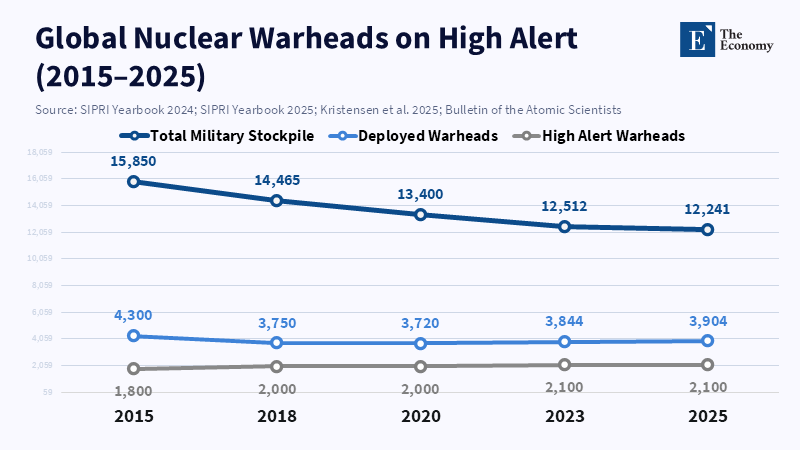
At the start of 2025, roughly 3,900 nuclear warheads were deployed with operational forces worldwide, and about 2,100 of those were kept at heightened operational alert — numbers that make bluster into a systemic risk (SIPRI, 2025; Kristensen et al., 2025). These figures are not abstract Cold War trivia; they change how organisations think about contingency, continuity and the very purpose of public education in crises. The phrase “nuclear escalation risks” has become shorthand for a cluster of threats: deliberate coercion, accidental launch, and the cascading social breakdown that follows targeted strikes or high-impact sabotage (SIPRI, 2024). That cluster now sits next to another structural shift — low-cost, hard-to-defend delivery systems such as armed drones — which compresses decision cycles and raises the odds that threatening rhetoric becomes an operational dilemma (Peterson, 2025). This column reframes the familiar puzzle (are threats empty or urgent?) by arguing that the policy problem is not whether a leader will press a red button today but whether modern technology, posture and disinformation together make a catastrophic miscalculation more likely — and why education systems must treat that probability as a governance problem they can help reduce (Office of the Director of National Intelligence, 2025).
Nuclear escalation risks: from rhetoric to structural vulnerability
The dominant frame — that most nuclear threats are rhetorical posturing and therefore safely ignorable — rests on two weak assumptions. First, it assumes decision-makers always act rationally in the narrow sense: deterrence holds, and leaders avoid self-destruction. Second, it assumes instrument choice matters more than system fragility. Both are overstated today. Deterrence still works in many scenarios, but modern warfare has introduced layers that change the odds: sub-strategic weapons, forward-positioned launchers, and rapid long-range strike capabilities that shorten warning times (Kristensen et al., 2025). When indicators move quickly, ambiguity turns into pressure. A leader watching an arsenal’s posture change and seeing domestic panic may conclude that quick, firm action is the lesser evil. That is not to say launch is likely on a whim, but small additional risks — a misinterpreted drill, a hacked sensor, a drone strike that looks like a strategic precursor — add up (Office of the Director of National Intelligence, 2025). The result is a new kind of fragility: not because leaders are irrational but because systems now present far more alarm signals in far less time, and because actors exploit ambiguity to gain leverage (Aydıntaşbaş et al., 2026).
This is where the notion of “empty threats” misleads. Empty threats are dangerous precisely because they can create self-reinforcing responses in adversaries and allies. A repeated pattern of rhetorical nuclear signalling without observable restraint can produce two opposite, equally damaging reactions: indifference among neighbours, and performative escalation by the issuer to show the threat “worked.” Either direction raises systemic risk. Moreover, posture changes matter. Recent public reporting that Russia has declared new nuclear-capable systems into service and has staged deployments in allied territory shows how signalling can alter force geometry and the perception of imminence (Press, 2025; Harding, 2025). Even if these deployments are meant as political theatre, they shorten the political and military response window. In short, the solid distinction between “real” and “bluff” erodes when posture, technology and communication noise join forces.
Nuclear escalation risks and drones: the new shock multiplier
Drones are the classic shock multiplier. They are cheap, dispersible, hard to attribute quickly, and lethal in aggregate (Peterson, 2025). War in 2025–26 has shown how massed drone attacks and deep strikes can create dramatic strategic effects without traditional force-on-force battles (Gatopoulos & Yurchuk, 2025). Recent large-scale barrages that involved hundreds to over a thousand unmanned systems and missiles in single campaigns demonstrated how quickly critical infrastructure and political symbols can be hit, sometimes with fatal results (Reuters, 2026). Those attacks do not always target leadership or nuclear forces directly; they do something arguably worse for crisis stability — they blur the line between the battlefield and the homeland and create fodder for sudden-escalation narratives. When a regime claims a drone strike hit an elite target or a presidential residence, the political momentum to “respond decisively” can be overwhelming. The key point for policy is simple: drones and related asymmetric tools lower the threshold at which crises start to feel existential to decision-makers.
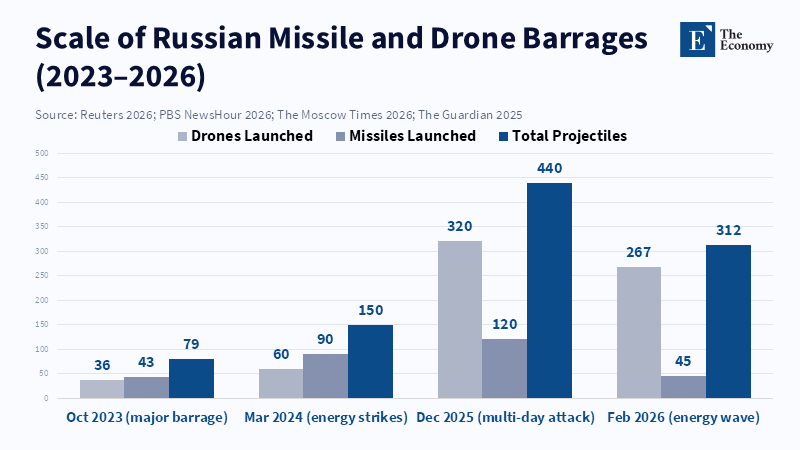
Practical examples deepen the point. In late 2025 and early 2026, reports described the movement and activation of a new medium-range, nuclear-capable system into proximate territory, and within weeks, regional strikes — some by drones — produced civilian fatalities far from front lines (Press, 2025; Reuters, 2026). Those incidents did two things simultaneously: they gave rhetorical ammunition to hardliners and they increased the political salience of “imminent threats” for national security councils. When leaders publicly link an attack on infrastructure or symbolic sites to an existential threat, the political clock accelerates. The capacity to mass drones makes such claims harder for outside observers to treat as pure bluff, because the observable damage creates audience pressure at home and abroad. The consequence is that an otherwise “empty” nuclear warning may have non-empty effects on crisis dynamics, and that alters the policy calculus for educators and administrators planning for continuity and civic resilience.
What educators and policymakers need to do about nuclear escalation risks
First, accept that risk management now includes information and organisational resilience as tools for reducing nuclear risk. Schools, universities and training institutions are central nodes in civic infrastructure; they form public understanding, procedural habits and institutional memory. The immediate policy goal is not to teach students to “respond to a nuclear strike” — that is outside the remit and counterproductive — but to develop a civic baseline that reduces panic, improves verification literacy, and preserves decision quality in panic-prone moments. That means integrating basic crisis literacy within curricula for administrators: explicit protocols for secure communications, basic red-team exercises about misinformation and false-flag narratives, and a unified taxonomy for evaluating claims of escalation so that recognized channels are trusted. Those are governance interventions that lower the odds that political leaders will feel compelled to make rapid, escalatory decisions because of chaotic social responses.
Second, invest in rapid verification and open reporting capacities within civilian institutions. One core failure in many crises is epistemic: leaders and publics rely on noisy signals (rumours, regime statements, social media clips) and must decide before a verified account exists. Educational institutions with technical capacity — universities, research labs, and national labs with open data mandates — can host independent verification cells that publish clear, understandable findings quickly (Office of the Director of National Intelligence, 2025). Those outputs must be designed for decision-makers, not for academic journals: short, classified-flagged briefings and public-readiness summaries that reduce information asymmetry. The payoff is simple: when independent, credible assessments are available fast, the political pressure to “do something dramatic” in the face of rumor decreases. Governments and donors should fund and certify such civilian verification nodes as a matter of crisis policy. Relevant doctrine writers and intelligence assessors already signal the need for external corroboration; the education sector can deliver it.
Third, don’t underestimate procedural reforms inside schools and universities. Emergency management plans should include scenarios in which communication channels are degraded and a cascade of misinformation could cause mass absenteeism or panic. Those plans are not simply operational; they shape the public mood through institutional signals. If schools close precipitously based on an unverified claim, that closure becomes a social amplifier. Modest measures — tiered closure triggers, public readiness drills that emphasise verification, and integrated communication lines with civil defense agencies — reduce erratic system responses that would otherwise feed escalation dynamics. These are small investments with outsized systemic benefits.
Anticipating objections and rebuttals
Some will object: “This is alarmist. Leaders have not used nuclear weapons since 1945; the probability is negligible.” That is true as an empirical statement, and the historical rarity of use is central to restraint. But policy is not about asserting that an event will happen; it is about reducing the chance that complex systems, social reactions and technological surprises create pathways where previously none existed (SIPRI, 2024). Treating nuclear signalling as pure theatre misses how modern attack options and social-media-age information cascades can make theatre lethal. Another rebuttal: “Military professionals already have safeguards.” They do, but safeguards are not perfect against cyber interference, human error, or political override in a crisis (Office of the Director of National Intelligence, 2025). The education and civic sectors are natural complements: safeguard the social information environment so procedural and institutional safeguards have space to function. Finally, some will claim that public discussion of these risks worsens panic. The opposite is true when discussion is framed by teaching verification skills, organizational procedures, and what citizens can reasonably expect from institutions. Calm competence scales better than silence when people confront ambiguous, scary claims.
The opening statistic about thousands of operational warheads and the hundreds kept at high alert is meant to shock only to the extent that it clarifies a trivial point: the systemic odds have changed in ways that matter for public institutions (SIPRI, 2025). The smart observer does not say “will they use them?” or “is this a bluff?” in isolation. Rather, we ask: does the existing mix of posture, delivery technology, and public information make a catastrophic miscalculation more likely? The answer today is yes — not because leaders want it, but because modern weapons and modern communications can conspire to produce decision pressure that previous generations did not face. The policy solution is not to militarise schools or to make education into civil defence drills. It is to integrate civic resilience into everyday institutional design: verification capacities anchored in civilian institutions, curricula that teach crisis literacy and verification, and protocols that avoid reactive closures on unchecked claims. Those steps are small, politically palatable and they reduce the probability that a rhetorical threat becomes an operational calamity. We should treat “nuclear escalation risks” as a governance problem that education and public institutions can measurably lower, and we should begin now.
References
Associated Press, 2025. Russia strikes Ukrainian city of Dnipro as Kyiv seeks security pledges in Paris. Associated Press, 17 April.
Aydıntaşbaş, A., Baev, P.K., Budjeryn, M., Gordon, P.H., Grzymała-Busse, A., Hamilton, D.S., Karlin, M., Pifer, S., Sisson, M.W., Stelzenmüller, C. and Wright, T., 2026. What price for peace in Ukraine? Washington, DC: Brookings Institution.
Director of Central Intelligence, n.d. Director of Central Intelligence Directive 6/4: Security Controls on the Dissemination of Intelligence Information, Annex A. Washington, DC: Central Intelligence Agency.
Gatopoulos, D. and Yurchuk, V., 2025. Drones, oil and escalation: Ukraine’s deep strikes impact Russia, altering war calculations. The Washington Post, 31 October.
Harding, L., 2025. Russia claims to have moved nuclear-capable missile system to Belarus. The Guardian, 30 December.
Kristensen, H.M., Korda, M., Johns, E. and Knight, M., 2025. Russian nuclear weapons, 2025. Bulletin of the Atomic Scientists, Nuclear Notebook series.
Office of the Director of National Intelligence, 2025. Annual Threat Assessment of the U.S. Intelligence Community. Washington, DC: ODNI.
Peterson, C., 2025. A short history of drone assassinations. Militant Wire.
Press, A., 2025. Russia’s nuclear-capable Oreshnik missiles have entered active service, Moscow says. AP News, 30 December.
Reuters, 2026. Russia hits Ukraine energy infrastructure with major missile and drone strikes. Reuters, 22 February.
SIPRI (Stockholm International Peace Research Institute), 2024. SIPRI Yearbook 2024: Armaments, Disarmament and International Security. Stockholm: SIPRI.
SIPRI (Stockholm International Peace Research Institute), 2025. World nuclear forces. In: SIPRI Yearbook 2025: Armaments, Disarmament and International Security. Stockholm: SIPRI.
Sudan Tribune, 2026. Drone strike reports and regional escalation dynamics. Sudan Tribune.
The Moscow Times, 2026. Ukrainian drone attack on Smolensk region fertilizer plant kills 7. The Moscow Times, 25 February.
PBS NewsHour, 2026. Russia’s nuclear-capable Oreshnik missiles now in active service, Moscow says. PBS NewsHour, 9 January.
Working across research, policy, and data-driven analysis, the Editorial Board ensures that published pieces reflect a consistent institutional perspective grounded in quantitative reasoning and long-term structural assessment.