The Real U.S. Interest in Ukraine: Why Distance Does Not Equal Irrelevance

Working across research, policy, and data-driven analysis, the Editorial Board ensures that published pieces reflect a consistent institutional perspective grounded in quantitative reasoning and long-term structural assessment.
Authored On
Modified
U.S. interest in Ukraine is about protecting system stability, not just territory
Support for Ukraine strengthens deterrence, alliances, and the U.S. defense base
The real cost is not aid itself, but the signal sent if support collapses

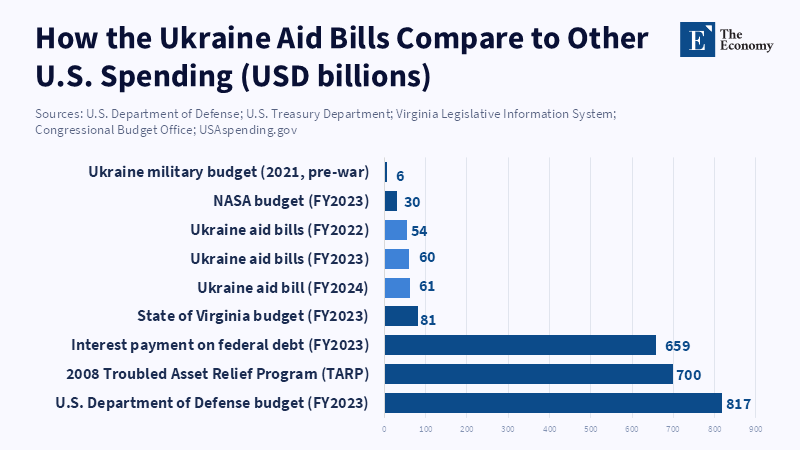
As we move into 2026, data indicates a shift in American sentiment regarding the war in Ukraine. A smaller share of the population believes Ukraine is winning. Many are questioning whether the continued financial commitment is justifiable (Pew Research Center, 2025; YouGov Plc, 2026). Since 2022, the U.S. has committed a large sum, exceeding $100 billion, in the form of military, financial, and humanitarian aid (USAFacts, 2025; Masters & Merrow, 2025). This level of commitment is comparable to past major security initiatives and surpasses the annual aid given to most partner countries (Congressional Budget Office, 2025). This difference between public opinion and the ongoing policy is worth analyzing. The discussion around U.S. involvement in Ukraine needs a different approach. Too often, discussion centers on geographic factors and high-level planning. However, to the average citizen, events in Eastern Europe can feel distant. If U.S. support is seen as only a matter of territory, it is not sustainable. A more thorough and structural approach is needed, taking into account deterrence, the revitalization of our defense industries, economic security, and alliance solidarity (Schake, 2024; Atlantic Council, 2020). This reconsideration is important because patience is thinning thin, while the stakes remain considerable.
U.S. interest in Ukraine is about System Continuity, Not Territory
The current debate frames U.S. involvement in Ukraine as a territorial matter. This viewpoint fails to understand the larger issue. The U.S. doesn’t simply care about a piece of land in Ukraine. What really matters is preventing the use of force to change borders in Europe without facing consequences (Atlantic Council, 2020). Since 1945, the U.S. has worked to pursue a system that promotes established rules and limits territorial takeovers. This system has reduced the probability of major conflicts and has encouraged economic growth for decades. When Russia made its move in 2022, it went against this system. If such aggression goes unchecked, it can create a dangerous example (Aydıntaşbaş et al., 2026).
Information regarding U.S. aid shows how Washington views this potential danger. Congress has approved over $175 billion in aid since the start of the conflict (Congressional Budget Office, 2025; USAFacts, 2025). A big chunk of this has been allocated to security. A significant portion of this money is spent in the U.S. to manufacture equipment (Masters & Merrow, 2025). While this may show weapons being delivered to Ukraine, the main goal is to send a signal. By backing Ukraine, Washington is communicating that borders in Europe cannot be altered by force without encountering opposition. This message is intended for Moscow, Beijing, and other nations (Schake, 2024).
Some people argue that the U.S. is overinvested in Ukraine because Russia has already suffered losses and is facing serious consequences. However, deterrence is more than simply punishing a single action. It is about discouraging future actions (Aydıntaşbaş et al., 2026). If Russia is allowed to keep its conquered territories without serious consequences, the clear takeaway would be that aggression comes with minimal costs. This lesson would have implications that reach beyond Eastern Europe, likely affecting the Baltic countries, the Balkans, and even the Indo-Pacific region (O’Brien, 2025). In this view, U.S. interest in Ukraine is linked to how seriously its commitments are taken elsewhere in the world.
U.S. Interest in Ukraine and the Defense Industrial Base
The renewal of the American defense industry is a second, less talked about but as vital, aspect of U.S. involvement in Ukraine. For years, American production was more focused on smaller operations than on large-scale warfare. The war in Ukraine showed the limitations of our stockpiles. It also sped up investment. Since 2022, production of artillery, air defense systems, and armored vehicles has increased significantly. Pentagon documents reveal long-term procurement contracts aimed at stabilizing and increasing output. This shift strengthens U.S. readiness for possible issues.
A big part of the security assistance given to Ukraine involves replacing equipment. The money is being used to replace the U.S. equipment that has been sent out (Masters & Merrow, 2025). This translates to jobs and contracts for Americans. While the overall impact on the economy might be small, it carries value in certain areas. Defense manufacturing centers in states such as Pennsylvania, Arizona, and Texas have seen more activity (Robertson, 2024). Therefore, U.S. interest in Ukraine also relates to domestic industrial policy. It is in line with efforts to rebuild supply chains in key industries.
There are those who claim that this turns war into a means of subsidizing industry. This point is worth considering. The question to ask is whether this investment would have happened without the war. It is hard to say. Before 2022, production numbers were much lower. The war made things more urgent. From a planning perspective, the U.S. can learn from the real-world data provided by the Ukraine conflict. American planners have been examining drone warfare, electronic warfare, and missile defense as they are being applied in the field. This information is being used to shape strategy and procurement (Schake, 2024). It makes future planning more solid. For those in education and policy analysis, this illustrates how conflict changes institutional learning, not only geopolitical situations.
U.S. Interest in Ukraine and European Burden Sharing
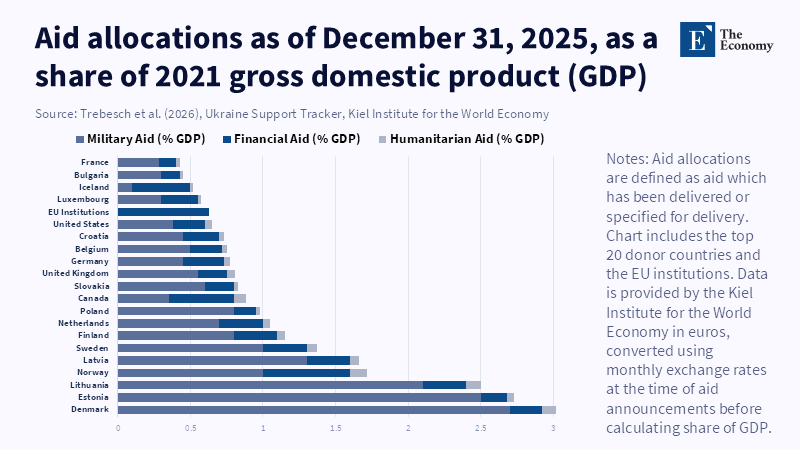
Another shared argument is that Europe should manage everything on its own. After all, they are closer to the war. The European Union and its members have been giving increased aid. By some estimates, when you add financial aid and humanitarian assistance, European commitments are close to, or exceed, what the U.S. has promised (European External Action Service, 2025; Kiel Institute for the World Economy, 2026). Since 2022, countries such as Germany, Poland, and those in the Nordic region have increased their defense spending significantly. Across Europe, members of NATO have pledged to exceed the 2 percent of GDP defense spending goal (Ruitenberg, 2025). This move did not happen on its own. It happened because the U.S. remained involved.
U.S. interest in Ukraine also includes keeping NATO united. When Washington acts like it is backing away, the alliance becomes weaker. When Washington shows that it is committed, European governments feel like they can act. Views across Europe are mixed, but the countries on the front lines strongly support Ukraine. According to a 2025 Statista report, 16 percent of people in Russia held a positive view of Ukraine (Statista, 2025). Urgency fades with distance. However, alliance systems work best when risk is shared. If the countries on the front lines feel abandoned, the alliance's credibility is undermined.
Some people think that once Crimea was taken in 2014, the big strategic loss had already happened. From this point of view, taking more land in eastern Ukraine does not change a lot. Even so, strategy is about more than just land and ports. It is about movement. If Russia is able to grow its control without any big pushback, European countries might pursue alternative solutions. They might pursue different arrangements. Part of the U.S.’s involvement in Ukraine is to prevent division in Europe. Division would hurt shared defense and make U.S. global strategy difficult.
U.S. Interest in Ukraine Beyond Strategy: Economic and Political Signals
People often wonder how the average American benefits from supporting Ukraine. It is a reasonable question. The advantages are not easy to see and take time to show. They do not show up in people's paychecks right away. Even so, economic history tells us that security promotes trade and investment (Munteanu, 2023). Europe remains a major economic partner of the U.S. A breakdown of security in Europe would disrupt energy markets, stock markets, and supply chains. The rise in energy costs in 2022 gave us a taste of this. Inflation went up across rich countries. This event showed how a war in one area can affect the global economy.
There is also a political signal connected to U.S. interest in Ukraine. Authoritarian countries are watching how the West is reacting. According to the Royal United Services Institute, polling indicates that more Americans, particularly Republicans, are starting to question the level of US support for Ukraine, which can fuel the perception that democracies may lack staying power and influence how risks are assessed in other parts of the world (Pew Research Center, 2025). This is why U.S. interest in Ukraine is tied to the level of trust people have in democracies. This does not mean making big promises without limits. It means connecting aid to clear goals and being open about how much things cost.
We cannot ignore what the public thinks. Current polling shows that many Americans are doubtful about Ukraine's chances (Pew Research Center, 2025). This shows that people are tired of war and are thinking about problems at home. Government officials need to make the goals clear. Do they want Ukraine to recover all of its land, reach an agreement, or contain the situation in the long term? When things are not clear, support fades. When things are stated clearly, support becomes stronger. U.S. interest in Ukraine needs to be stated in a way that connects system durability to day-to-day economic security.
Another issue is that pushing for continued support might raise the chances of things getting out of hand with a country that has nuclear weapons. This is a serious concern. Since 2022, U.S. policy has made managing escalation a key priority (Aydıntaşbaş et al., 2026). Assistance has been measured. Direct involvement from NATO has been prevented. The fact that NATO and Russia have not fought directly shows that deterrence and restraint can coexist. U.S. interest in Ukraine does not require the most extreme form of escalation. It requires consistent and measured involvement.
The discussion also concerns key minerals and reconstruction. Ukraine has lithium, titanium, and other materials that are useful for contemporary industries (World Economic Forum, 2024). Even if access to resources should not be the only factor driving policy, they are part of the broader economic picture. Rebuilding after the war could include Ukraine more deeply within European markets. This would change the area's supply chains. U.S. interest in Ukraine means having a say in how things are rebuilt after the war, instead of letting competing countries do it.
People see a distant war that is costing them more and more. Government officials see commitments to allies and risk in the system. This difference causes people to doubt the U.S. interest in Ukraine. Even so, reducing the issue to pieces of land misses the main point. The real U.S. interest in Ukraine is in upholding rules against conquest, strengthening its defense industry, preserving NATO unity, and demonstrating democratic resolve (Atlantic Council, 2020; Schake, 2024). These factors are not easy to see, but they last. They affect the environment where Americans live and do business. The question is not about whether Ukraine is winning today. The question is whether the rules that have kept major wars from happening for many years will last. If support breaks down, the precedent will have effects that go far beyond Eastern Europe. If support is maintained with clear goals and a division of work, the signal will be just as strong. Government officials need to state this clearly. Those in education and analysis need to explain this in detail. U.S. interest in Ukraine is not only about a map. It is about the structure of the international system that helps American security and success. The cost can be seen. The cost of backing down might be much higher.
References
Al Jazeera (2025) Tracking US and NATO support for Ukraine: A full breakdown. 21 August. Doha: Al Jazeera.
Atlantic Council (2020) Strategic context: The rules-based international system. Washington, DC: Atlantic Council.
Aydıntaşbaş, A., Baev, P.K., Budjeryn, M., Gordon, P.H., Grzymała-Busse, A., Hamilton, D.S., Karlin, M., Pifer, S., Sisson, M.W., Stelzenmüller, C. and Wright, T. (2026) What price for peace in Ukraine? Washington, DC: Brookings Institution.
Congressional Budget Office (2025) Federal budget data and analysis related to U.S. support for Ukraine. Washington, DC: Congressional Budget Office.
Demeš, P. (2025) Strategic autonomy starts with Ukraine: The EU must move faster on critical raw materials. Bratislava: GLOBSEC.
European External Action Service (2025) EU assistance to Ukraine (in U.S. dollars). Brussels: European External Action Service.
Kiel Institute for the World Economy (2026) Ukraine Support Tracker. Kiel: Kiel Institute for the World Economy.
Masters, J. and Merrow, W. (2025) How much U.S. aid is going to Ukraine? New York: Council on Foreign Relations.
Munteanu, P. (2023) ‘The energy crisis and its real impact on the inflation rate’, Proceedings of the International Conference on Business Excellence, 17(1), pp. 48–61.
National Security and Defense Council of Ukraine (2026) Ukrainian defense industry: Scale, effectiveness, results. Kyiv: National Security and Defense Council of Ukraine.
O’Brien, R. (2025) ‘Ukraine’s true value’, The Japan Times, 6 March.
Pew Research Center (2025) US views of Ukraine aid, NATO and European defense in 2025. Washington, DC: Pew Research Center.
Robertson, R. (2024) ‘Pennsylvania, Arizona, Texas benefit most from US defense aid for Ukraine’, San Antonio News, 9 September.
Ruitenberg, R. (2025) ‘NATO says all allies to meet 2% defense-spending target this year’, Defense News, 29 August.
Schake, K. (2024) Dollars and sense: America’s interest in a Ukrainian victory. Washington, DC: American Enterprise Institute.
Serohina, K. (2026) ‘Russia increases weapon and equipment production, no slowdown expected – ISW’, RBC-Ukraine, 16 February.
Statista (2025) Public opinion toward Ukraine in Russia 1998–2025. Hamburg: Statista.
USAFacts (2025) How much aid has the US given Ukraine? Bellevue, WA: USAFacts.
World Economic Forum (2024) The future of critical raw materials in Ukraine and the world. Geneva: World Economic Forum.
Working across research, policy, and data-driven analysis, the Editorial Board ensures that published pieces reflect a consistent institutional perspective grounded in quantitative reasoning and long-term structural assessment.