The Limits of Resilience: How Wartime Labor Market Friction Reshapes Work and Wages

Working across research, policy, and data-driven analysis, the Editorial Board ensures that published pieces reflect a consistent institutional perspective grounded in quantitative reasoning and long-term structural assessment.
Authored On
Modified
War creates severe wartime labor market friction across sectors
Ukraine shows rising unemployment and uneven wage recovery
Smart labour policies can reduce wartime labor market friction

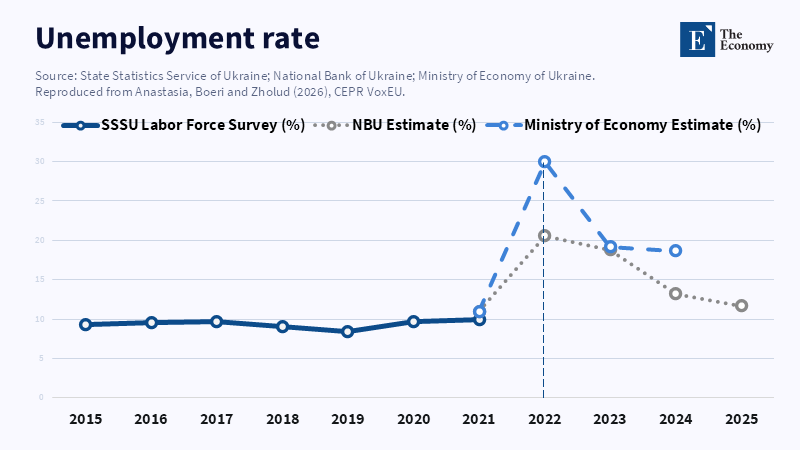
When war strips a country of a third of its workforce and sends millions across borders, the labour market does not simply shrink — it reconfigures. In Ukraine, out-migration and mobilization removed roughly 3 million workers from the domestic economy, while several hundred thousand more were taken into uniform or displaced internally. That combination of sudden supply loss, sectoral collapse, and a rapid pivot to military production creates what we should call wartime labor market friction: a set of persistent mismatches between who can work, where jobs exist, and which skills employers need. The immediate consequence is paradoxical. In places where factories or defence producers remain solvent, wages rise as employers compete for scarce labour; in many service and trade sectors, incomes fall as demand vanishes. Understanding the scale, duration, and channels of these frictions is the single most important task for decision-makers who want labor markets to sustain livelihoods through war and rebuild quickly after it.
Wartime labor market friction: supply shocks, demand collapse, real wages
The most visible driver of wartime labor market friction is the simultaneous hit to labour supply and to demand. When millions exit the labour pool — through flight, internal displacement, or mobilization — vacancies in some sectors become harder to fill. At the same time, whole industries suffer revenue collapses because supply chains break, domestic markets shrink, and investment dries up. The result is a dual pressure on wages that depends on local conditions: tight labour markets where production continues; collapsed wages where businesses have lost markets or capital. In Ukraine’s case, the arithmetic is stark. Population and refugee counts compiled during 2022–2025 show several million adults abroad, while official and research-based tallies indicate several hundred thousand to perhaps over half a million mobilized.
Counting losses to employment, therefore, requires combining population movements with defence mobilization figures and estimates of casualties and long-term disability, and that accounting produces a working-age labour loss on the order of millions, concentrated among young men but not limited to them.
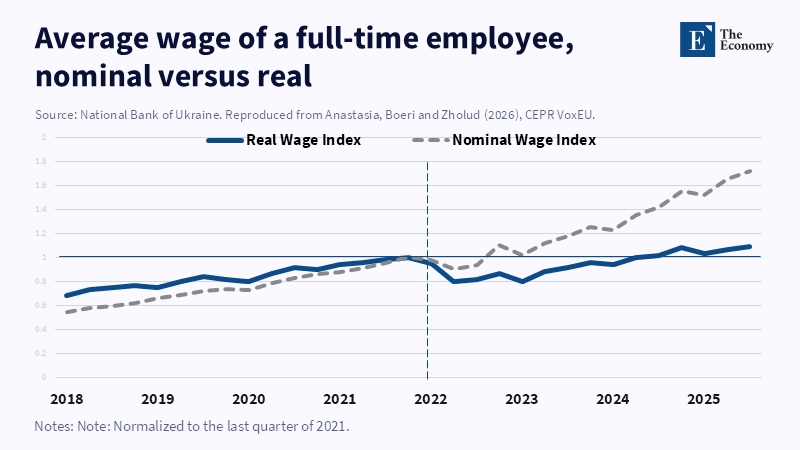
But raw headcounts alone do not explain wage dynamics. According to the OECD, employers in sectors with increased defence activity, such as construction and IT, have faced worker shortages that have driven up wages, while firms in areas like retail, hospitality, and urban services have struggled as they lost customers and could not raise pay even when staff were available. The net effect on national real wages has been uneven: initial income collapses for numerous households were followed by partial recoveries throughout regions and sectors that retooled successfully. These patterns show that wartime labor-market friction is not a single scalar shock but a collage of localized shortages, sectoral demand collapses, and institutional constraints (e.g., transport or banking interruptions) that prevent wages and employment from adjusting smoothly.
Wartime labor market friction: mismatches, retraining, and the digital safety valve
A defining feature of wartime labor market friction is skill and spatial mismatch. The jobs created by a wartime economy — both in the defence sector and in reconstruction-related activities — often require different skills from those of displaced retail, hospitality, or micro-business workers. Meanwhile, many skilled workers are serving in the armed forces or living abroad under temporary protection, so the available talent pool does not line up with employer needs. This mismatch raises the cost of finding and training suitable workers, lengthens vacancy durations, and reduces productive output even when capital and demand exist. Empirical work using online job-ad posting databases shows that where vacancy platforms remain active, demand for certain occupations surged while many traditional service roles disappeared; in other words, digital labour signals reveal a split labour market rather than a simple contraction.
That is where remote work and platform access matter. According to the European Union Agency for Fundamental Rights, digital channels and freelancing channels have offered some opportunities for displaced Ukrainians to access remote work abroad, though these options come with major barriers that can limit full participation and inclusion in foreign labor markets. They supported households that would otherwise have faced a total income loss. Yet platform work is not a panacea. It tends to favour certain skills (IT, design, translation), requires internet access and language capability, and often pays in volatile currencies. Moreover, dependence on foreign demand makes incomes susceptible to exchange-rate swings and changing global demand. Therefore, a policy that treats online work as the main fix for wartime labor market friction will over-rely on a partial, skill-skewed buffer and will fail to resolve deep structural mismatches at home.
Wartime labor market friction: policy choices that shorten scarring and support rebuilding
Faced with wartime labor market friction, policymakers have three strategic choices: contain the short-term income shock; reduce mismatches quickly; and preserve the capacity to rebuild. Containment means targeted income support that replaces lost labour income when jobs cannot be sustained — not blanket handouts that blunt incentives, but calibrated transfers that protect consumption as workers search for work or retrain. Reducing mismatch requires active labour market policies deployed with wartime urgency: scaled-up short vocational programs tied to employer demand, rapid certification for refugees and returnees, and subsidies for firms that hire and retrain workers from collapsed sectors. The evidence from online vacancy studies and household monitoring suggests that short, intensive retraining focused on digital, logistics, and basic manufacturing skills shortens unemployment spells and increases job matches.
Preserving reconstruction capacity is the third pillar. Authorities must avoid letting core productive firms die for lack of short-term liquidity. According to UNHCR Ukraine, strengthening support for viable firms through targeted programs that emphasize hiring and training displaced workers can help maintain the sectoral base and reduce long-term workforce issues. This approach is most effective when paired with well-defined legal measures that facilitate the return and recognition of displaced workers, including simplified processes for validating experience gained abroad and guaranteeing access to social protection settlements. In practice, this means combining temporary income support, rapid demand-driven retraining, and liquidity to solvent firms — a three-part policy mix aimed squarely at the specific frictions wartime creates, not a one-size-fits-all stimulus.
Wartime labor market friction: anticipating critiques and where the evidence is thin
Two critiques are predictable. First, some will argue that wage rises in certain localities prove that labour shortages dominate and policymakers ought to simply let wages clear. This is superficially true—but incomplete. Wage rises in specific firms or regions frequently coexist with mass unemployment or inactivity elsewhere; a national laissez-faire policy risks entrenching regional inequality and leaving large groups dependent on unstable, low-quality jobs or remittances. Second, others will argue that market forces, combined with generous access to host-country jobs (as in parts of Europe), render domestic policy intervention unnecessary. That too understates the problem: cross-border work and temporary protection have been lifesaving for many, but they shift social and fiscal burdens to host countries and create long-term human capital frictions if credentials and experience are not made portable.
There are also clear evidence gaps. According to research by Anastasia, Boeri, and Zholud, detailed data on how many mobilized individuals were previously high-skilled workers is limited; casualty and long-term disability rates remain unclear; and much of the rapid labor reallocation occurs informally and is not reflected in official vacancy statistics. As a result, policies need to remain flexible, with close monitoring and quick adjustments as new information becomes available. Practical measures include creating high-frequency labour-market dashboards that combine administrative payroll data, online vacancy data, and social-benefit data; running rapid, randomized pilots of retraining programs; and working with host countries to validate refugee skills. The alternative is slow learning and avoidable scarring.
Wartime labour market friction is not a sole shock you can wait out. It is a compound of lost workers, reoriented demand, skill mismatches, and institutional breaks, which together make labour markets rigid and unequal. The Ukrainian experience shows both a surprising degree of resilience and stark limits: where firms and platforms connect labour with demand, incomes recover; where markets are broken, households fall into poverty, and skills erode. Officials must treat frictions as a policy problem in their own right — not simply as a byproduct of conflict. That means targeted income protection, rapid demand-linked retraining, liquidity to viable firms tied to hiring and certification pathways for displaced workers. If governments accept this tripod now, they can both protect livelihoods today and shorten the timeline to an efficient, inclusive reconstruction tomorrow.
The views expressed in this article are those of the author(s) and do not necessarily reflect the official position of The Economy or its affiliates.
References
Anastasia, G., Boeri, T. and Zholud, O. (2026) A wartime labour market: The case of Ukraine. IZA Discussion Paper No. 18363.
Anastasia, G., Boeri, T. and Zholud, O. (2026) ‘A wartime labour market: The case of Ukraine’, CEPR VoxEU Column, 4 March.
European Union Agency for Fundamental Rights (2023) Barriers to employment of displaced Ukrainians. Luxembourg: Publications Office of the European Union.
Kuras, T. (2024) ‘Unlocking opportunities: how UNHCR empowers displaced people in Ukraine to find employment and rebuild their lives’, UNHCR Ukraine, 26 December.
OECD (2025) OECD Economic Surveys: Ukraine 2025. Paris: Organisation for Economic Co-operation and Development.
Pham, T., Talavera, O. and Wu, Z. (2023) ‘Labor markets during war time: Evidence from online job advertisements’, Journal of Comparative Economics, 51(4), pp. 1316–1333.
Rockwool Foundation Berlin (2026) Still Standing: The Ukrainian Labor Market at War. Berlin: Rockwool Foundation Berlin.
UNHCR (2025) Ukraine refugee crisis: Aid, statistics and news. Geneva: United Nations High Commissioner for Refugees.
Working across research, policy, and data-driven analysis, the Editorial Board ensures that published pieces reflect a consistent institutional perspective grounded in quantitative reasoning and long-term structural assessment.