Sodium’s Moment: Why Sodium-ion Batteries Matter Now

Working across research, policy, and data-driven analysis, the Editorial Board ensures that published pieces reflect a consistent institutional perspective grounded in quantitative reasoning and long-term structural assessment.
Authored On
Modified
Sodium-ion batteries promise cheaper, safer energy storage
The technology still needs large-scale testing and validation
Targeted deployment could reshape clean energy systems
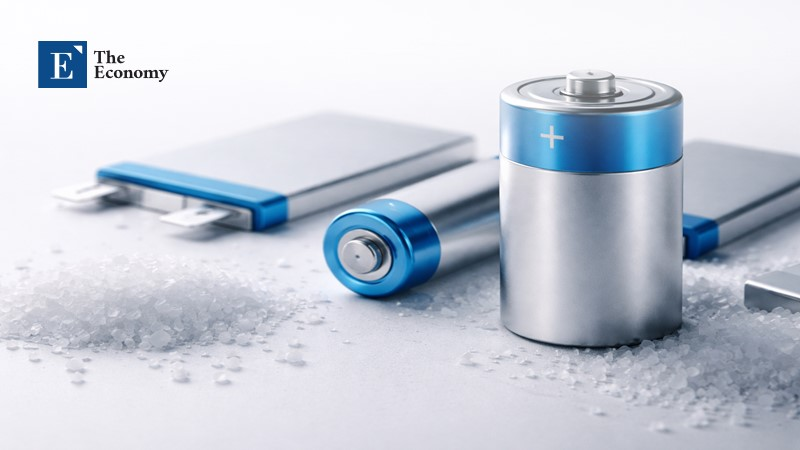
The rise of sodium-ion batteries could be a transformative shift in the electrification landscape. If the global manufacturing capacity expands substantially from its current small base to the levels projected by some, the geography and politics behind the move to electric power will change. This is because sodium-ion batteries offer several advantages. They rely on readily available materials. They can often be produced using existing lithium-ion battery manufacturing equipment. They also perform better in cold temperatures compared to many other battery types. Claims by companies like CATL, citing energy density near 175 Wh/kg and robust operation in very cold conditions for their Naxtra cells, suggest sodium-ion batteries could make EVs more suitable for winter use. It's important to note, however, that the market is still new and development is dependent on various factors. The eventual scale and applications of sodium-ion batteries will depend on how quickly technology and manufacturing costs improve, plus how quickly we resolve materials limitations, and how well the batteries perform in real-world systems.
Re-evaluating the Claims about Sodium-Ion Batteries
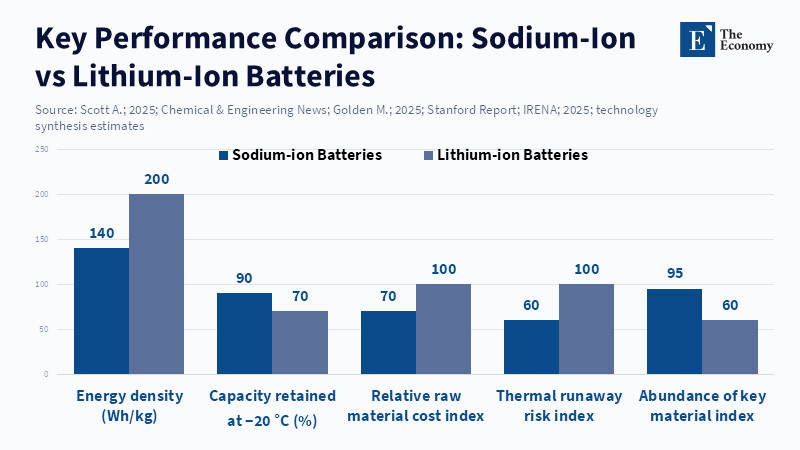
It's tempting to simplify the situation by saying sodium is cheaper and safer, so it’ll replace lithium everywhere. But this is an oversimplification. Sodium-ion batteries certainly offer benefits. Compared to lithium, sodium is more abundant. Some sodium-based batteries have a lower risk of overheating. Additionally, manufacturers can reuse parts of existing lithium-ion production lines for sodium-based batteries. Keep in mind, though, that the shift to new energy sources is a complex process influenced by factors beyond material properties alone. When comparing sodium-ion and lithium-ion batteries, we must consider energy density, cost per usable kilowatt-hour at the battery pack level, recyclability, charging speed, and performance in cold temperatures. Thinking of sodium-ion batteries as a single, universal solution oversimplifies matters. Instead, we should consider them a complementary option with strengths and weaknesses distinct from those of lithium-ion batteries.
It's important for educators and policymakers to re-evaluate sodium-ion batteries. The way we talk about them shapes purchasing decisions, educational programs, and public expectations. According to PV Magazine International, policymakers should not assume that sodium-ion batteries can fully replace lithium batteries across all applications, as this could lead to misguided investments and inadequate training programs. Instead, we should frame the discussion to distinguish between realistic, short-term applications, like urban delivery vehicles, stationary energy storage, and light vehicles in cold regions, and longer-term applications that demand higher energy density. Being cautious isn't about resisting change; it's about approaching things practically. By considering sodium-ion batteries as one option among a range of battery technologies, institutions can run pilot programs and gather data on their performance in real-world conditions, rather than relying solely on lab results.
The idea of a game-changer can also obscure the geographical element. Right now, rapid growth in sodium-ion battery production is happening in specific industrial areas. Mass adoption will depend on how manufacturing, raw-material processing, and trade policies develop. Therefore, public policy should focus less on declaring a winner and more on creating the conditions for success, such as testing standards, transparency, and recycling infrastructure. These would allow this battery technology to prove itself in situations where it offers the most help to people and power grids.
What Data from 2023–2025 Tells Us
Current data helps us keep our expectations realistic. Information and research from 2023–2025 show three consistent trends. First, forecasts of production capacity vary, but most expect significant growth from a small base. For context, lithium-ion production is already at a much higher base. Some expert estimates project sodium-ion battery production of tens of gigawatt-hours per year by the mid-2020s and potentially several hundred gigawatt-hours by 2030 if scaling is successful. These figures suggest sodium-ion batteries could capture a noticeable portion of the battery market without overtaking lithium-ion. Planners should create models based on these possible outcomes rather than assuming sodium will become dominant.
Second, cell-level performance is getting better in laboratories and controlled tests. Manufacturers report sodium-ion cells with energy densities near the lower end of typical lithium battery energy densities. Also, independent tests show they retain usable capacity better at low temperatures than many lithium-ion versions. This is good news for fleet managers in cold climates because a battery that holds a charge and can be charged safely at −20 °C or lower can change how they operate their vehicles. It's important to remember that cold-temperature claims often come from cell-level or lab tests. The behavior of the complete battery system in a vehicle depends on the pack design, the chargers, and the power demands of the vehicle's accessories. Third, sodium-ion batteries might become competitive if conditions are met. Models show they could rival cheap lithium cells by the 2030s if manufacturing costs drop and materials remain affordable. But this requires gains in anode materials and persistent low lithium prices. Educators should teach students to compare scenarios and remain open to multiple outcomes.

Actions should follow data. Fleet or grid administrators should run small, monitored sodium-ion pilot programs—urban vehicles, campus vehicles in cold climates, and energy storage with renewables—and collect standard performance metrics. Require independent checks of manufacturer claims to reduce risk and generate data for others. Next, revise procurement language. Instead of specifying “sodium-ion only,” use performance-based tendering: require capacity retention at −20°C, cycle-life targets, and concrete recycling plans. This rewards real-world performance and speeds up learning, as field data is more valuable than lab specs.s.Update education and training: teach system-level battery evaluation, pack-level cost per usable kWh, and case studies. Highlight where sodium-ion batteries fit, compare alternatives, and teach basic lifecycle and supply chain analysis. Simple battery pack experiments at varied temperatures aid learning.
Addressing Concerns and Providing Answers
A common criticism is that sodium-ion batteries are inferior because their larger, heavier ions limit energy density. Data confirm a lower theoretical density than that of top lithium batteries. Still, recent company reports and lab results show densities suitable for many uses. Even modest density gains could boost competitiveness. Lower density is a trade-off, not a deal-breaker, in urban or stationary applications where weight matters less. Some fear that scaling sodium-ion batteries shifts supply risk to input suppliers. This is partly true: sodium is abundant, but materials like hard carbon, binders, and some electrolytes may be region-specific. The solution is diversify materials sources, promote transparent supply chains, and support domestic processing. Diversity reduces risk without depending on a single chemistry.
Finally, there are concerns that industry announcements will be ahead of real-world results, leading to malfunctions. This is a valid risk. The best way to address it is through standardized, independent testing and public reporting. Before large-scale public purchases, require third-party certifications for cold-weather performance and safety. Support open data platforms that publish pilot results. These actions protect consumers and ensure that deployment decisions are based on evidence rather than marketing alone.
In conclusion, sodium-ion batteries are important because they expand the options for moving toward cleaner energy. They aren't a perfect substitute for lithium-ion batteries, but they are a practical option for specific uses right now. Some of those uses involve city electric vehicles, fleets operating in cold climates, and stationary storage systems. According to a GlobeNewswire report, while sodium-ion batteries may offer certain advantages, their performance can be negatively affected in extremely hot or cold environments, which should be carefully considered when deciding on their use. The most effective public strategy is to weigh both their strengths and their climate-related limitations, rather than simply accepting or rejecting the technology outright. Support independent testing, conduct pilot programs with clear goals, and teach system-level battery evaluation. If we do this, sodium-ion batteries can expand the benefits of electrification. At the same time, we can make sure that purchasing and educational budgets are used responsibly. If not, we may repeat patterns of hype and disappointment. We will also miss an opportunity to make electrification more inclusive and sustainable.
The views expressed in this article are those of the author(s) and do not necessarily reflect the official position of The Economy or its affiliates.
References
A1 Solar Store (2025) Saltwater batteries: Do they worth their salt?, A1 Solar Store blog, 9 July 2025.
Degen, S.; Barker, J.; Rudola, A. (2023) Sodium-ion battery market and technology reviews, Industry analysis report.
Deri Y Energy (2025) Sodium-Ion vs Lithium-Ion Batteries: Cost, Safety & Future Outlook, Deri Y Energy blog, 2025.
Discovery Alert (2025) Sodium-Ion Battery Cost Reduction: Market Analysis & Trends, Discovery Alert, 2025.
EnergyX (2025) Sodium-Ion vs Lithium-Ion Batteries: Cost, Safety & Future Outlook, EnergyX, 2025.
Gizmochina (2025) CATL’s sodium-ion batteries hit record energy density, raising prospects for EV adoption, Gizmochina, 30 December 2025.
International Renewable Energy Agency (IRENA) (2025) Sodium-ion batteries: A technology brief, IRENA, 2025.
Mordor Intelligence (2025) Sodium-ion Battery Market Size, Growth, Share & Competitive Landscapes 2031, Mordor Intelligence report, 2025.
Newsroom, Reuters (Zhang, K. and Goh, B.) (2025) China’s CATL launches new sodium-ion battery brand, Reuters, 21 April 2025.
Process Safety and Environmental Protection (2025) Thermal runaway comparison and assessment between sodium-ion and lithium-ion batteries, Process Safety and Environmental Protection, vol.193, pp.842–855. doi: 10.1016/j.psep.2024.11.118.
Q. Wiltson Energy (2025) Electric Vehicle Battery Performance in Extreme Cold: A Tiered Analysis, Wiltson Energy, 2025.
Scott, A. (2025) Sodium-ion batteries: Should we believe the hype?, Chemical & Engineering News, 17 November 2025.
Service, R.F. (2025) Move over lithium: Sodium batteries could one day power a green economy, Science, February 2025.
Stanford Report (Golden, M.) (2025) Sodium-ion batteries need breakthroughs to compete, Stanford Report, 13 January 2025.
The Battery Magazine (International Renewable Energy Agency coverage) (2025) Sodium-ion Batteries to Surge by 2030, But Lithium-ion Will Retain Dominance: IRENA, The Battery Magazine, 4 December 2025.
TheGreen Bein (2025) The German saltwater battery: A game-changer for clean energy?, TheGreen Bein, 25 September 2025.
Wiltson Energy (2025) Electric Vehicle Battery Performance in Extreme Cold: A Tiered Analysis, Wiltson Energy, 2025.
You, X. (2026) A salt battery could make EVs more winterproof—if it holds up on the road, Scientific American, 3 March 2026.
Yao, A.; Benson, S.M.; Chueh, W.C. (2025) ‘Critically assessing sodium-ion technology roadmaps and scenarios for techno-economic competitiveness against lithium-ion batteries’, Nature Energy, vol.10, pp.404–416.
Working across research, policy, and data-driven analysis, the Editorial Board ensures that published pieces reflect a consistent institutional perspective grounded in quantitative reasoning and long-term structural assessment.