Geopolitical shocks and local labor: why the Canada–US travel shock should refocus education and labour policy

Working across research, policy, and data-driven analysis, the Editorial Board ensures that published pieces reflect a consistent institutional perspective grounded in quantitative reasoning and long-term structural assessment.
Authored On
Modified
Geopolitical shocks can destabilize local labor markets
The Canada–U.S. travel decline shows how policy disputes cause job losses
Education systems must build resilient workforce pathways

The sudden disappearance of cross-border tourists is able to destabilize entire local job markets. A case in point is the decline in Canadian visits to the United States in 2025, which dropped by about 25%. According to the U.S. Bureau of Labor Statistics, from June to September 2024, there were 7.6 million job losses at closing and contracting private-sector establishments, denoting a decline of 131,000 jobs compared to the previous quarter. The consequences included more than just a reduction in revenues. It also weakened wage growth, led to fewer hiring plans at the company level, and resulted in reduced hours in sectors that provide training and employment opportunities for entry-level workers. This situation is not limited to tourism. It represents a common pattern that occurs when international events (such as tariffs, changes in visa policies, or diplomatic issues) suddenly reduce the need for local services that require many employees. Therefore, educators, administrators, and regional policymakers need to view these events as risks that affect the entire workforce system, rather than only isolated business issues. The policy approach needs to change from simply providing emergency support to making more long-term changes.
How Geopolitical Shocks Cause Local Job Losses
The collapse in travel between Canada and the U.S. clearly illustrates this process. A 25% decrease in border crossings affects areas where visitors account for a large part of sales. These areas include border towns, tourist areas, and entertainment venues. Businesses that offer lodging, food, retail, and small attractions often have limited financial resources and operate with minimal staffing. When they lose customers, the initial response is to reduce employee hours. According to The Canadian Press, Telus recently announced it will cut 6,000 jobs, citing industry changes, regulations, and industry pressures as reasons for the cutback. This provides definite support for the idea that drops in demand quickly lead to payroll reductions in localized industries that depend heavily on labor. These job losses are significant because they are geographically concentrated and typically affect younger, less-skilled workers.
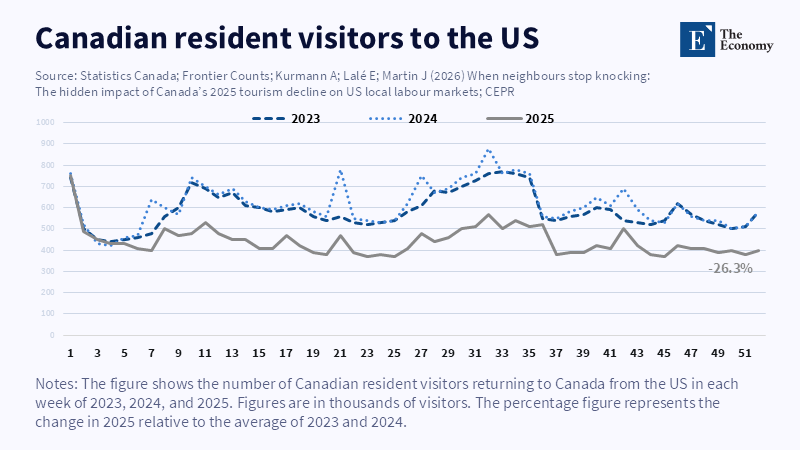
The impact then spreads to finances and wages. Drops in tourism revenue lower company profits and taxable income in local areas, which affects local governments' ability to fund training programs and employment initiatives. Simultaneously, with less demand in the sector, employers postpone salary increases and reduce promotion opportunities that would typically raise wages for workers at entry and mid-career levels. The immediate result is a downward pressure on local wage growth, along with longer job searches for displaced workers. These forces can turn a short-term decrease in demand into permanent losses in earnings unless there are rapid, well-planned policy measures.
The Wider Effects of Political Shocks on the Job Market
A shock in one sector rarely stays contained. Less tourist spending reduces the need for supplies, cleaning, maintenance, and transport. These upstream suppliers then receive fewer orders, which may cause them to cut staff or change their contracts. The CEPR study considers the immediate losses as minimum estimates, mainly because these supply-chain and service relationships are hard to measure immediately. Where local economies have a limited range of industries, these effects are greater. Researchers have observed that decreases in employment at affected businesses account for only part of the overall effect. Household spending declines, informal work disappears, and some small businesses close permanently, reducing local hiring capacity for years.
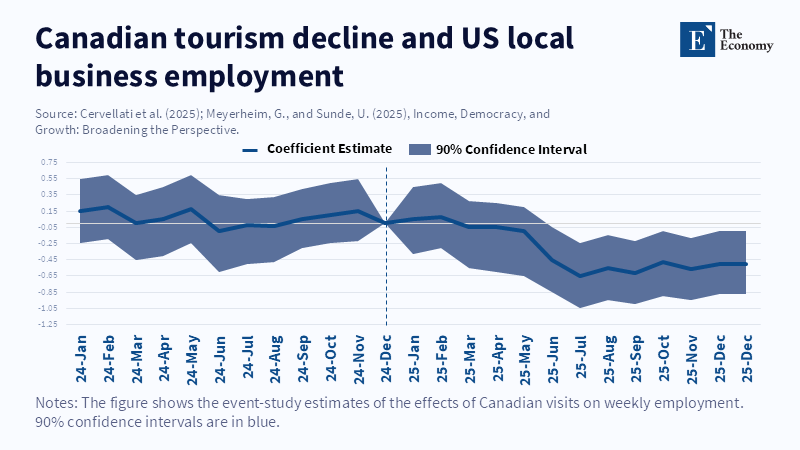
These secondary effects are important for education and training policy in two ways. The contractions reduce the need for quick, vocational training usually offered by community colleges and local providers. According to CIEE, access to affordable internship and training programs for Canadian students has recently expanded, delivering new opportunities for career development in the United States. This disrupts a key way for young people to enter the job market. If geopolitical shocks become more common, as evidence suggests, the strength of local workforce systems becomes a key policy issue rather than just a minor program concern.
Changing Policy: From Instant Aid to Sustained Strength
Immediate support measures (such as grants, short-term wage support, and temporary unemployment benefits) are needed immediately after a shock. The Canada–U.S. situation, however, is that there are not enough. According to the Bank of Canada, when policy-related events such as trade interruptions occur, the job market typically reflects this through higher unemployment in affected sectors and groups, weaker hiring, more layoffs, reduced hours, and an increase in involuntary part-time work. These shifts imply the need for structural responses in recruitment practices and wage policies. First, workforce systems need adaptable, cross-sector retraining that can be used across different regions. Second, vocational programs should teach skills that can transfer, including customer service, logistics coordination, and managing digital booking and inventories. These skills are useful to businesses across many sectors. Third, local financial plans need to include funds for training partnerships to ensure that programs continue without interruption. In short, the goal is to develop skills that can survive the shock, rather than using financial resources to lessen its effects.
Putting these ideas into action is feasible. Regions should map out where employers are concentrated and predict the effects of demand shocks, determining which jobs would be lost, which skills are transferable, and at which training capacity can be quickly increased. Colleges and training providers should provide certificates for individual course modules that can be stacked to get full diplomas. This enables displaced workers to demonstrate their skills while working toward further credentials. Policymakers should negotiate agreements with regional employers to focus on placing retrained workers. This creates a kind of insurance that reduces the gap between job supply and demand once the economy recovers. According to The Conference Board of Canada, recent labor market data show a decrease in employment and a steady unemployment rate, which underscores the importance of structural changes, such as retraining, to help absorb job losses in affected industries and support the ongoing vitality of local job markets.
Practical Steps for Educators, Administrators, and Decision Makers
The immediate need for educators is to assess and prioritize curriculum. They should review courses and internships to find which modules can be directly used in other sectors (for example, skills learned at a hotel front desk are applicable to retail and healthcare reception). Then they should convert these modules into short certifications that can be obtained in weeks rather than months. Employer advisory councils should include businesses outside the main local industry to expand placement options. These actions improve students' employment prospects, even when the main local industry declines.
Administrators should manage data. Current measures, such as local transaction volumes, hotel occupancy rates, and border entry statistics, should be included in labor demand dashboards available to colleges and workforce boards. This allows programs to increase or decrease in size within weeks, instead of months. It also enables focused outreach, allowing young workers to be quickly enrolled in short retraining programs before experiencing long periods of joblessness. Policymakers should set up funding triggers so that emergency training funds are automatically released when specific levels of economic decline are reached. This reduces political delays and keeps programs running smoothly.
It is important that the response recognizes the effects on different groups. Research points out that job losses are concentrated geographically and affect small and medium-sized businesses and entry-level workers the most. Therefore, support and retraining should prioritize younger workers, part-time staff, and women in service positions. These groups often have longer re-employment periods, and their earnings losses can result in lifetime gaps. Failing to focus on these vulnerable groups risks increasing current inequalities and reducing the productive workforce for the coming years.
Addressing Possible Criticisms
One predictable criticism is that these policy recommendations are overemphasizing the need for structural changes. Critics claim that short-term subsidies are cheaper and easier to implement politically. Subsidies alone, however, leave the local labor pipeline fragile. When a sector loses workers and then slowly recovers, companies often reorganize and introduce automation into parts of the job. As a result, many displaced workers never go back to their jobs. Training and placement help prevent permanent damage. Studies on demand shocks demonstrate that early retraining reduces long-term joblessness and improves earnings for displaced workers. A recent study by Brian K Kovak and Peter M Morrow found that workers in industries facing greater Canadian tariff reductions had a higher risk of being laid off from large firms, but their long-term cumulative earnings were not significantly affected. This suggests that concerns about long-lasting earnings losses from such shocks may be exaggerated. Additionally, although some contend that restructuring workforce systems in response to rare geopolitical shocks may not be necessary, the research indicates that the prolonged effects on earnings can be limited. The recent rise in tariffs, travel warnings, and unstable cross-border policies suggests that these shocks are not rare events. The tourism situation serves as an example, not an exception. Regions that have a strong connection to a single foreign market (such as border economies, export-dependent towns, or energy and commodity centers) are at risk. Preparing workforce systems for such shocks is like implementing climate change adaptation plans for coastal cities: a sensible investment to defend against possible, repeated risks.
The Canada–U.S. travel collapse shows how geopolitical shocks can spread from policies, impacting customers and staff. According to a report by Matthew Sellers, although immediate aid is beneficial, difficulties such as weakened hiring pipelines and reduced access to internships or short-term certifications for young and low-paid workers can persist, especially during periods of labor market disruption. Recently, Service Canada resumed processing low-wage LMIA applications in eight regions where unemployment rates have dropped below 6%, illustrating how policy decisions often respond to up-to-date labor market data. Real-time measures can signal when demand is decreasing and provide lasting ways to get training that can transfer across sectors. Colleges, workforce boards, and local government must consider preparedness for shocks as a key part of the local infrastructure. By doing so, local job markets will remain stable when the next tariff, visa law, or diplomatic issue limits demand, and workers will still have chances to advance.
The views expressed in this article are those of the author(s) and do not necessarily reflect the official position of The Economy or its affiliates.
References
Al-Akkad, L. (2025) Future-Ready Workforce Strategies and Matching Skills Model: The Energy Transition Case. C.D. Howe Institute.
Card, D., Khatiwada, I. and Riddell, W.C. (2005) ‘Estimating the returns to community college schooling for displaced workers’, Journal of Econometrics, 125(1–2), pp. 271–304.
Federal Reserve Bank of Chicago (2024) The High and Lasting Costs of Job Displacement. Chicago Fed Insights Policy Brief.
Garcia-Cabo, J., Lipinska, A. and Navarro, G. (2022) ‘Sectoral shocks, reallocation, and labor market policies’, European Economic Review, 156.
Gabriel, M., Christoph, E. and Bertin, P. (2025) Tariffs and Labor Markets: The Employment Impact of the Recent Trade Conflict. arXiv preprint.
Government of Canada (2024) Government of Canada invests in retraining opportunities for workers. Employment and Social Development Canada.
Hyman, B., Kovak, B. and Leive, A. (2024) ‘Wage insurance: A potential policy for displaced workers’, Liberty Street Economics, Federal Reserve Bank of New York.
Jacobson, L., LaLonde, R.J. and Sullivan, D.G. (2005) ‘Is retraining displaced workers a good investment?’, Economic Perspectives, 29, pp. 3–16.
Kelleher, S.R. (2025a) ‘Canadian road trippers boycotting U.S. could mean a $4 billion economic loss’, Forbes.
Kelleher, S.R. (2025b) ‘Canadian car visits to U.S. plunge 37% in July—Seattle, Portland, Detroit hit hardest’, Forbes.
Kurmann, A., Lalé, É. and Martin, J. (2026) ‘When neighbours stop knocking: The hidden impact of Canada’s 2025 tourism decline on U.S. local labour markets’, VoxEU, Centre for Economic Policy Research.
Marguerit, D. (2025) Augmenting or Automating Labor? The Effect of AI Development on New Work, Employment, and Wages. arXiv preprint.
Mäkelä, E. and Stephany, F. (2024) Complement or Substitute? How AI Increases the Demand for Human Skills. arXiv preprint.
OECD (2024) Job Creation and Local Economic Development 2024: The State of Regional Labour Markets. Organisation for Economic Co-operation and Development.
Riddell, W.C. (2008) Economic Change and Worker Displacement in Canada: Consequences and Policy Responses. Bank of Canada.
Statistics Canada (2021) Impact of COVID-19 on the tourism sector, second quarter of 2021. Statistics Canada Analytical Paper.
Tourism HR Canada (2025) International Workers and Immigration in Tourism. Tourism Human Resource Council of Canada.
Traveling Lifestyle (2025) ‘These U.S. border states’ economies are hit hard by Canadian tourism declines of up to 30%’, Traveling Lifestyle, December.
Comparative Migration Studies (2026) ‘Deskilling and labour market barriers among skilled racialized immigrants in British Columbia: a mixed-methods study’, Comparative Migration Studies, 14.
Journal of Public Economics (2025) ‘The employment effects of a pandemic wage subsidy’, Journal of Public Economics, 246.
Working across research, policy, and data-driven analysis, the Editorial Board ensures that published pieces reflect a consistent institutional perspective grounded in quantitative reasoning and long-term structural assessment.