How China Economic Coercion Became Takaichi’s Strongest Campaign Asset

Working across research, policy, and data-driven analysis, the Editorial Board ensures that published pieces reflect a consistent institutional perspective grounded in quantitative reasoning and long-term structural assessment.
Authored On
Modified
China’s economic pressure on Japan has strengthened Takaichi instead of weakening her
Beijing’s coercion has raised public support for a tougher Japanese security and trade stance
The more China escalates, the more it helps the leader it wants to contain
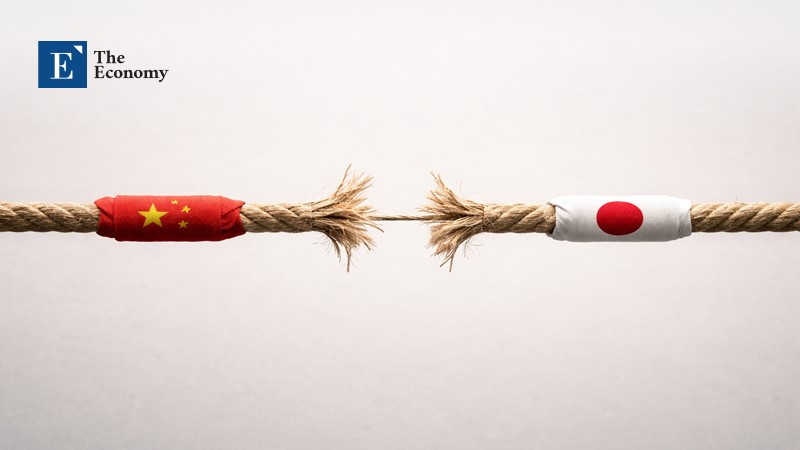
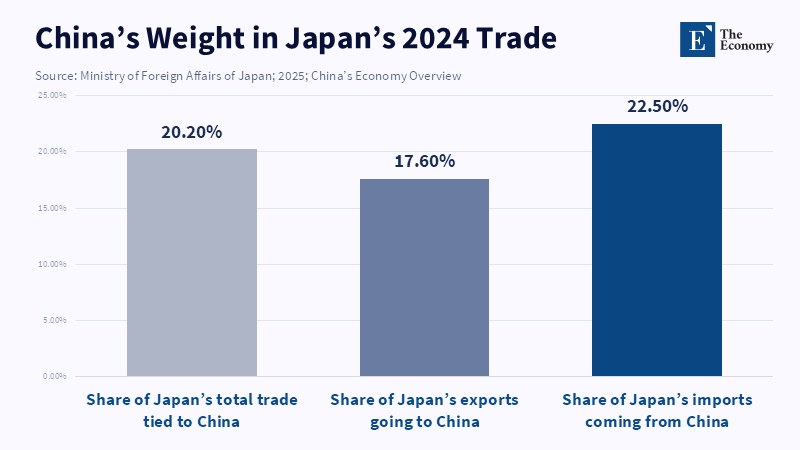
One in every five yen of Japan’s trade involves China. In 2024, China accounted for 20.2 percent of Japan’s total trade, with 17.6% of exports and 22.5 percent of imports. This level of economic connection might suggest that any Japanese leader would tread carefully and be vulnerable to pressure. But the opposite happened. When Beijing responded to Sanae Takaichi’s comments on Taiwan with travel warnings, seafood bans, export controls, and public criticism, her position in Japan did not weaken; it strengthened. By February 2026, her party had won 316 out of 465 seats in the lower house—their best result yet. This fact is important. China’s economic pressure is no longer only a foreign policy tactic aimed at Japan. It has become a political advantage for the very leader Beijing seeks to weaken. Each new act of pressure allows Takaichi to argue that China is not just a difficult neighbor but a coercive power, and she calls for a firmer stance from Japan in response.
China’s Economic Coercion Has Turned Takaichi’s Warning Into Proof
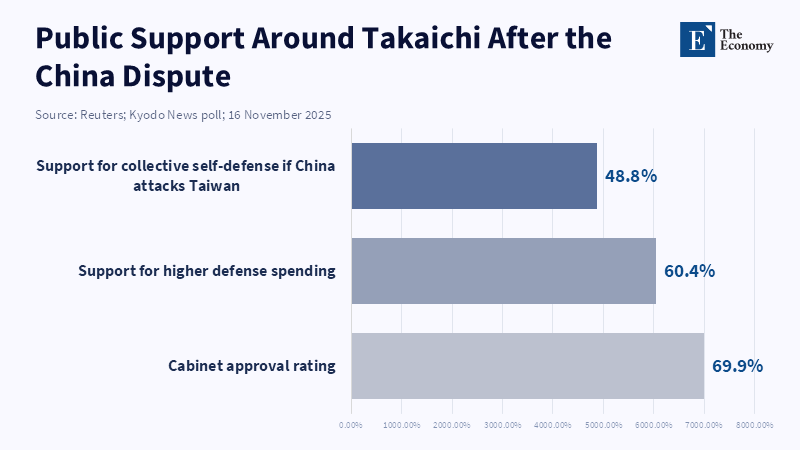
Beijing's first error is assuming that its pressure affects only governments. In democracies, it also affects voters, businesses, and schools. Economic coercion from China doesn’t come across as a dry trade signal in Japan. Instead, it's seen as a very public attempt to punish the prime minister for her open remarks. This changes how people see the situation. While trade disputes might seem like bargaining, travel warnings, seafood bans, and threats to key supplies look like bullying. This causes Takaichi to be seen less as a politician causing unnecessary trouble and more as someone who understood China’s approach earlier than many others. That explains why Beijing’s pressure backfired. After her November 2025 comments, polling showed her cabinet’s approval at 69.9 percent. The same polls found that 48.8 percent supported the idea that a conflict involving Taiwan could justify Japan’s collective self-defense, and 60.4 percent agreed with her push for higher defense spending.
This trend continued even as tensions grew. Polls from late December still showed support for Takaichi in the high sixties to mid-seventies range. In March 2026, despite another domestic controversy, a Jiji poll still found her cabinet approval at 59.3 percent. This steadiness matters more than any single spike. It indicates that China’s economic pressure didn’t just cause a brief surge of support, then fade. Instead, it helped create a lasting political narrative. Japanese voters increasingly see China not simply as a difficult market but as the main security threat. A January 2026 government survey found 68 percent named China’s military buildup and activity near Japan as their top security worry, up from 61 percent three years earlier. Support for the Self-Defense Forces also reached record highs. In this context, Beijing’s anger no longer weakens Takaichi; it supports her argument. China tries to raise the cost of its stance at home, but in practice, it lowers the political price for being tough.
China’s Economic Coercion Is Rewriting Japan’s Political Coalition
This is why the standard economic argument against Takaichi has not worked. Japan is highly exposed to China; its bilateral trade amounted to 44.2 trillion yen in 2024. Over 31,000 Japanese companies still have bases in China. Before the freeze, Chinese tourists were a major part of Japan's inbound tourism. Japanese firms are well aware of the risk. A Reuters survey in January showed that over two-thirds expected the broader economy to suffer from worsening relations. Also, 44 percent said their own business was already affected or likely to be affected. That is real economic pain. But pain does not always cause moderation. It can also make people support protective measures. Businesses may back stockpiling, new suppliers, and strategic distance. When companies view dependence as a risk, political emphasis shifts toward resilience rather than accommodation. China’s economic coercion is helping push that kind of change.
The tourism numbers highlight this shift. China’s pressure significantly reduced travel from China to Japan. According to The Japan Times, arrivals from China to Japan dropped by 61 percent in January 2026 compared to the previous year, a decline ascribed to changes in the timing of the Lunar New Year and travel warnings. This detail matters. It shows that while economic pain is clear and reinforces the sense of threat, it’s not widespread enough to force Japan into retreat. Politically, that benefits Takaichi. The pressure is enough to show Japanese voters she is facing a real opponent, but not strong enough to prove her position unsustainable. The result was not backlash but a landslide victory. Her party’s 316-seat win was not in spite of China’s coercion but partly because Beijing kept proving that dependence could be turned into pressure.
China’s Economic Coercion Is Accelerating the Policy Shift Beijing Fears
The impact goes beyond elections. China’s economic pressure is speeding up policy changes that Beijing fears most. Japan is already on track to increase defense spending to 2 percent of GDP, and the 2026 defense budget passed the 9 trillion yen mark. The country is also moving faster to secure supply chains, strengthen economic security policies, and improve resilience in critical minerals. The reasoning is clear: when dependence becomes a weakness, every pressure act makes diversification look like common sense rather than ideology. This is especially relevant for rare earths, semiconductors, advanced manufacturing materials, and dual-use technologies. China remains essential to Japan’s industrial base, but the more Beijing uses that importance as a weapon, the stronger the case for Japan to reduce its dependence over time. So, the pressure is fueling the very moves toward de-risking, tighter alliances, and military planning that China opposes.
There is a broader lesson here. Recent studies show that when faced with economic coercion, countries try to improve alternatives, even if it means a more fragmented and less efficient global economy. We are watching this unfold now. Each time China uses economic leverage in a way that seems political rather than commercial, Takaichi’s argument grows stronger. Critics can say she helped trigger the conflict, which is partly true. But once Beijing chose to openly punish Japan, the domestic meaning of the dispute changed. It became harder for moderates to claim that calm words alone would restore stability because China was clearly willing to use trade, travel, and key materials as tools of pressure. Under this condition, even voters who are not natural hawks begin to see a tougher stance as simple prudence. Economic coercion from China not only boosts nationalists; it also pulls cautious centrists toward them.
Some might argue this interpretation is too optimistic. What if Beijing uses much harsher tools that make the economic cost unbearable? That risk exists. Japan remains exposed, and a severe rare-earth cutoff or a broad trade hit would hurt. But even then, China’s political victory isn’t guaranteed. According to a report from People’s Daily, Chinese officials have criticized the G7’s stance on economic measures against Japan, in response to Western claims that China’s restrictions followed Japan’s discharge of treated wastewater. This dispute could reinforce support within Japan for accelerating efforts to decouple from China in key industries, as public pressure frequently influences how governments respond to economic coercion. In Japan’s case, Beijing has done the opposite: it framed the issue as one of national dignity, economic security, and strategic freedom. So each new action looks less like smart diplomacy and more like a live demonstration of the problem Takaichi highlights. Unless China combines pressure with credible steps to reduce tensions, harsher moves may trap Beijing rather than free it.
What China’s Economic Coercion Means for Educators and Policymakers
For educators, this means economic coercion should not be taught simply as a trade topic. It’s also a political signal. Students studying international relations, public policy, journalism, and economics need to understand how external pressure can reshape domestic legitimacy. The Japanese case shows that sanctions and supply shocks don’t just affect prices; they also reshape narratives about threat, sovereignty, and competence. This makes media literacy and civic education more important. Schools and universities should teach how foreign pressure influences news, party competition, public opinion, and trust in institutions. Policy programs should emphasize second-round effects—how actions meant to force concessions abroad can instead strengthen the hardest stance at home. Officials who miss this risk view coercion as just an economic cost rather than a battle over public meaning.
For administrators, especially in universities and research institutions, the key lesson is to diversify without panic. Heavy reliance on any single partner country creates political and financial risks. Exchange programs, research supply chains, lab materials, and student recruitment need careful assessment. This doesn’t mean cutting all ties with China, which would be clumsy and counterproductive. Instead, it means understanding where dependencies are high and building alternatives before crises hit. For decision-makers, the message is even clearer. They should help exporters, tourism operators, and manufacturers cope with shocks while continuing to reduce strategic dependence in minerals, technology, and logistics. Policymakers should also keep their rhetoric measured, aiming for steady resilience rather than constant escalation. The main point is hard to ignore: unless Beijing pairs pressure with realistic ways to de-escalate, China’s economic coercion will keep strengthening the Japanese leader who claims China is proving her right.
The paradox in this story is clear. According to an AP News report, while China imposed a nearly two-year ban on Japanese seafood imports in response to the release of treated radioactive wastewater from the Fukushima nuclear power plant, this move did not undermine Japanese leadership. Instead, the campaign appeared to strengthen public concerns over security and boost the leader’s approval, resulting in a strong electoral mandate. Economics still matters—business costs are real and may grow if the conflict escalates. But in democratic politics, feelings of humiliation, fear, and resolve often move faster than numbers do. That is why China’s economic coercion has become Takaichi’s strongest political asset. Unless Beijing recognizes that warnings, bans, and public attacks feed the political momentum she builds, it will continue playing to her tune. The risk for the region isn’t just another diplomatic clash; it is a cycle where coercion strengthens hawks, hawks push for rearmament, and rearmament invites more coercion. Breaking this cycle requires one side to stop giving the other proof that its approach works.
The views expressed in this article are those of the author(s) and do not necessarily reflect the official position of The Economy or its affiliates.
References
Clayton, C., Maggiori, M. and Schreger, J. (2024) A theory of economic coercion and fragmentation. BIS Working Papers No. 1224. Basel: Bank for International Settlements.
Clayton, C., Maggiori, M. and Schreger, J. (2024) A theory of economic coercion and fragmentation. NBER Working Paper No. 33309. Cambridge, MA: National Bureau of Economic Research.
CNA (2026) ‘Chinese response to Takaichi “usual tactics”: Japanese lawmaker’, Focus Taiwan, 16 March.
Geddie, J. and Kelly, T. (2026) ‘Japan’s “Iron Lady” Takaichi forges historic election win’, Reuters, 8 February.
Jiang, X. (2025) ‘Japan records new high of inbound tourists in 2024’, China Daily, 16 January.
Jiji Press (2026) ‘Takaichi Cabinet Approval Falls to 59.3 Pct: Jiji Poll’, Nippon.com, 12 March.
Katada, S.N. and Solís, M. (2026) ‘China’s economic coercion strengthens Takaichi’s hand’, East Asia Forum, 11 March.
Kelly, T. (2026) ‘China tops Japanese public’s security worries in latest government poll’, Reuters, 9 January.
Kihara, L. and Geddie, J. (2026) ‘Landslide election win clears path for Japan’s Takaichi to deliver tax cuts’, Reuters, 9 February.
Ministry of Foreign Affairs of Japan (2025) China’s economy overview / 中国経済・日中経済関係. Tokyo: Ministry of Foreign Affairs of Japan.
Murakami, S. (2025) ‘Support for Takaichi stays firm as China dispute festers’, The Japan Times, 22 December.
Nippon.com (2026) ‘A landslide for Takaichi’s LDP: House of Representatives election results’, Nippon.com, 9 February.
Sugiyama, S. (2025) ‘Japanese divided on military response to China over Taiwan, Kyodo poll shows’, Reuters, 16 November.
Suzuki, H. (2026) ‘Japan sets February record for inbound tourists with nearly 3.5 million visitors’, Reuters, 18 March.
Takenaka, K. (2026) ‘Two-thirds of Japan firms see tension with China hurting economy: Reuters poll’, Reuters, 14 January.
Wikipedia contributors (2024) ‘China–Japan relations’, Wikipedia.
Wong, T. (2026) ‘China is piling pressure on Japan’s Sanae Takaichi. Will it work?’, BBC News.
Xinhua News Agency (2025) ‘Japan’s defense budget tops record 9 trln yen for fiscal 2026’, Xinhua News Agency, 26 December.
Xiong, G. (2024) ‘Beijing’s sanctions dilemma: Chinese narratives on economic coercion’, Brookings, 21 October.
Yamaguchi, M. (2025) ‘Japan’s Cabinet OKs record defense budget that aims to deter China’, Associated Press, 26 December.
Working across research, policy, and data-driven analysis, the Editorial Board ensures that published pieces reflect a consistent institutional perspective grounded in quantitative reasoning and long-term structural assessment.