Progressive Carbon Pricing or Climate Revolt: Why Young Households Cannot Carry the Transition

Working across research, policy, and data-driven analysis, the Editorial Board ensures that published pieces reflect a consistent institutional perspective grounded in quantitative reasoning and long-term structural assessment.
Authored On
Modified
Carbon pricing fails when it looks flat but hits younger and poorer households hardest
The real burden comes through wages and living costs, not just energy prices
Only progressive carbon pricing can make climate policy both effective and politically durable
A climate policy can look sound on paper and still fail in practice. Recent research on climate inequality highlights why. Since 1990, the richest 10% of people have been responsible for about two-thirds of global warming. Yet studies from Europe show that when carbon prices rise, it is often younger, poorer, and less secure households—not the wealthiest polluters—that suffer the most. This creates a political divide in climate policy. In Australia, a national carbon price was scrapped after just two years. Canada removed its fuel charge in April 2025, even though the government argued most households received more back than they paid in. In South Korea, young plaintiffs won a historic court case, arguing that the climate law imposed an undue burden on future generations. These examples point to a difficult reality: carbon pricing will not endure unless it is visibly progressive.
Progressive carbon pricing starts by targeting the right problem
The standard defense of carbon pricing is simple: put a price on pollution, reduce emissions, and let the market find the cheapest way to cleaner and growth. That reasoning still matters. Carbon pricing is expanding, not disappearing. Recent data show that direct carbon prices now cover about 28% of greenhouse gas emissions and generated over $100 billion in public revenue in 2024. So the debate is no longer about whether carbon pricing belongs in climate policy—it does. The real question is who pays first, who pays the most, and who gets protection. Without dealing with these distributional issues, the transition won’t be efficient; it will be fragile. A fragile climate policy breaks down as soon as living costs rise, elections become close, or trust erodes.
Looking at Australia, Canada, and South Korea reveals different angles of this problem. Australia demonstrated how fast a carbon price can be seen as an elite tax when compensation is poorly understood and the message is reduced to “tax.” Canada showed that even well-designed systems with rebates can lose support if people see the surcharge clearly every week, yet feel the rebate less clearly and later. South Korea’s case was different—the court ruled that climate policy wasn’t overly ambitious but that it unfairly pushed most of the burden onto young people and future generations. This is a serious warning. Climate policy can appear unfair politically, whether it is too weak or has a flat pricing design. In both cases, young people end up paying.
Canada’s example is especially telling because it contests a common assumption. It’s not enough to show that most households benefit overall. A quarterly rebate might still fail politically if it feels abstract, arrives too late, or is small compared to the obvious weekly costs. People experience policy in cash flow, timing, and stress—not averages. A family paying more at the pump or in stores today, but receiving a rebate months later, can still feel squeezed, especially if wages are low and rent is high. This doesn’t mean rebates don’t help; it means progressive carbon pricing needs to be designed based on how people actually experience the costs—not just how models forecast it. The political success of a tax depends on what people see and when they see it.
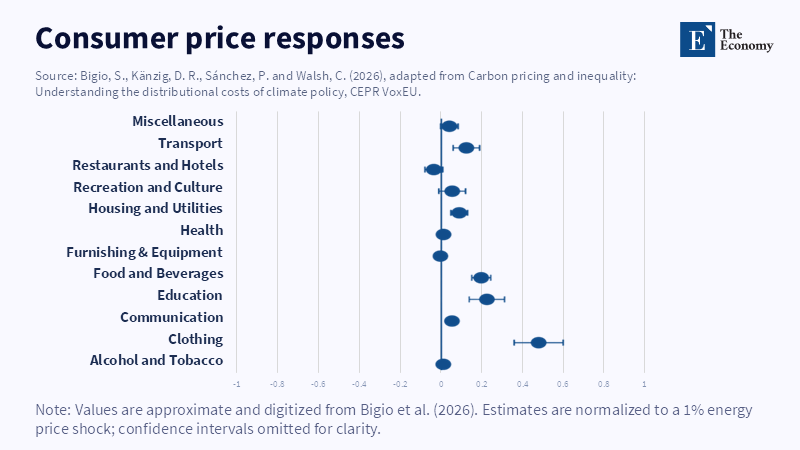
Economic research supports this political insight. Studies tracking carbon price shocks across European households find that losses don’t stop at higher bills for power or fuel. They also affect wages, jobs, and overall wealth. That’s why political backlash isn’t just confusion that better messaging can fix. If policy lowers real incomes for renters, borrowers, commuters, and those with little financial reserve, then anger is a reasonable response to an unfair transition. Progressive carbon pricing should consider labor income and household security, not just the carbon content of gasoline or electricity.
Progressive carbon pricing needs to look more like social insurance
A fair carbon price can’t be a flat charge that makes heating, commuting, or raising children in expensive cities feel like a heavy tax on ordinary life, while wealthier households treat extra costs as minor. That’s why carbon tax design must be openly progressive. The carbon price itself can stay broad, but the way revenue is redistributed must be uneven. An effective system would return revenues to protect younger and lower-wealth households first, through larger rebates at the bottom, payroll tax cuts for low- and middle-income earners, better housing and transit support where alternatives to energy are scarce, and higher charges on luxury emissions and unexpected windfall profits from carbon-heavy activities. The carbon price signals change across the economy, while social protections are carefully targeted.
This is not a call to weaken efforts to reduce emissions—in fact, it’s quite the opposite. Recent studies on public opinion show that recycling revenue back to the public increases support for carbon pricing. A major review of 35 studies with over 100,000 respondents finds that adding some form of revenue recycling boosts acceptance. Experiments in Germany also show that clearer carbon dividends raise approval. Though preferences differ across countries—some voters prefer visible green spending, others like direct rebates—the overall lesson is consistent. People don’t reject climate policy just because it costs money; they reject it when they don’t see clearly and quickly how the burden is fairly shared. Progressive carbon pricing makes fairness visible.
The argument for focusing on the top 10% of emitters is also stronger than many governments admit. Research on climate inequality shows that the richest 10% contributed about two-thirds of warming since 1990, with the richest 1% alone about one-fifth. This doesn’t mean replacing all climate tools with wealth taxes, but it does mean that flat carbon charges on households are a poor fit, morally and politically, in a world with extreme emissions inequality. Since unequal consumption, ownership, and influence sustain the carbon-heavy economy, climate policy revenue should reflect this structure. Big-ticket items like luxury air travel, large vehicles, second homes with high energy use, and carbon-intensive investment income shouldn’t be treated the same as commuting, heating, or basic food.
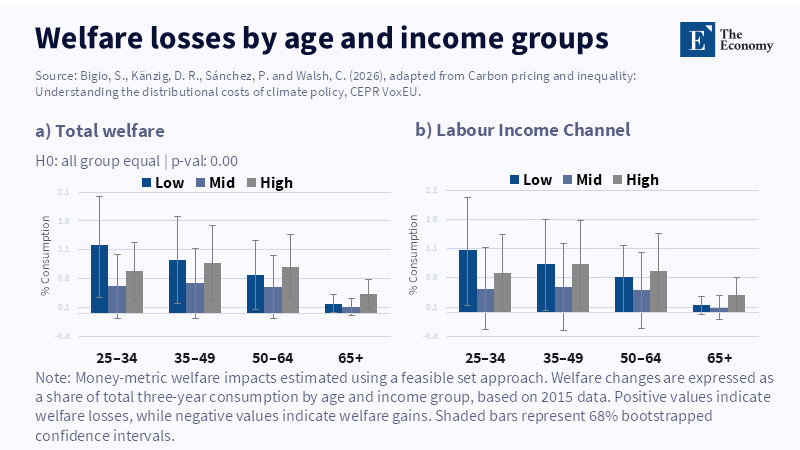
The same logic applies across the generations. Young adults face higher housing costs, less wealth, and smaller savings than older generations had at the same age. OECD data shows the median household headed by someone under 35 owns just over a quarter of the overall median wealth. Around 40% of people in their late 20s still live with their parents in OECD countries, with even higher shares in countries such as Korea, Italy, Greece, and Slovakia. This is not a generation with spare capacity to handle a badly designed price hike. They are juggling rent, debt, unstable work, and delayed family plans. Carbon pricing that ignores these facts won’t seem green—it will seem careless.
Progressive carbon pricing as an education issue
This matters for education more than many climate debates acknowledge. Young adults are not only future taxpayers but also students, apprentices, young workers, and new parents. When costs for energy, housing, and transport rise faster than wages, the impact shows up in attendance, stress, mobility, and trust. Schools and universities can encourage sustainability as much as they want, but if students mainly see climate policy as another financial burden layered on top of rent and commuting, the message they learn isn’t responsibility; it’s hypocrisy. That’s why educators and administrators should stop seeing carbon pricing as only a financial or technical matter. It’s also about whether climate policies help or hurt educational opportunity.
Practical steps are clear. Educational institutions should teach climate policy with distributional fairness integrated, not added as an afterthought. Governments should pair any increase in carbon pricing with transport discounts, housing upgrades, and focused support for students and apprentices. Part of carbon revenues should go directly to programs supporting youth—grants for energy improvements to rental housing, cheaper public transportation for students, and funding for vocational training in clean sectors. These aren’t side benefits; they’re essential to making progressive carbon pricing credible. When younger households face higher prices today for long-term climate stability, governments need to support them in tangible ways immediately.
There is also a civic lesson here. Schools are where democratic legitimacy is learned and tested. Students are taught that climate policy should rely on evidence, fairness, and long-term responsibility. But South Korea’s court case made clear what happens when governments ask young people to trust these ideals while pushing the hardest costs into the future. The court rejected the deal, ruling that failing to set clear targets after 2030 would place too much of a burden on future generations. Other governments should take note. If carbon pricing is presented as a clean, technocratic fix but the real costs land on the least wealthy and least heard households, younger citizens won’t see a just transition. They’ll see a managed shifting of costs downwards and forwards.
Some commentators might say this approach is too complicated, too political, or too costly. But the current system is already those things. Carbon pricing without strong redistribution is politically shaky. Without fairness across generations, it is socially fragile. Without visible returns, opponents easily portray it as punishment. The real challenge is that highly targeted systems can become administratively complex, and that’s a valid concern. Yet complexity alone isn’t a reason not to act. It means designing layered policies: a simple universal base dividend, larger supplements for low-income and low-wealth groups, labor tax relief where wages are most hurt, and separate fiscal tools for luxury consumption and carbon-heavy corporate profits. In short, keep the carbon price simple but make compensation clearly progressive.
The initial paradox should now be clear. The people most responsible for climate damage aren’t the ones most likely to resist carbon pricing. Instead, resistance often comes from those least able to pay, with the least wealth to fall back on, and the longest future affected by policy mistakes. That’s why the next generation of climate policies can’t follow the old pattern of pricing first, compensating later, and explaining better. They must start with progressive carbon pricing to survive politically. The wealthy should pay more because they emit more, own more, and can absorb costs better. Younger, poorer households should pay less because they already face greater risks than models typically show. If governments don’t build this fairness into the tax system, every future carbon price will feel like a tax on everyday life, and voters will keep trying to repeal it.
The views expressed in this article are those of the author(s) and do not necessarily reflect the official position of The Economy or its affiliates.
References
Balestra, C., Caisl, J. and Hermida, L. (2025) Mapping trends and gaps in household wealth across OECD countries. OECD Papers on Well-being and Inequalities, No. 37. Paris: OECD Publishing.
Barrez, J. (2024) ‘Public acceptability of carbon pricing: unravelling the impact of revenue recycling’, Climate Policy, 24(10), pp. 1323–1345.
Bigio, S., Känzig, D. R., Sánchez, P. and Walsh, C. (2025) Carbon Pricing and Inequality: A Normative Perspective. NBER Working Paper No. 34125. Cambridge, MA: National Bureau of Economic Research.
Bigio, S., Känzig, D. R., Sánchez, P. and Walsh, C. (2026) ‘Carbon pricing and inequality: Understanding the distributional costs of climate policy’, VoxEU, CEPR.
Cournède, B. and Plouin, M. (2022) No Home for the Young?: Stylised facts and policy challenges. Paris: OECD Publishing.
Department of Finance Canada (2024) ‘Government announces Canada Carbon Rebate amounts for 2024–25’. Ottawa: Government of Canada.
Department of Finance Canada (2025) ‘Removing the consumer carbon price, effective April 1, 2025’. Ottawa: Government of Canada.
Gregg, A. (2024) ‘South Korea’s climate law ruling a win for human rights’, Human Rights Watch.
Känzig, D. R. (2023) The unequal economic consequences of carbon pricing. NBER Working Paper No. 31221. Cambridge, MA: National Bureau of Economic Research.
Logg-Scarvell, J. (2025) ‘Carbon pricing backlash: Elite and grassroots protest in Australia and Canada’, Carnegie Endowment for International Peace.
Meijer, E. (2020) ‘Korean youth group launches constitutional challenge to climate policies’, Institute for Energy Economics and Financial Analysis.
Mohammadzadeh Valencia, F., Mohren, C., Ramakrishnan, A., Merchert, M., Minx, J. C. and Steckel, J. C. (2024) ‘Public support for carbon pricing policies and revenue recycling options: A systematic review and meta-analysis’, npj Climate Action, 3.
OECD (2024) Pricing Greenhouse Gas Emissions 2024: Gearing up to bring emissions down. Paris: OECD Publishing.
Phillips, B. (2024) ‘South Korean Constitutional Court ruling: A landmark decision in climate litigation’, International IDEA.
Schöngart, S., Nicholls, Z., Hoffmann, R., Pelz, S. and Schleussner, C.-F. (2025) ‘High-income groups disproportionately contribute to climate extremes worldwide’, Nature Climate Change, 15(6), pp. 627–633.
World Bank (2025) State and trends of carbon pricing 2025. Washington, DC: World Bank.
Woerner, A., Imai, T., Pace, D. D. and Schmidt, K. M. (2024) ‘How to increase public support for carbon pricing with revenue recycling’, Nature Sustainability, 7(12), pp. 1633–1641.
Working across research, policy, and data-driven analysis, the Editorial Board ensures that published pieces reflect a consistent institutional perspective grounded in quantitative reasoning and long-term structural assessment.