Europe’s Next Energy Shock Will Be Felt in the Classroom

Working across research, policy, and data-driven analysis, the Editorial Board ensures that published pieces reflect a consistent institutional perspective grounded in quantitative reasoning and long-term structural assessment.
Authored On
Modified
Europe’s energy shock did not end in 2022
Poor households cut other essentials before they cut heat or power
That is why targeted energy subsidies now matter for both welfare and education

Targeted energy subsidies should be integrated into education policy rather than only addressed within welfare policy. Between the first halves of 2021 and 2025, household electricity prices in Europe increased by approximately 30%, while gas prices escalated by 79%. Even after the most severe price spikes subsided, 9.2% of individuals in the EU were unable to keep their homes adequately warm in 2024. This aggregate figure conceals more acute hardships; for example, around 19% of Greek households experience energy poverty, a fact with significant educational implications. Energy insecurity intersects with multiple aspects of students' lives—including attendance, concentration, homework completion, accrued campus debt, demand for school meals, and local public funding. When energy costs become prohibitive, low-income families do not simply adjust consumption optimally; they favor heating and lighting as long as possible and then make reductions in other areas such as food quality, transportation, savings, and the quiet necessary for learning. Consequently, targeted energy subsidies ought to be considered a component of foundational education resilience rather than emergency relief.
The Economic Mechanism Behind Energy Poverty
The underlying economic mechanism is clear, yet policy responses frequently overlook key nuances. A 2023 European Commission report highlights that rising electricity and gas prices not only raise relative energy costs—prompting reductions in consumption—but also suppress real incomes, causing households to curtail expenditure more broadly. Without behavioral responses or income support, the surge in energy prices across the EU from August 2021 to January 2023 would have increased both energy and transport poverty considerably. Wealthier households typically have greater flexibility to adjust energy use—by reducing demand, shifting consumption patterns, upgrading appliances, or absorbing higher costs—whereas lower-income households face constrained options due to essential needs and inadequacies in housing quality and appliances. Thus, market adjustments in this context are frequently rigid budgetary compressions with limited substitution possibilities, situations where targeted energy subsidies demonstrate greater efficiency and equity than broad price controls.
Empirical evidence supports this perspective. A European Commission study covering August 2021 to January 2023 estimated that, absent behavioral responses and income support, energy and transport poverty would have risen sharply throughout the EU. The same research criticized many emergency measures for being broadly applied, fiscally burdensome, and often regressive. A 2023 European Parliament report further documented that over 41 million Europeans were unable to keep their homes adequately heated in 2022, pointing to the persistence of energy poverty beyond only price increases. Mis-targeting of relief efforts remains a concern for education policymakers just as much as for finance ministries because families facing basic energy shortages struggle to maintain stable study environments, adequate sleep, digital access, and consistent school participation.
Household-Level Evidence from the 2022 Energy Crisis
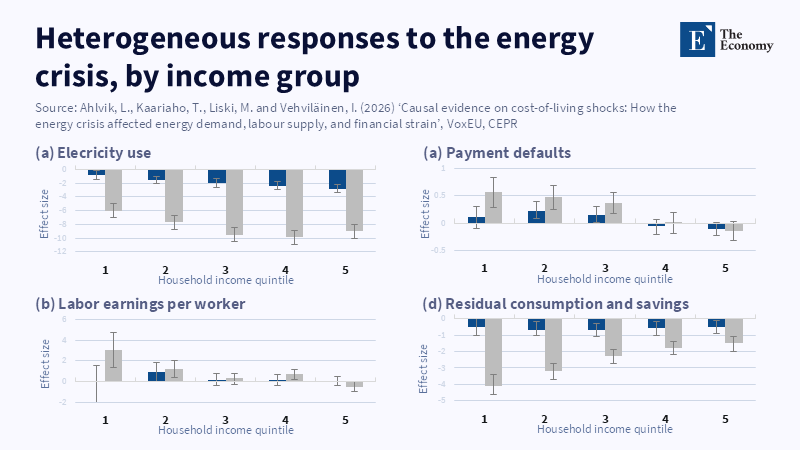
Data from Finland yield compelling behavioral insights derived from household-level microdata collected during the 2022 energy crisis. Researchers utilized the quasi-random expiration of fixed-term electricity contracts to compare households entering the crisis with protective contracts versus those suddenly exposed. According to an IMF article, wholesale electricity prices in Europe surged from an average of €35 per megawatt-hour in 2020 to over €500 per megawatt-hour by March 2022, highlighting the pronounced exposure of some groups. Middle- and higher-income households managed to reduce electricity consumption modestly and increase earnings slightly, while low-income households lacked the flexibility both to lower demand and to mitigate shocks through income, exhibiting more frequent defaults and cutbacks in other expenditures. This evidence indicates that when low-income households reduce energy use, it is not a smooth adjustment but instead a reflection of having no remaining flexibility.
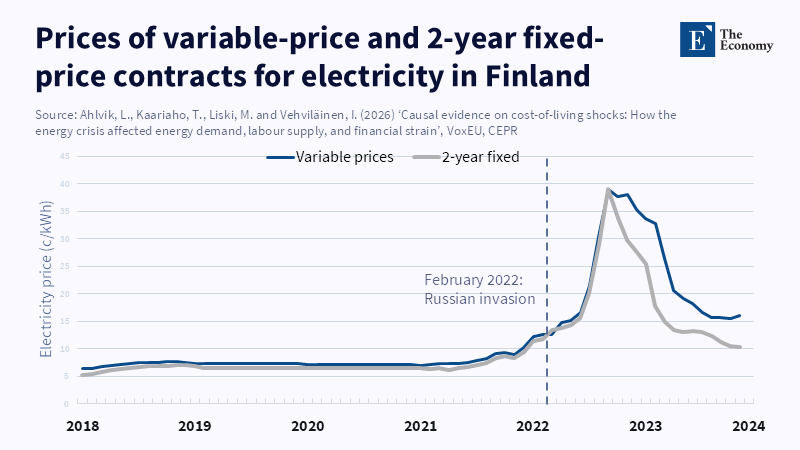
This finding reinforces long-established theoretical arguments. As James P. Stucker demonstrated in 1976, energy price increases disproportionately hurt poorer households, since energy constitutes a larger share of their budgets, including indirectly through the goods they consume. Finland’s targeted compensation schemes for energy-intensive companies further accentuate the relevance of this evidence to current policy debates in Europe. It refines the classic argument of regressive incidence with contemporary causal data, illustrating that substitution is constrained by essential energy demands, poor housing conditions, and limited financial capacity. Accepting these factors clarifies that targeted energy subsidies are grounded not only in compassion but also in policy precision, directing relief toward vulnerability rather than average consumption.
The wider European context confirms that Finland’s situation is representative rather than exceptional. Reports drawing on Eurostat and HEPI data indicate that average household electricity prices in the EU rose from 22 to 28.7 cents per kilowatt-hour between early 2021 and early 2025, while gas prices rose from 6.4 to 11.4 cents per kilowatt-hour. Although the market stabilized relative to crisis peaks, electricity prices in EU capitals remained 38% higher in January 2026 than in January 2021. Furthermore, tax and levy components of household electricity and gas prices increased to 27.6% and 31.1%, respectively, by mid-2025. The acute crisis phase ended, but the elevated baseline costs persist. This ongoing pressure necessitates that targeted energy subsidies be conceived as recurrent instruments rather than exceptional wartime measures.
Geopolitical Pressures and the Ongoing Energy Transition
Geostrategic developments further magnify these problems. Following the onset of conflict in Iran in early 2024, European wholesale gas prices approximately doubled, with the Dutch contract reaching €74 per megawatt-hour—a level significantly lower than 2022 peaks but still substantial given the tighter global LNG market and Europe's reduced reliance on Russian gas imports. Europe has decreased Russian gas imports from over 40% pre-Ukraine invasion to about 13% in 2025, aiming for a complete ban by late 2027. While strategically imperative, these shifts maintain European exposure to external price volatility until demand declines and buildings become more energy-efficient. Thus, targeted energy subsidies should be viewed as transitional measures to prevent social fragility during this energy transition, rather than as substitutes for it.
Educational institutions are disproportionately and prematurely affected by these energy shocks. Students may exhibit declines in learning outcomes before official poverty statistics become apparent. A 2024 Portuguese study found that 4.2% to 14% of surveyed upper secondary students experienced chronic discomfort at home and school, with disadvantaged adolescents and those with health issues particularly affected. This pathway from energy insecurity to educational loss is critical. Inadequate home heating undermines concentration, and poorly heated classrooms exacerbate the issue. While EU member states have adopted measures such as direct financial aid and price caps to mitigate rising household costs, there is limited analysis on whether families forego essential daily needs, such as internet access, or compel older children to increase paid work. The educational impact frequently manifests first as fatigue, diminished focus, incomplete homework, and heightened demand for institutional support.
Policy Implications for Education Systems
For education administrators, these findings show that responses to energy crises should extend beyond generic anti-inflationary interventions. Education ministries must consider targeted energy subsidies for low-income families with children, hardship funds tied to attendance risk, protected transportation support, and regulations preventing utility disconnections during critical school periods. Concurrently, increasing investments in retrofitting schools and student housing is advisable. Evidence linked to Commission initiatives shows that such renovations reduce energy costs, improve indoor comfort, and enhance learning environments, exemplified by a Romanian technical high school that reduced energy use by approximately 60%. Strategically, whereas blanket subsidies temporarily lower costs for all, targeted subsidies preserve learning conditions for students most susceptible to disruption.
From a fiscal perspective, anticipatory measures are prudent. Eurostat data indicate that public education expenditure accounted for 4.6% of GDP in the EU in 2022. Rising household utility expenses tend to have secondary effects on educational institutions, including increased demand for meal assistance and emergency grants, as well as fee arrears. Simultaneously, local authorities may face higher operational costs for heating public buildings, alongside increased service demand due to household distress. Hence, integrating targeted energy subsidies with protected education budgets is preferable to treating these policy areas in isolation. Early intervention in the form of preventive support that sustains learner well-being is both more cost-effective and less detrimental to human capital formation than delayed remedial social spending.
A common critique contends that targeted energy subsidies entail administrative complexity, risk political narrowing, and may exclude some vulnerable groups, whereas broad tax reductions and price caps provide swift and visible relief. While these concerns are valid, maintaining untargeted measures for extended periods incurs fiscal inefficiencies, distorts price signals, disproportionately benefits households that can adapt independently, and diverts resources from necessary structural improvements such as insulation, heat pumps, smart metering, and school upgrades. An optimal approach comprises an initial broad relief phase at crisis onset, swiftly followed by targeted subsidies calibrated to income, housing efficiency, family structure, disability status, and arrears risk. Future European policy effectiveness will hinge less on expenditure capacity and more on carefulness in allocation.
Therefore, the initial statistic should be interpreted as a warning indication rather than a remnant of a past emergency. With electricity prices approximately 30% and gas prices approximately 79% above early 2021 EU averages, the pertinent question is not whether households experienced an energy shock, but rather which systems absorb its subsequent impacts. Delaying intervention until arrears, defaults, or increased winter mortality become evident risks high social costs. Instructional settings provide an earlier, observable signal manifested in discomfort, distraction, hunger, and growing institutional pressure. Consequently, integrating targeted energy subsidies into social and education policy systems is vital to mitigate entrenched harm before future cost spikes. The convergence of evidence from Finland, the broader European data, and established distributional theory uniformly supports the proposition that just and efficient responses focus on durable protection for those with limited flexibility, rather than uniform price reductions.
The views expressed in this article are those of the author(s) and do not necessarily reflect the official position of The Economy or its affiliates.
References
2EU.Brussels (2026) ‘Energy poverty eases: 9.2% of EU citizens still struggle to heat homes in 2024’, 3 February.
Ahlvik, L., Kaariaho, T., Liski, M. and Vehviläinen, I. (2025) Household-Level Responses to the European Energy Crisis. CEPR Discussion Paper No. 19972. Paris and London: CEPR Press.
Ahlvik, L., Kaariaho, T., Liski, M. and Vehviläinen, I. (2026) ‘Causal evidence on cost-of-living shocks: How the energy crisis affected energy demand, labour supply, and financial strain’, VoxEU, CEPR, 17 March.
Bos, M.S., Contreras, D., Schwartz, L., Alfonso, M., Bergamaschi, A., Corena Forero, C.A., Elacqua, G., Minoja, L. and Paez Trujillo, A.M. (2025) Heat-Proof Education in Latin America and the Caribbean. IDB Monograph 1310. Washington, DC: Inter-American Development Bank.
BUILD UP Editorial Team (2022) ‘High school in Romania turned into nearly-zero energy building’, BUILD UP, 21 June.
DW News (2025) ‘EU energy chief vows ban on all Russian gas imports by 2028’, YouTube video, 17 June.
European Commission, Directorate-General for Employment, Social Affairs and Inclusion (2023) ‘New paper on how higher energy prices affect EU households published’, news article, 20 December.
European Commission, Directorate-General for Energy (2021) ‘Electricity and gas prices in the first half of 2021’, news article, 20 October.
Eurostat (2025a) ‘Household electricity prices in 1st half of 2025: -0.5%’, news article, 29 October.
Eurostat (2025b) ‘Household gas prices fall 8.1% in the 1st half of 2025’, news article, 29 October.
Eurostat (2025c) ‘Public spending on education was 4.6% of the EU’s GDP’, news article, 3 July.
Eurostat (2026) ‘9.2% of EU population struggled to keep their home warm’, news article, 2 February.
Fulvimari, A., Temursho, U., Vaitkeviciute, A. and Weitzel, M. (2023) Economic and Distributional Effects of Higher Energy Prices on Households in the EU. Luxembourg: Publications Office of the European Union.
Galseku, P.M., Keenan, G.S., Stevenson, L., Cousins, R., Lingwood, J., Dixon, H. and Bourke, L. (2026) ‘The association between food insecurity and academic performance among higher education students: A systematic review’, Current Nutrition Reports, 15(1), article 17.
International Energy Agency (2023) Greece 2023 Energy Policy Review. IEA Energy Policy Reviews. Paris: OECD Publishing.
International Energy Agency (2026) Household Energy Affordability. Paris: IEA.
Kökény, L., Hortay, O., Pálvölgyi, D. and Kökény, L. (2025) ‘Evolving energy poverty in the European Union in multi-crisis years 2022–2024: A large sample analysis’, Energy Research & Social Science, 129, article 104374.
Leino, A.R.J. (2026) The Power of Choice: Household Electricity Contract Behaviour in Finland Across the 2022 Energy Crisis. Master’s thesis. Aalto University, School of Business.
Makridou, G., Matsumoto, K. and Doumpos, M. (2024) ‘Evaluating the energy poverty in the EU countries’, Energy Economics, 140, article 108020.
Psatha, A. (2024) ‘Putting people first: renovate to future proof Europe’s schools’, European Sustainable Energy Week news blog, 2 May.
Reaños, M.A.T., Palencia-González, F.J. and Labeaga, J.M. (2025) ‘Measuring and targeting energy poverty in Europe using a multidimensional approach’, Energy Policy, 199, article 114518.
Stucker, J.P. (1976) The Impact of Energy Price Increases on Households: An Illustration. Santa Monica, CA: RAND Corporation.
Twidale, S. (2026) ‘Explainer: Where does the EU get its gas and how is it impacted by the Iran conflict?’, Reuters, 19 March.
Valente, I. and Gouveia, J.P. (2024) ‘Growing up in discomfort: Exploring energy poverty and thermal comfort among students in Portugal’, Energy Research & Social Science, 113, article 103550.
Widuto, A. (2023) Energy Poverty in the EU. Brussels: European Parliamentary Research Service, European Parliament.
Yanatma, S. (2026) ‘Four years after Russia’s invasion: How have electricity and gas prices changed across Europe?’, Euronews, 26 February.
Working across research, policy, and data-driven analysis, the Editorial Board ensures that published pieces reflect a consistent institutional perspective grounded in quantitative reasoning and long-term structural assessment.