Urban Density Is a Public Good—Until Policy Turns It Into Scarcity

Working across research, policy, and data-driven analysis, the Editorial Board ensures that published pieces reflect a consistent institutional perspective grounded in quantitative reasoning and long-term structural assessment.
Authored On
Modified
Urban density reduces the cost of accessing jobs, education, and daily services
When supported by housing and transport, concentration increases efficiency and opportunity
The real risk is not density, but scarcity that turns access into exclusion

Urban density is often described as a social failure. The usual picture is crowding, pressure, noise, and stress. But one 2024 OECD finding cuts through that story. In cities, 76% of people can walk to a primary school and a childcare facility within 15 minutes. In suburbs, only 36% can. That gap is not a lifestyle detail. It is a measure of who can reach learning, care, and work without long daily costs in money, time, and energy. The same pattern appears in transport. In OECD urban centres, 84% of people can walk to public transport within 10 minutes, compared with 56% in suburbs. This is why the debate over concentration is regularly framed the wrong way. The real issue is not whether cities are too concentrated. It is whether urban density is being managed well enough to turn proximity into broad access. Done well, concentration is not a burden on ordinary households. It is one of the few systems that makes modern life cheaper, faster, and more open to people who are not rich.
Why urban density still beats distance
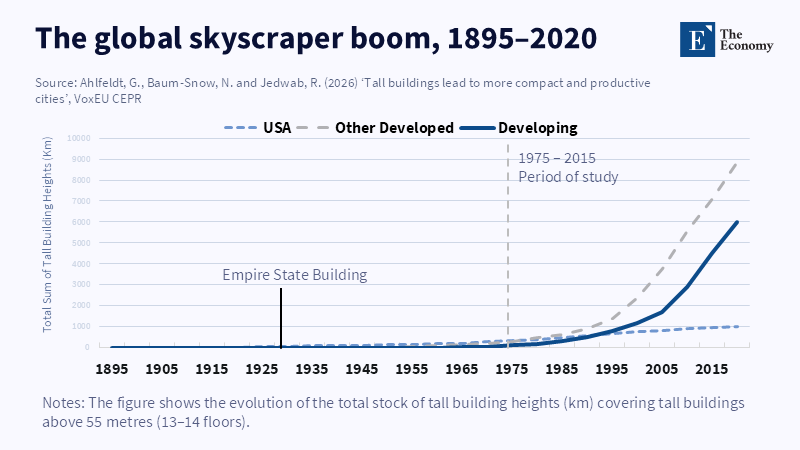
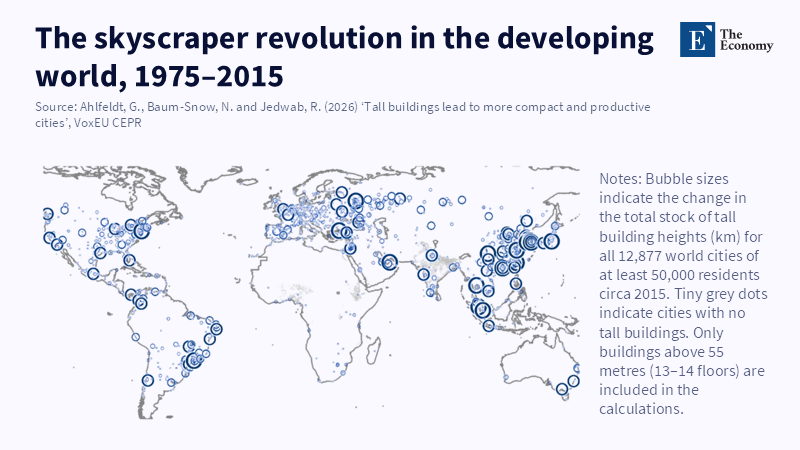
The strongest case for urban density is simple. It turns distance into access. A dense city shrinks the cost of reaching people, firms, schools, clinics, suppliers, and ideas. That is why concentration keeps returning, even when critics declare it broken. Across five OECD countries, a doubling of city size is associated with a 2% to 5% increase in productivity after researchers adjust for worker sorting. Around the world, recent research on tall buildings and urban form finds that greater building height allows cities to accommodate more people while using less land. In a global sample of 12,877 cities, taller building stock is associated with higher population and lower built area, which is another way of saying that urban density can create both growth and compactness simultaneously. The large cities of developing economies, the authors estimate, would be at least one-third smaller on average without their tall buildings. That does not read like excess. It reads like fiscal compression.
Urban density matters because modern economies reward matching. Workers need many employers. Employers need many workers. Students need many pathways from school to work. A thin local market can rarely provide that. A thick one can. Recent World Bank work makes the point clearly. Cities are places where firms and people interact, where knowledge gets shared on the job, and where human capital builds faster because people learn from a larger pool of peers. This matters for education more than many education debates admit. A training system is not just a curriculum. It is a geography. A good vocational programme in a weak local market still leaves students with few firms, few mentors, and few chances to switch. Urban density lowers that risk. It gives learners access to more nearby institutions, more specialized courses, more internships, and more employers within reach on the same day.
Even recent work that tempers the idea that bigger cities automatically solve national growth does not erase the case for agglomeration. It sharpens it. The gains are real, but they depend on whether cities are governed well enough to convert proximity into repeated low-cost contact. That is the key correction. The right lesson is not that urban density no longer matters. It is that urban density works best when it is backed by housing supply, transport links, and metropolitan coordination. Concentration does not guarantee efficiency. But when a city can turn proximity into dense networks of contact, learning, and matching, efficiency rises fast.
Urban density is a social subsidy for ordinary households
Critics often speak as if the wealthy are the natural winners from urban density. In reality, badly managed suburban distance is often easier for the wealthy to absorb. Car ownership, longer travel, scattered services, and duplicated household costs are all easier to bear with a higher income. Dense cities help people who cannot buy their way out of friction. OECD and ITF research make this point clearly. In Europe’s biggest cities, poor residents rarely own cars because they can rely on cheaper modes. In more car-dependent places, poor households are trapped because they have no viable alternatives and are hit harder by increases in fuel prices. Another 2024 OECD study finds that people in remote areas are 12% more likely to own a car, whereas rural residents are 20% to 30% more likely to use cars for commuting and leisure. What looks like freedom from the city often means forced spending.
That cost burden has become so visible that the European Commission has named it directly. In 2024, it reported that 21% of households at risk of poverty face unaffordable transport costs. This is the point urban policy still misses too often. Mobility is not only about speed. It is about whether access to work, school, childcare, health care, and social life requires a private machine that must be bought, insured, fueled, parked, and repaired. For a high-income household, that may be manageable. For a lower-income household, it can become a tax on opportunity. Urban density reduces that tax when it is tied to public transport, mixed land use, and daily services within walking distance. It does not eliminate hardship. But it changes the budget line in a way that suburban sprawl usually does not.
The same pattern shows up within education and skills. The 2025 OECD Skills Outlook reports that 40% of adults who grew up in cities earned a bachelor’s degree or higher, compared with 26% of those who grew up in villages. According to the OECD, adults are more likely to participate in job-related non-formal education and training in cities than in rural areas; however, these differences in participation rates do not necessarily imply that every city is equitable. They do show that location shapes educational opportunity long before labour market outcomes appear. For educators and university leaders, this should be a warning. Access is not solved when a course exists on paper. Access exists when students can reach campus, combine study with work, find nearby placements, and move between learning and earning without losing hours to transit each day. Urban density makes that circulation easier. A dispersed system can work too, but only with much heavier public subsidy and far better planning than most countries deliver.
When urban density stops working
Still, the critics are right about one thing. Urban density has a breaking point. But that point is not density itself. It is scarcity inside density. When cities block new housing, underbuild transport, and fragment land-use decisions across many small authorities, they turn proximity into exclusion. Then the gains from concentration are captured by insiders and priced out of the market for everyone else. The OECD’s 2024 policy highlights show how serious that danger has become. According to the OECD, over the past decade, housing prices in large cities with populations of 1.5 million or more rose by nearly 68 percent, while prices in very small cities increased by only 16 percent. They monopolise it. Everyone else is pushed farther away and forced to pay more for less access.
That is why the right response to city pressure is not anti-urban romanticism. There is more supply, more height where appropriate, and stronger coordination across the whole metropolitan area. Older OECD work remains highly relevant here. Across five OECD countries, having twice as many municipalities within a metropolitan area is associated with about 6% lower productivity, and the penalty is reduced by about half when a metropolitan governance body exists. This is not a technical side issue. It goes to the core of whether urban density feels efficient or exhausting. Fragmented administration often means one authority restricts housing, another neglects transit, another approves offices, and no one is responsible for the full daily journey people actually live. A city can be dense on paper and still fail in practice if its institutions are too scattered to plan as one labour market.
This is the best rebuttal to the claim that the answer lies mainly in dispersing people into ever wider suburban belts or in trying to recreate economic mass through looser networks of smaller settlements. Polycentric development has value. Smaller cities matter. Digital tools matter too. But the evidence does not support the idea that spreading households farther apart remains a low-cost substitute for real urban access. The same OECD material that highlights the strengths of concentration also shows the weaknesses of suburb-first development: only 36% of suburban residents can walk to school and childcare within 15 minutes, and only 56% can reach public transport within 10 minutes. Those are not small gaps. They are structural disadvantages that compound across the week. A city becomes oppressive when it rations central access. The cure is not to abandon urban density. It is to stop hoarding it.
Designing urban density for schools, skills, and social mobility
For an education journal, the policy lesson is sharp. We should stop treating urban form as background scenery and start treating it as part of the learning system. Urban density shapes whether students arrive on time, whether parents can combine work and childcare, whether adult learners can attend evening courses, and whether graduates can move across firms without moving house. Education ministries, universities, and city governments should therefore plan with time-to-opportunity measures, not just enrolment targets or building counts. A campus with weak transit may look accessible on a map and still be exclusionary in daily life. A school network that ignores housing growth may increase nominal capacity while reducing practical access. The best urban density policy for education is not abstract density. It is connected density: homes, schools, transit, libraries, health services, and jobs are placed close enough to reinforce one another.
That also means building for families, not just for investors or short-term singles. Too many cities defend exclusionary low-rise rules in the name of preserving neighbourhood character, then allow the market to answer demand with expensive micro-units in a few overburdened zones. That is not a serious urban density strategy. If cities want to keep lower-income and middle-income households near opportunity, they need more mid-rise and high-rise housing near transit, more family-sized units, more student housing, and more childcare and school capacity planned at the same time as residential growth. They also need pricing and land policies that keep public transport cheaper than forced car ownership. Urban density should reduce the cost of participation in city life. When it raises that cost, the policy design has failed.
The opening statistic should stay with us. If 76% of city residents can walk to school and childcare within 15 minutes, while only 36% of suburban residents can, then concentration is not only about economic output. It is about daily reach. It is about whether ordinary people can live near the systems that help them learn, work, and adapt. The future will not belong to cities that simply pack in more people. It will belong to cities that use urban density to widen access before scarcity locks the gate. That is the real dividing line. Concentration, up to a point, is one of the most efficient forms of social organisation we have. The policy task is not to push people outward in the hope that distance will feel fairer. It is to build dense cities that remain open enough for non-rich households to stay inside the circle of opportunity.
The views expressed in this article are those of the author(s) and do not necessarily reflect the official position of The Economy or its affiliates.
References
Ahlfeldt, G., Baum-Snow, N. and Jedwab, R. (2026) ‘Tall buildings lead to more compact and productive cities’, VoxEU CEPR, 19 March.
Ahrend, R., Farchy, E., Kaplanis, I. and Lembcke, A.C. (2014) What Makes Cities More Productive? Evidence on the Role of Urban Governance from Five OECD Countries. OECD Regional Development Working Papers, No. 2014/05. Paris: OECD Publishing.
Ahrend, R., Farchy, E., Kaplanis, I. and Lembcke, A.C. (2017) ‘What makes cities more productive? Agglomeration economies and the role of urban governance: Evidence from five OECD countries’, Journal of Regional Science, 57(3), pp. 385–410.
Central Statistics Office (2024) Survey on Income and Living Conditions (SILC) 2024: Impact of Cost of Living Measures on Poverty and Income. Dublin: Central Statistics Office.
European Commission, Directorate-General for Employment, Social Affairs and Inclusion (2024) Transport Poverty: Definitions, Indicators, Determinants, and Mitigation Strategies – Final Report. Brussels: European Commission.
Jedwab, R. and Barr, J.M. (2022) ‘The skyscraper revolution: Tall buildings and urban habitat of the 21st century’, VoxEU CEPR, 13 October.
McCarthy, O. and Egeland, J. (2024) Sustainable Accessibility for All. ITF Research Reports. Paris: OECD Publishing.
OECD (2023) Education at a Glance 2023: OECD Indicators. Paris: OECD Publishing.
OECD (2024) OECD Regions and Cities at a Glance 2024. Paris: OECD Publishing.
OECD (2025) Integrated Urban Policy to Achieve the SDGs. OECD Regional Development Papers. Paris: OECD Publishing.
OECD (2025) OECD Skills Outlook 2025: Building the Skills of the 21st Century for All. Paris: OECD Publishing.
Ostermeijer, F., Koster, H.R.A., van Ommeren, J. and Nielsen, V.M. (2022) ‘Automobiles and urban density’, Journal of Economic Geography, 22(5), pp. 1073–1095.
Serik, A. (2025) ‘Are megacities still vital for economic success?’, EC[ON]OMY, 12 May.
TaxAfterImDead (2024) ‘CMV: City concentration / urbanization is not the solution to building more homes’, Reddit, 7 March.
World Bank (n.d.) Human Capital Report. Washington, DC: World Bank.
World Bank (2024) Cities’ Role in Scaling Up Job Creation and Growth. Washington, DC: World Bank.
Zhang, P., Gao, L., Ribeiro, F.L., Jia, B., Gao, Z. and Rybski, D. (2025) ‘The third dimension of cities: Relating building height, urban area, and population’, arXiv.
Working across research, policy, and data-driven analysis, the Editorial Board ensures that published pieces reflect a consistent institutional perspective grounded in quantitative reasoning and long-term structural assessment.